
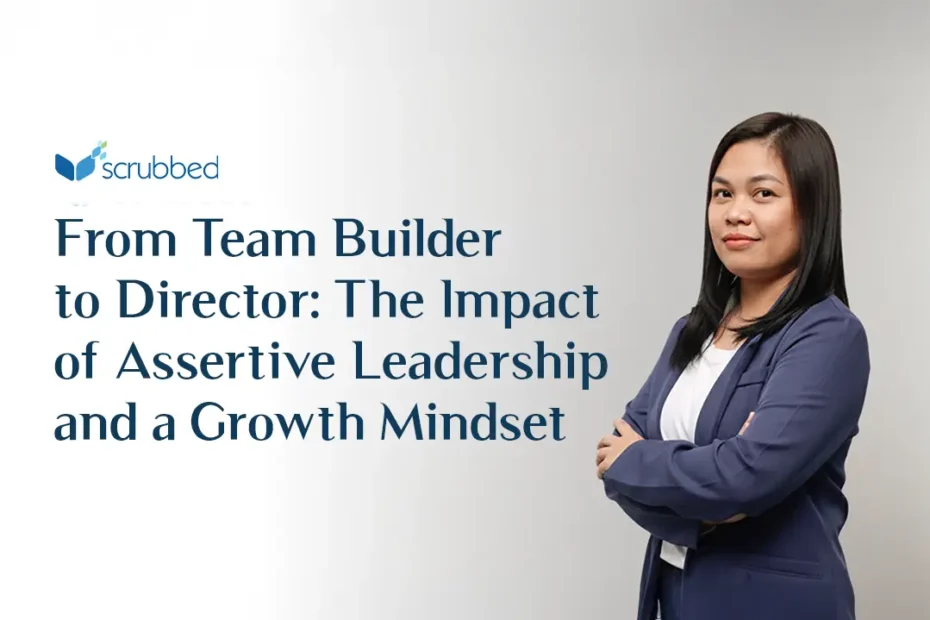
From Team Builder to Director: The Impact of Assertive Leadership and a Growth Mindset

Scrubbed

Scrubbed

From Team Builder to Director: The Impact of Assertive Leadership and a Growth Mindset

Scrubbed Names Joy Mendoza-Gallardo as Director for SAT5

Scrubbed is thrilled to announce the promotion of Joy Mendoza-Gallardo to Director for SAT5. Joy, who has spent nearly seven years with the firm, steps into this role following her exceptional performance and strategic contributions as a Senior Manager leading the Professional & Business Services (PBS) team.


When Joy first took on leadership of the team—then known as Technology & Services (T&S), now the Professional & Business Services (PBS) group—it comprised fewer than 10 professionals primarily supporting early-stage and startup clients. Through her deliberate drive to embrace new opportunities, navigate challenges with resilience, and her intentional focus on strengthening client relationships, developing future leaders, and instilling a strong execution culture, the team steadily scaled in both size and capability. Today, PBS has evolved into a high-performing team of more than 100 professionals, delivering both small and highly complex client engagements across multiple accounting service offerings. This proven ability to build leaders, deepen client partnerships, scale teams, and sustain a high-impact organization is a defining pillar of what earned her this milestone.


Joy’s leadership style is often described as assertive, empowering, and grounded in accountability. Her teams are known for their strong ownership mindset and execution discipline, values she consistently cultivates and models. While her leadership is firmly anchored in clarity and action, it is also strengthened by her ability to build genuine personal connections.


A lighthearted example of this connection is how colleagues often tag her whenever the firm talks about the aspiration to “Bring Joy to the Workplace,” both because it echoes her name and because it genuinely reflects the energy and positivity she brings to the team. When she later became a mom, her team jokingly began calling her “mother” — a nickname Joy views as a reflection of trust rather than role.


“It actually warms my heart,” Joy shares. “To me, it means they see me not just as a leader who sets direction, but someone who brings comfort, support, and a sense of home to the group.


This blend of dedication and leadership naturally extends into her new role as Director for SAT5, the firm’s newly established sector accounting team. While the position builds on her leadership of the PBS team, it represents a significant expansion of her scope. Her mandate now covers broader oversight, deeper client partnership, and stronger alignment with the firm’s 5 Key Business Objectives set during the Leadership Summit. Her three priority areas include:


  • Leadership and Oversight of the PBS Team — Ensuring strong team performance, capability building, and service excellence across all engagements.
  • Client Relationship Management and Growth — Strengthening partnerships with key clients, including one of Scrubbed’s major U.S.-listed clients, which she will continue to focus on growing.
  • Operational and Strategic Execution — Driving operational efficiency and ensuring that SAT5’s initiatives and team outputs are aligned with the achievement of Scrubbed’s 5 Key Business Objectives (KBOs) established during this year’s Leadership Summit.

Looking for strategic accounting and business services advisory? Click here.


Moving from a Senior Manager to a Director requires shifting from a team-focused lens to a firm-wide leadership perspective. Joy’s mandate is to deepen client relationships while strengthening team engagement and alignment with the 5 KBOs set in this year’s Leadership Summit. She notes that balancing these requires intentional prioritization, discipline, and strategy.


What excites her most in this new mandate is the retention of high-performing professionals. Joy intends to explore stronger, more meaningful ways to support, grow, and retain talent across Scrubbed—drawing heavily on her strengths in project management, problem-solving, and continuous improvement. Her ability to structure work, streamline processes, and address challenges proactively has long been a driver of team success, and she plans to leverage these same capabilities to build a more empowered and engaged workforce.


This focus on people is paired with a clear strategy for technology and operational efficiency. One of the biggest trends and challenges she is preparing her teams and clients to navigate is how to effectively leverage emerging AI tools to drive real efficiency. The goal, she explains, is to remove manual friction, strengthen processes, and free up both clients and teams to focus on higher-value, strategic work.


Reflecting on her journey, Joy recalls the unexpected moment her promotion was announced at the Leadership Summit. As one of the event organizers, she didn’t anticipate the decision would be finalized so soon. “When it was announced, I felt a bit emotional. It was like all the challenges and tough moments I had pushed through flashed back to me in that instant,” she shares, describing a mix of surprise and deep gratitude.


Her commitment to Scrubbed deepened in early 2020 during a U.S. business trip, just as the Philippine lockdown was announced. She led a team to onboard and support clients during a time of global uncertainty. The accounts her team supported at that time – now among Scrubbed’s top accounts. That experience reinforced her belief in the firm’s purpose and the power of resilient teams.


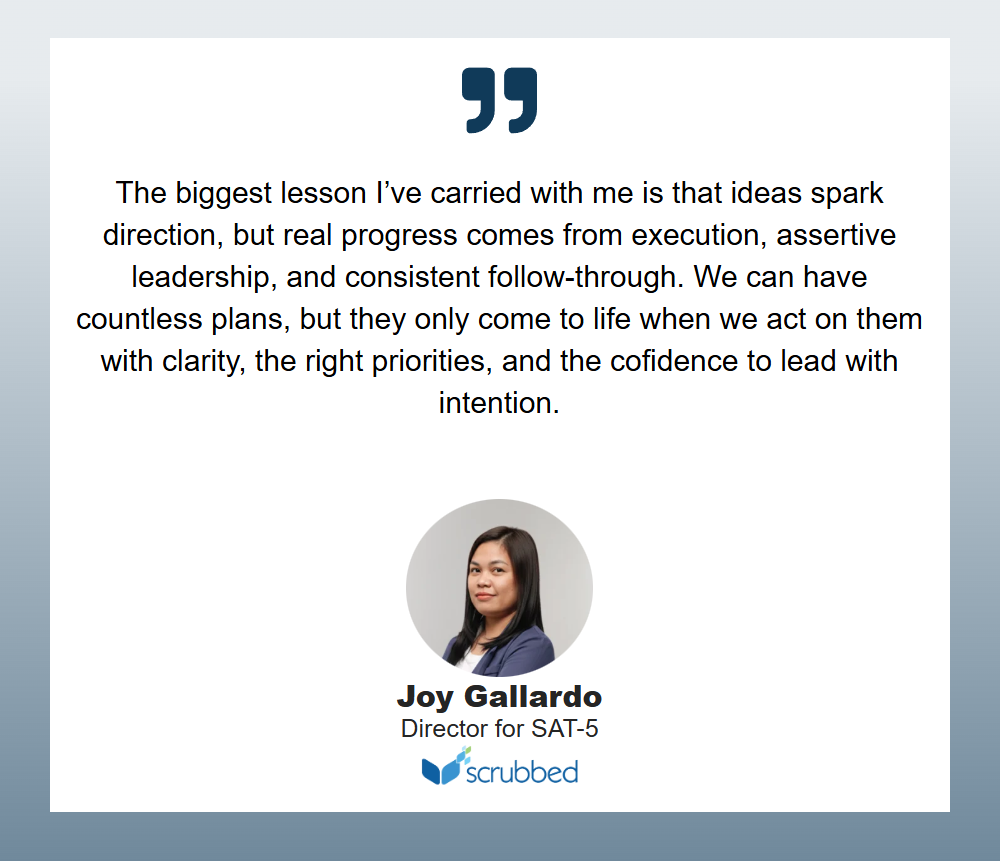
This journey has distilled her career into one critical lesson that she advises everyone to carry forward:

Screenshot 2026 07 22 102905
This emphasis on execution shapes Joy’s working style. She describes her leadership as “assertive yet collaborative,” an approach she finds even more essential at the Director level. Assertiveness enables her to move priorities forward, make timely decisions, and drive results without waiting for perfect conditions. At the same time, leading at a firm-wide scale requires strong collaboration across service lines and support groups—ensuring initiatives are aligned, momentum is sustained, and the highest level of service is consistently delivered.

In developing her team, her vision is to foster professionals who take full ownership of their growth. If she could instill one trait in every person, it would be personal accountability: the mindset of taking charge, acting on what they can control, and following through with intention.

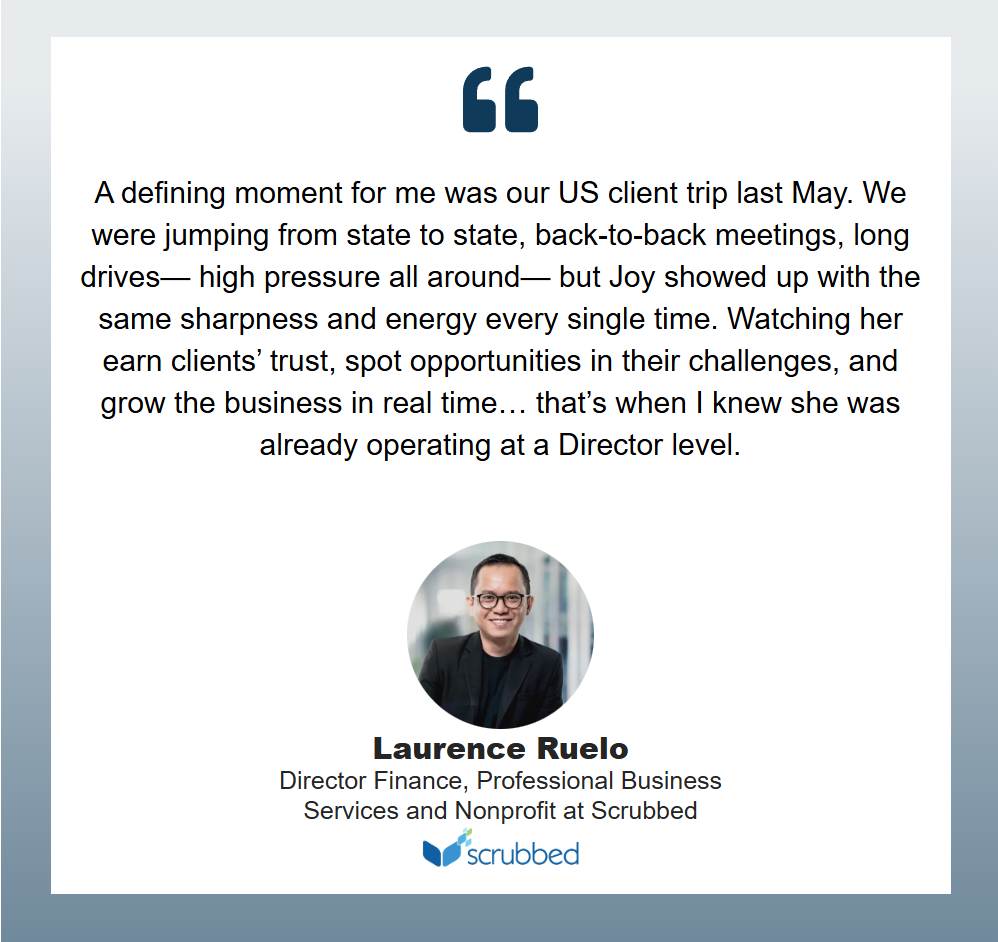
No leader reaches this stage alone. Joy credits her mentor, Laurence Ruelo, for providing thoughtful feedback, steady guidance, and consistent support throughout her career.
Screenshot 2026 07 22 103123
As she steps into this new chapter professionally, Joy wants to carve out space for a meaningful personal milestone in the coming year: taking her family on an international trip. With two young children, she knows it will be challenging, but she sees it as a rare and important moment. “I want to see the world through their eyes—watching them react to new places, new sights, and new experiences for the very first time.”

Ultimately, Joy’s professional journey is defined by the same quality she encourages her younger self to keep: embrace opportunities, stay courageous, and keep moving forward with intention. Her story reflects how leadership is built through deep professional mastery, disciplined execution, and a genuine commitment to people. As she steps into this new chapter, her leadership will continue shaping the growth of SAT5 and the broader Scrubbed community.


Related Content

Blogs

5 Financial Pillars That Can Help CFOs Drive Success

5 Financial Pillars That Can Help CFOs Drive Success

The accounting and finance functions and the role of the CFO are both changing dramatically, with the CFO now expected to help lead a company’s transformation alongside other C-suite executives. By leveraging these 5 financial pillars, CFOs can play an integral role strategically in driving their businesses to thrive and succeed.Pillar #1: A Sound Finance StrategyMost new businesses are born from an idea for an innovative product or service, so their initial strategic planning efforts tend to focus on developing a product or service strategy. As the company’s core offering takes shape, the strategy discussion shifts to the many functions needed to get the product into the market and to keep clients satisfied, like sales, marketing, and customer service.It’s rare for companies to develop a finance strategy at the onset. But that’s a big miss, because it takes significant financial resources to scale a business effectively. Without a well-developed finance strategy, the company runs the risk of being in reactive mode financially—always scrambling for the funds to invest in staff, equipment, or technology, or to expand into new geographic and vertical markets.It’s critical for the CFO to develop and execute on a sound finance strategy, perhaps now more than ever. While the exercise will likely involve cross-functional participation, it’s up to the CFO to take the lead, ensuring that strategy and funding are in place or readily available to fuel the company’s growth.Pillar #2: The Right ResourcesEven the best products are destined to fail unless they’re supported by the right resources, including people, processes, and technology. At every stage in a company’s life cycle, decisions about how and when to invest in those resources can make a major impact on the trajectory of the business.For example, the right technology platform is critical to gathering and disseminating the financial information that production, marketing, human resource (HR), and other functions need to make the most informed operational decisions. But while some early-stage companies are quick to invest in highly sophisticated financial technology, they don’t always maximize their use of the functionality, which greatly reduces return on investments (ROI). Or when it comes to building the right talent, they might staff up internally on functions that could be handled more cost-effectively in an outsourced mode, especially in the early stages or at times of rapid expansion.By identifying and investing in the optimal resources, aligned to the company’s needs based on its life cycle phase, the CFO can help position the business for profitable growth.  Pillar #3: A Cross-Functional Approach For decades, accounting and finance typically operated in a vacuum. Today, the CFO’s reach spans far beyond accounting and financial reporting, directly touching many operational decisions that are integral to the company’s ability to thrive.The most successful CFOs find ways to work effectively across departments and functional groups. When the CTO wants to invest in a new enterprise resource planning system or the head of HR wants to increase salaries to better compete for talent, the CFO is actively engaged—lending unique skills and capabilities to the decision-making process, conducting the necessary analyses, and ensuring the decision is on target strategically and viable financially.By building strong relationships across the organization and establishing processes to ensure finance is integral to operational decision-making, the CFO can play a central role in driving the business’s success.  Pillar #4: A Willingness to Embrace AnalyticsIn nearly every function in every organization, the tool that helps operational leaders measure performance today is analytics. While it could be easy to dismiss analytics as a buzzword, the right analytics provide businesses with information that is much more actionable and insightful than the static reports of the past.CFOs that take a lead role in driving their organizations’ success readily adopt analytics and help each functional group determine the most appropriate key performance measures (KPIs) for their needs. For instance, the CFO might collaborate with those responsible for risk management to develop KPIs for revenue and cash flow and use analytics to keep tabs on how those figures are trending. Sometimes those analytics translate directly to dollars; other times, they provide the data needed to guide more qualitative decisions.  By embracing analytics, the CFO can manage the day-to-day financial operations more effectively and help leaders across the enterprise use the most relevant metrics to guide operational decision-making and management.     Pillar #5: An Innovative Workforce StrategyDramatic changes in how and where we work, fueled recently by the Covid19 pandemic, have forever altered the way businesses approach staffing. Those that adopt an innovative workforce strategy place themselves in the strongest position to succeed, even despite a tight labor market.CFOs that take a modern view of staffing recognize that the current business environment opens the door to more flexible work arrangements that go far beyond providing convenience for employees; they can also prove more cost-effective for the company. Outsourcing certain business functions is a prime example. CFOs should have input into decisions about which functions might be outsourced effectively, as well as the processes and technologies needed to support this arrangement for a successful experience.By championing an innovative workforce strategy, the CFO can help the organization overcome staffing constraints, mitigate the risk of turnover, gain crucial capabilities that aren’t resident in-house, and flex in sync with customer demands and expectations.

Read More >
Blogs

The CPA Firm’s Roadmap to Meeting Tight Audit Deadlines

The CPA Firm’s Roadmap to Meeting Tight Audit Deadlines

Every CPA firm knows the rhythm of the busy audit season: the long hours, the constant pressure, and the impossible balance between speed and accuracy. But what used to be a seasonal challenge has become a deeper structural issue for the profession.With fewer accounting graduates entering the field, growing client demands, and increasing audit complexity, firms can no longer rely on sheer effort to meet deadlines. CPA firm turnover is averaging around 15% nationally and nearly 71% of Big 4 auditors reporting mental health worries due to work pressures. The old model, hire more people, work more hours, simply doesn’t scale.The firms finding success today are the ones rethinking their audit approach. They’re replacing reactive, deadline-driven habits with proactive systems built on planning, visibility, and smart capacity management.This roadmap provides five core, actionable strategies that move beyond wishful thinking and establish a disciplined, collaborative framework to ensure timely completion without sacrificing the integrity of the audit.Step 1: Strategic PlanningThe planning phase is where you negotiate reality, manage expectations, and build essential time buffers to protect your team. Here’s how this step usually goes:Setting Realistic TimelinesThe single most destructive action in deadline management is setting a one-sided, unrealistic deadline without client input. This only creates resentment and guarantees delays.Suggested Action: Schedule a dedicated meeting with key client stakeholders early in the process. Use this time to negotiate and agree on an achievable timeline for deliverables, fieldwork, and final sign-off. This collaborative approach manages expectations on both sides and sets a realistic, mutually accepted path forward. When the client agrees to the timeline, they inherently take ownership of meeting their own deliverables, dramatically improving their response time.Buffering for Client DelaysEven the most collaborative client will face unexpected internal hiccups. If your internal deadline is the same as the final delivery date, you have no recourse when issues arise. You need built-in protection.Suggested Action: The usual buffer to set is an internal deadline of two days before the official one. This two-day margin serves as your firm’s safety net. Furthermore, when communicating with the client, give them a one or two-day window to provide the necessary information before your internal deadline. This proactive strategy ensures that if the client misses their internal date by a day or two, your firm’s final schedule remains protected, insulating your team from external chaos.Step 2: Focused ExecutionOnce the timeline is set, execution must be focused on ensuring maximum audit efficiency and professional skepticism is applied where it matters most.Prioritizing High-Risk AuditsThe most efficient audit is not the one that finishes every section fastest but the one that allocates the most senior resources to the areas carrying the highest risk.Suggested Action: Accounts that carry the highest risk of material misstatement must be prioritized and tackled first in peak season. These are the areas that will receive the most extensive and/or detailed audit procedures and require the judgment of senior staff.Common priority areas include: revenue and related accounts (such as Accounts Receivable and Cash), Inventories, Complex accounts (like derivatives or specialized equity), and accounts flagged during planning due to weak internal controls. By front-loading the heavy, high-risk lifting, you surface critical issues early when there is still time to resolve them.Avoiding BottlenecksBottlenecks are inevitable, but their impact is manageable. Delays typically stem from a few common issues: a client’s slow response to requests, unexpected material events or errors, and the discovery of mistakes from previous audits. It’s common to encounter one, or even all, of these hurdles during an audit.Suggested Action: When an audit encounters one or more of these hurdles, do not proceed in silence. The moment the delay is quantified, you must immediately renegotiate a new, achievable timeline with the client. Trying to push through an unexpected week-long delay on the original schedule will only lead to rushed, sub-par work. Anticipating and communicating delays early is the hallmark of professional project management.Using Project TrackersWhile sophisticated audit software exists, the core need remains visibility and accountability for both the firm and the client.Suggested Action: Maintain a simple, centralized project tracker. Often, keeping an Excel file is the most effective low-tech solution. This tracker should monitor the progress of each audit area and, crucially, track what is still needed from the client (the Pending Client List, or PBC). Clear, shared tracking ensures everyone knows the exact status of the engagement and holds the client accountable for their outstanding items.Step 3: Expand Capacity Through Strategic PartnershipEven with great planning and process discipline, there’s one reality every CPA firm faces: capacity. This capacity constraint creates the unavoidable bottlenecks that these strategies are designed to mitigate, especially given that the unemployment rate for auditors sits at 2.0%. The talent shortage is the bottleneck.The most effective solution to this crisis is leveraging the dedicated, experienced offshore accounting professionals from Scrubbed. This will allow your firm to instantly scale capacity for high-volume tasks without the overhead or long lead time of permanent hiring, establishing the firm’s forward-looking strategy.Here’s how we make it possible:Audit Support. We handle all your testing, confirmations, and workpaper preparation so your team can focus on analysis and client relationships.Tax Preparation and Compliance. From 1040 and 1120 returns to nonprofit filings, we can help you ensure timely and compliant submissions even during the busy seasons.Accounting and Bookkeeping. We manage your daily bookkeeping, account reconciliations, and month-end close activities, so your team can dedicate more time to strategic initiatives.Transaction and Advisory Support. For firms providing M&A, valuation, or due diligence, we deliver the support you need to strengthen your advisory engagements.As a long-time partner to CPA firms of all sizes, Scrubbed provides access to highly trained accounting and audit professionals who work seamlessly as part of your extended team. We follow your firm’s methodology, align with your tools and standards, and deliver consistent, high-quality work.Beyond Just Meeting the DeadlineMeeting tight deadlines shouldn’t come at the expense of your team’s well-being or your firm’s reputation. With the right systems and the right partners in place, it’s possible to deliver every audit on time, with the quality and confidence your clients expect.The ultimate benefit is not just a timely report either, but a sustainable practice. Leveraging proactive steps and strategic partnerships like Scrubbed allows CPA firms to reduce staff stress and burnout, increase the efficiency of review cycles, and consistently deliver high-quality reports, solidifying trust with clients.Don’t let the next busy season dictate your schedule. Partner with Scrubbed to build a resource plan that helps your team meet deadlines without burnout, and deliver quality audits every time.

Read More >
Blogs

Outsourced Accounting for Nonprofits: Choosing a Partner with the Right Expertise

Outsourced Accounting for Nonprofits: Choosing a Partner with the Right Expertise

Nonprofits have unique accounting needs. Meeting the financial requirements of donors, board members, regulators, and other stakeholders takes effective, precise accounting practices that demonstrate both fiscal integrity and compliance with governing tax laws.Like most organizations in the private sector, many nonprofits do not have the expertise or bandwidth in-house to manage the complexities of their accounting needs. Unlike for-profit firms, nonprofits are under heightened regulatory scrutiny to maintain their tax-exempt status, which means their accounting requirements can be much more extensive.Accordingly, an outsourced accounting model is a great option for many nonprofits. Selecting the right partner can be tricky, though, as not all accounting firms fully understand the breadth of financial pressures nonprofits face.So, what skills and expertise should nonprofits look for on an outsourced accounting partner – and what other attributes are essential to a successful relationship?Sector, Regulatory ExperienceThe accounting firm you select should have deep experience working with nonprofit organizations and have experts on staff who are well versed in all governing tax laws. Ultimately, the partner you choose must be able to help your organization:Maintain transparency with stakeholdersEnsure that funds are properly used to support the missionMeet all U.S. GAAP standardsStay compliant, check out our Nonprofit accounting page and see how Scrubbed can help your NPO.Reporting ExpertiseFinancial reporting is key to helping your nonprofit maintain compliance and communicate well with stakeholders. To that end, your outsourced accounting partner must have the expertise and staffing capacity to help you both keep complete, up-to-date financial records and create the many reports donors, board members, regulators, and other stakeholders require.Perhaps the most important financial statement a nonprofit must produce is the Form 990, which is filed annually with the IRS and must be accessible to the public as well. This form is used to demonstrate that the nonprofit qualifies for tax-exempt status, that its funding is, in fact, directed toward its underlying mission, and that the organization is not in any way abusing its tax-exempt status. Board members, donors, the media, and members of the general public may request a nonprofit’s Form 990 as well to see how funds are used and assess the organization’s overall financial health.Other key reports your accounting firm must be experienced at creating include:Statement of Activities[LW1]Statement of Financial PositionCash Flow StatementFunctional Expenses StatementBudget-to-actual reports are also recommended for nonprofits for both evaluating operating practices and future strategic planning.Beyond ReportingWhile reporting, planning, and regulatory compliance are critically important to your nonprofit’s success, the partner you select should also be there for the day-to-day financial tasks that keep your organization running smoothly, including:Building and managing your budgetTracking donor-restricted fundingManaging government grantsFiling invoices and reimbursementsProviding comprehensive audit supportAs a nonprofit, though, your organization is about much more than money management. Nonprofits are expected to operate with the utmost integrity and transparency, which is why the reputation of the accounting firm you select is so critical. So, be sure to check references and confirm that you are working with a partner that shares your values and that brings to your organization the ethical standards that define your mission and that your donors and communities deserve.

Read More >

Contact Information

SF Bay Area Headquarters
111 Anza Boulevard, Suite 320, Burlingame, CA 94010, United States

Phone: (800)837-5160
Email: [email protected]

"Scrubbed" is the brand name under which Scrubbed Advisory, LLC and Scrubbed Assurance LLP provide professional services. Scrubbed Advisory, LLC and Scrubbed Assurance LLP practice in an alternative practice structure in accordance with the AICPA Code of Professional Conduct and applicable law, regulations, and professional standards. Scrubbed Assurance LLP is a licensed independent CPA firm that provides attest services to its clients, and Scrubbed Advisory, LLC provides tax, finance, and support services to its clients. Scrubbed Advisory, LLC is not a licensed CPA firm.

Copyright © Scrubbed. All rights reserved.