

Leadership in Focus: Scrubbed Promotes New Director in Corporate Finance

Sarah Masiba

Sarah Masiba

Braning & Content Writer

Leadership in Focus: Scrubbed Promotes New Director in Corporate Finance

Scrubbed Names Frederick Ozaeta as Director of Corporate Finance

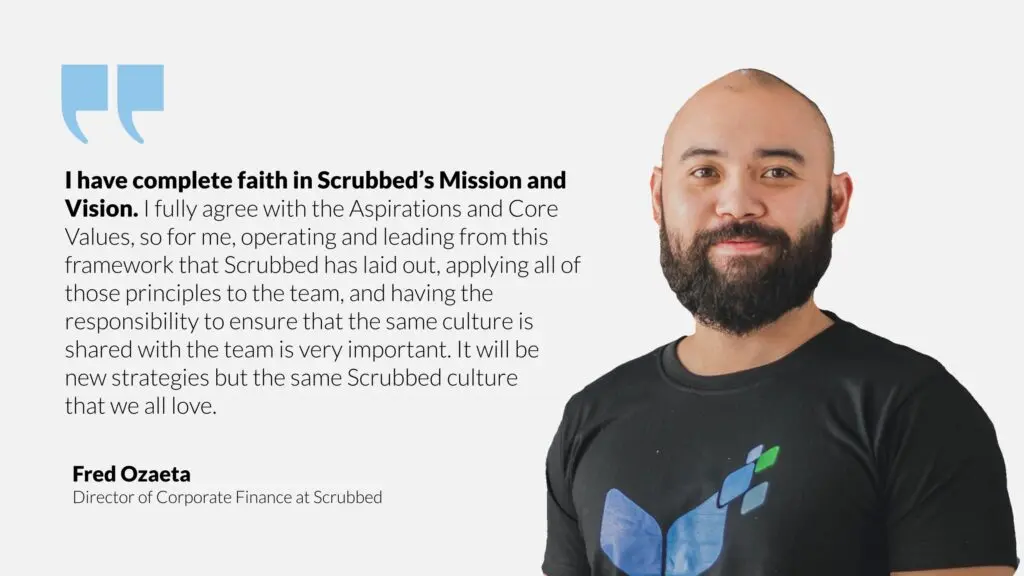
Scrubbed is thrilled to announce the promotion of Frederick Ozaeta to Director of Corporate Finance, a role he has been unofficially managing since Aira Pineda, the previous Corporate Finance Director, assumed the position of Chief Financial Officer. With over 10 years of experience in financial planning and analysis across the Philippines and the U.S., Fred has demonstrated exceptional dedication and expertise in the field.


Looking for Full-Service Corporate Finance Advisory? Click here.


His leadership journey at Scrubbed has been marked by a deep understanding of Corporate Finance (CorFin) operations, particularly in financial planning and analysis as a senior manager. In his new role as Director, Fred will oversee all three main groups within CorFin: Financial Planning & Analysis (FP&A), Mergers & Acquisitions (M&A), and Data & Analytics (D&A). He is eager to expand the team’s capabilities and expertise from an entrepreneurial standpoint, explore new service offerings, and think strategically about innovative approaches that can set Scrubbed apart in the market.


Prior to joining Scrubbed, Fred’s last stint was with the T-Mobile FP&A team in Washington where he led and participated in the budget and forecast cycles of both subsidiary and consolidated financials for various multinationals. He was also part of finance teams for Fortune 500-owned companies in the Biotech and Medical Devices field. Fred’s experience spans more than just his years before joining Scrubbed. His six years at Scrubbed have been equally formative, contributing to his growth as a leader. He has worked closely with various CEOs and CFOs, providing him with a unique perspective on the industry. “All those experiences add up,” Fred notes, “and they prepare you for the next level.”


Fred is Scrubbed’s very own ‘Mr. Efficiency Guy,’ and his leadership philosophy is centered around a results-oriented culture that values independence and freedom. He believes in empowering his team members to operate at peak efficiency while giving them the space to explore and innovate. “I see myself as more of a facilitator than an authoritative figure,” Fred says, emphasizing his collaborative approach to decision-making.
Blog Graphics Graphs Charts 2 1 1024x576


One of the major challenges Fred has identified in the CorFin landscape is recruitment. As the demand for specialized and technical talent grows, finding the right talent and ensuring they are the right fit for the team has become increasingly difficult. “Our pool of candidates is much smaller compared to other fields like accounting,” Fred explains. Despite this, he remains focused on building capacity and ensuring the team is well-equipped to provide exceptional service to clients.


Regarding the role of technology and innovation in the corporate finance department’s operations and decision-making processes, Fred recognizes that Data & Analytics (D&A) as a service will be directly impacted by the tools used to analyze and structure client data. He believes that with AI as an emerging tool, it’s essential to make sure that we are on the curve if not ahead in adoption, ensuring Scrubbed provides the most efficient and high-quality service to its clients. This is particularly important when addressing areas such as risk and SOX compliance, where data integrity and transparency are critical for clients navigating regulatory landscapes.


As Director of Corporate Finance, Fred is ready to tackle the challenges ahead and lead the CorFin team to new heights. At the same time, he wants to ensure that his team practices work-life balance. With two boys, he makes sure that his evenings and weekends are spent with his family. “My hobby is being a father,” he says. He wants the same for his team—to be able to do the things they love with the people they cherish, which, in turn, will reflect positively on their productivity. His strategic vision, commitment to innovation, and dedication to fostering a strong team culture will undoubtedly drive success for Scrubbed in the years to come.


Contact Our Corporate Finance Team

Whether you're planning for growth, optimizing financial performance, or navigating complex business decisions, Scrubbed’s Corporate Finance team delivers strategic guidance tailored to your goals. From FP&A and M&A to data-driven insights, our professionals help you make confident decisions that drive long-term success.

CONTACT US
Contact Our Corporate Finance Team

Related Content

Blogs

New Presentation and Disclosure Requirements on Contributed Nonfinancial Assets: Here’s What You Need to Know

New Presentation and Disclosure Requirements on Contributed Nonfinancial Assets: Here’s What You Need to Know

Contributions are one of the primary sources of funds for any Not-for-Profit Organizations (NPOs) that allow them to run daily operations. Contributions, though, are not limited to cash but take the form of in-kind items such as products or services. In recent years, the accounting of in-kind contributions has been a cause for concern, with a particular focus on the valuation and disclosures surrounding them. Some instances have been identified where the valuation of in-kind contributions was overstated, leading to an inflated representation of revenue, proceeds, and program expenses, which are critical indicators of an NPO’s size and efficiency. This issue has gained the attention of stakeholders and regulatory bodies, who have demanded more detailed information on the measurement of nonfinancial assets contributed and their usage in the NPO’s programs and activities. To address this, in June 2020, the Financial Accounting Standards Board (FASB) introduced changes to the General Accepted Accounting Principles for documenting and presenting the value of in-kind contributions in the financial statements through the Accounting Standards Update (ASU) 2020-07. This ASU enhances the presentation and disclosures for contributions of nonfinancial assets or contributed services to increase credibility and transparency. ASU 2020-07 applies to any NPO that receives contributions in the form of nonfinancial assets, which includes any products or services. On the other hand, the recognition and measurement of contributed securities and other financial assets are outside the scope of this update as, more often than not, they are readily convertible to cash.You might also want to visit our Nonprofit Financial Reporting page!What Are the Changes In Reporting Contributed Nonfinancial Assets or Services? Historically, NPOs were not required to provide detailed information on the value and use of contributed nonfinancial assets in financial reports. Disclosure requirements are limited to contributed services to which no other specific disclosure requirements for contributed nonfinancial assets were enumerated. ASU 2020-07 brings the following fundamental changes and additions: Enhanced Disclosure Requirements A separate line item for contributed nonfinancial assets within the statements of activities.NPOs are now required to present contributed nonfinancial assets distinctively and can no longer be presented in the same line item as cash and other financial contributions.Disaggregated disclosures of contributed nonfinancial assetsA supporting note disclosure must disaggregate the amount of contributed nonfinancial assets to detail its composition per type (i.e., fixed assets, utilities, material, supplies, intangible assets, services, etc.).NPOs can determine the appropriate disaggregation level on the types of contributed nonfinancial assets to be disclosed. However, they must apply professional judgment in determining the needs of stakeholders, depending on the NPO’s specific activities.For each category of contributed nonfinancial assets, NPOs need to disclose the following: Qualitative information about whether the contributed nonfinancial assets were either monetized or used during the reporting period. A description of the programs and activities in which those assets were used should be disclosed.Assuming there are no donor-imposed restrictions on the usage or monetization of contributed nonfinancial assets, it is best practice for NPOs to use the asset or the proceeds from the sale of the asset to the program and activities it is intended to be used.Policy (if any) on monetizing, rather than using, contributed nonfinancial assets.Although an NPO may have a policy of monetizing contributed nonfinancial assets, it must consider any donor-imposed restrictions on the usage or disposal of these assets. When monetizing commodities immediately after donation, it should also assess whether it acts as a principal or agent in the transaction to determine proper recognition of gross revenue with the cost of goods sold or only net proceeds.Description of any donor-imposed restrictions associated with the contributed nonfinancial assets.The update requires the disclosures of any donor-imposed restrictions on contributed nonfinancial assets. These restrictions can often affect the valuation as they can impose limitations in using these assets in the best possible scenario (i.e., selling rather than using).Description of the valuation techniques and inputs used to arrive at a fair value measure at initial recognition.Contributed nonfinancial assets are reported at fair value when received. NPOs must follow the guidance of ASC 820-10-50-2(bbb)1, which requires disclosures of valuation techniques, inputs used in fair value measurement, and any changes in either or both of the valuation approach and the valuation technique, including the reasons for the changes.ASC820 provides details steps in fair value measurement that NPOs should follow according to the type of contributed nonfinancial assets. It also describes three approaches for determining fair value. An NPO must use fair value techniques consistent with these approaches – market approach, cost approach, or income approach.NPOs might find identifying publicly available inputs to fair value measurements challenging. At these times, NPOs must make reasonable, fair value estimates by referring to active market transactions.There may be instances where an exact match of contributed nonfinancial assets is not observable in an active market. In these cases, NPOs should make reasonable adjustments to the active market prices to better present the valuation of the contributed nonfinancial asset. NPOs should ensure it uses multiple reference prices and that these references are current, actual, and made in an arms-length transaction under a stable financial condition or economy.The principal or most advantageous market used to arrive at a fair value measure if it is a market in which an NPO is prohibited by a donor-imposed restriction from selling or using the contributed nonfinancial assets.The update defines a “Principal Market” as the market with the greatest volume and level of activity for the asset or liability, while it refers “Most Advantageous Market” to the market that maximizes the amount that would be received to sell the asset or minimizes the amount that would be paid to transfer the liability, after taking into account transaction costs and transportation costs.In the process of valuation, should an NPO uses a principal or most advantageous market in which the NPO is prohibited by a donor-imposed restriction from selling or using the contributed nonfinancial assets, such fact and the details of the market used shall be disclosed.Also read: 8 Ways to Ensure Your Nonprofit Is Tax Compliant How should NPOs implement the update? To ensure compliance with the new guidance, NPOs that have not yet made the shift should disseminate the requirements to staff, especially those in accounting roles. Further, NPOs should review their contributions intake and tracking procedures to ensure they capture the required information at the level of detail needed, which may include implementing new controls on valuation and disclosures. NPOs can still apply the concept of materiality in complying with the disclosure requirements of the update. Further, NPOs can create new general ledger accounts to monitor each asset per type and valuation approach separately. As a guide, ASC 958-605-55-70 (V and W) provides illustrative examples of presentation and disclosures for contributed nonfinancial assets. NPOs are required to effect the changes retrospectively. Thus, comparative information must be revisited, and transition disclosures following ASC 250-10-50-1 must be made. When Is the Update Effective? NPOs should apply this amendment for annual periods beginning after June 15, 2021, and interim periods within annual periods beginning after June 15, 2022. NPOs have the option for early adoption.

Read More >
Blogs

How Scrubbed Visualizes Big Data for Clients?

How Scrubbed Visualizes Big Data for Clients?

There is no shortage of available financial and operational data today, which are critical to making informed, timely business decisions. The challenge is how to access and view that data in a way that makes it both usable and useful, enabling you to quickly glean insights that are vital to running a successful business. When a company with more than 60 different entities across the US needed a better view into its financial and operational data—both at a consolidated level and for each entity individually—the solution wasn’t so simple. The organization’s existing systems didn’t have the capability to consolidate data across all those entities and deliver it in a visual format that made the data usable. And without both a consolidated and per-entity view of information, business leaders couldn’t turn this wealth of data into actionable insights.                                                                                                                                                              Data Visualization - ScrubbedOvercoming Platform Limitations The client recognized that a dashboard that consolidated its financial and operational data across every entity was the ideal solution for turning this data into a useful decision-making tool. The company tapped Scrubbed, its outsourced accounting and finance partner, to identify the best technology platform for the job. Scrubbed evaluated PowerBI (which the client previously used for data reporting) and Tableau, but neither platform could easily consolidate the massive amount of data and various types of data that leaders across the company rely on for making strategic and operational decisions. The client also sought a platform that was easier to use than many traditional reporting solutions. Based on its research, the Scrubbed team recommended the ClicData business intelligence platform. ClicData can connect data from more than 250 sources into a single data warehouse and turn it into interactive dashboards and visualizations that make data more usable and insightful. Several factors tipped the scales toward ClicData, including its affordability, ease of access, and ease of use. The cloud-based platform doesn’t require individual users to install software or an application; instead, any employee with an Internet connection can be given secure access to the platform, based on the company’s controls and preferences. Depending on the choice of subscription, an organization also can choose to store its data on shared servers. But while the ClicData platform was the ideal tool for providing ready access to key operational information, with the ability to consolidate a massive store of data, the company needed a data visualization expert to fully leverage the platform’s capabilities. Since Scrubbed has extensive experience developing data visualizations for companies across many industries and technology platforms, the client turned to the Scrubbed team again, this time to develop its data visualizations using ClicData. Gaining an Enterprise-Wide ViewScrubbed used ClicData to consolidate sales, inventory, marketing, and financial data across the client’s 60+ entities and develop useful, impactful data visualizations designed to provide key insights at a glance. The platform’s ability to easily connect with disparate data sources proved a critical capability, providing a much-needed enterprise-wide view of data. To access the client’s inventory data, Scrubbed used ClicData to connect to the DEAR inventory management system. From identifying how many SKUs the company has on hand at any point, to determining if products are at risk of running out of stock, the connection to DEAR provides a single view into the client’s inventory position across the organization and makes inventory planning easier and more effective. To access the client’s sales data, Scrubbed used the platform to connect to the various sales technology solutions the organization relies on, including Salesforce and HubSpot. To access the client’s marketing data and develop robust marketing dashboards, Scrubbed used ClicData to connect to a wide range of platforms, including Facebook, Instagram, YouTube, and Google Analytics. Scrubbed also used the business intelligence platform to develop financial planning and analysis dashboards that enable the client’s leadership to understand the organization’s financial health enterprise-wide and at the entity level. Since taking on this endeavor Scrubbed has developed 20 data dashboards, along with dashboard templates, for use by staff members across the organization, all the way up to the board level. The Scrubbed team easily customized the dashboards and data visualizations with the client’s logo and other branding elements.Getting Started with Scrubbed for Data Visualizations Recognizing that data visualizations have become essential to effective decision-making, especially for organizations with data housed on disparate systems, Scrubbed has developed a highly effective process for helping companies put the power of data visualizations to work The process starts with a deep-dive discussion about your business needs, challenges, and pain points. Our team works to understand your current process for gathering and reporting on data and the types of reports that business leaders rely on to make operational and strategic decisions. Once the data visualization project gets underway, our team does all the technical work needed to gain access to your data sources, extract the necessary data, and build dashboards that meet your business needs. Rather than simply recreate existing reports, we work to enhance and improve their look and feel and make other modifications that can make your data more useful and usable. What makes our data visualization services especially effective is the fact that they’re provided by Scrubbed statisticians, business analysts, and data visualization experts who also have finance and accounting backgrounds. They’re the ideal resources to help our clients turn large amounts of data across disparate systems into drivers of effective decision-making. This is especially valuable in specialized sectors, such as life sciences and biotech accounting services, where complex data must be translated into clear, actionable insights. Looking ahead, Scrubbed plans to enhance our data visualization services by adding predictive analytics capabilities later this year. We’re also exploring additional data services like inventory forecasting, diagnostic analytics to support forensic accounting, and industry-specific analytics applications. Scrubbed’s data visualization services are a great complement to our other finance and accounting services—from full-service bookkeeping and accounting, to fractional CFO services, tax compliance support, complex financial planning and analysis, corporate finance solutions that support your business through every stage of growth, and transaction advisory services for companies ready for a merger or acquisition. To learn how data visualization can transform your reporting and help you make timely, informed business decisions, contact Scrubbed to schedule an introductory call or give our demo dashboard a try.

Read More >
Blogs

Why More CPA Firms Are Outsourcing Audit Work—and It’s Not Just About Lower Costs

Why More CPA Firms Are Outsourcing Audit Work—and It’s Not Just About Lower Costs

For years, outsourcing was viewed mainly as a way to cut costs. Firms that outsourced their audit work were often perceived as simply trying to find “cheaper” ways to get the work done. For smaller firms, this alone can make a real difference in profitability. In fact, in Deloitte’s 2020 Global Outsourcing Survey, cost savings was cited as the main reason 70% of businesses chose to outsource.But that’s no longer the full story. According to Deloitte’s latest survey, only 34% of businesses pointed to cost reduction as their primary driver, while 42% emphasized access to talent as their main reason.In other words, outsourcing isn’t just about saving money anymore. It’s about positioning a firm for growth and long-term success. Read on as we explore the top reasons to outsource your audit functions and how Scrubbed can help you maximize these benefits:1. Improved ScalabilityOne of the biggest challenges for CPA firms is managing workload spikes during busy season. Hiring and training new staff takes time, and most firms can’t justify carrying that extra cost once demand tapers off. This challenge is further compounded by a shrinking pipeline of new talent. According to the AICPA, the number of accounting graduates has dropped nearly 17% over the past decade, with bachelor’s degrees in accounting falling 7.8% and master’s degrees declining 6.4% in the 2021–22 academic year alone.Outsourcing solves this by giving firms instant access to experienced professionals who can step in and contribute right away. Instead of turning down work or pushing existing teams too thin, firms can confidently take on more clients and larger engagements.This scalability is especially valuable when deadlines are tight. Picture a firm facing three major audits all due within the same month. Without extra support, even the strongest team could quickly become overwhelmed. Outsourcing ensures deadlines are met without overworking employees or sacrificing quality.2. Increased Focus on Core Business OperationsPartners and senior auditors are some of a firm’s most valuable assets. Yet too often, they get pulled into routine work that doesn’t require their level of expertise. When outsourcing is used strategically, firms can delegate lower-level audit procedures to external teams while keeping higher-value work in-house. This means partners and seniors can spend more time on more strategic tasks like analysis, review work, problem-solving, client communication and advisory services.For example, instead of vouching support documents, handling confirmations or preparing tie-outs, a senior can focus on analyzing financial statements and advising a client on future strategy. This helps improve efficiency and strengthen client relationships by ensuring they have access to the firm’s top talent when needed.3. Flexibility During Off-Peak PeriodsAudit demand is rarely steady; it usually peaks during tax season, slows down in the summer, and then spikes again at year-end. Because of this, firms that hire to prepare for peak season risk being overstaffed during the slower months, or worse, unprepared when specialized expertise is needed.At the same time, firms are under increasing pressure to expand into higher-value advisory services, while still meeting their audit obligations. Balancing both priorities with limited resources can strain even the strongest teams.By outsourcing, you have the flexibility to match your resources with the current demand. You can easily scale up when you need more support during the busy season, and just as easily scale back when workloads ease without the cost and burden of underutilized staff.This flexible staffing model also works well for special audit engagements that require specific knowledge, such as:Single audits for organizations receiving federal fundsERISA and 401(k) plan audits with complex compliance requirementsNonprofit audits with unique reporting standardsGovernment audits with additional regulatory requirementsInstead of turning these opportunities down when you lack the specialists for the job, you can simply bring in outsourced expertise as needed.4. Ability to Offload Repetitive Administrative TasksSome of the most common bottlenecks in audit engagements don’t come from the technical work at all. Instead, they come from time-consuming but necessary tasks like collecting prepared-by-client (PBC) documents, sending confirmations, or performing tie-outs. While these tasks are essential, they don’t necessarily require senior-level expertise. By outsourcing this type of work, firms can shorten timelines and avoid the bottlenecks that can frustrate both staff and clients.The benefits of outsourcing also go beyond efficiency. Retention has become a major challenge for firms, especially when staff feel overworked or stuck doing repetitive, low-value tasks. In fact, finance and accounting teams face the highest burnout rates by far across different industries. When talented professionals spend too much time on this type of work, they are more likely to burn out or leave the profession altogether.Outsourcing helps reduce that risk by shifting administrative tasks away from internal teams, allowing them to focus on higher-value responsibilities like analysis, problem-solving, and client communication. In the long run, offloading repetitive work supports both stronger retention and a healthier, more motivated team.5. Higher Quality OutputOutsourcing audit work to the experts means it will be managed by professionals whose core expertise is auditing, bringing with them the proven processes, advanced tools, and deep knowledge that result in accurate and timely deliverables.Around 66% of internal audit teams report that their current skills don’t fully align with business priorities, which can lead to missed opportunities and delays. Firms are turning to outsourced specialists to bridge this gap and meet client demands, with 74% of leaders already utilizing external support for their finance functions.6. Measurable ResultsOutsourcing doesn’t just sound good in theory, it can also deliver measurable results in practice. Firms that have outsourced audit support often report the following results:Faster turnaround times. Some firms have cut PBC collection timelines in half, allowing them to complete audits more quickly and reliably.The ability to take on more work. With extra capacity available on demand, firms no longer need to turn away engagements because of staffing constraints.Improved client satisfaction. Clients notice when audits run smoothly and deadlines are consistently met, which strengthens loyalty and referrals.In Scrubbed’s collaborations with UHY and BryMar CPAs and Advisors, we see how outsourcing audit support can provide measurable improvements in both firm performance and client satisfaction.For UHY, partnering with Scrubbed led to increased efficiency and scalability, and stronger audit quality. The added support helped ease staff workloads, improved retention, and even supported a consistent annual growth of 10% in its audit practice.BryMar CPAs and Advisors saw similar results. By offloading their routine tasks to our external team, their senior staff was able to focus on higher-level work, partners spent more time with clients, and the overall quality of service and client experience improved.Discover the Strategic Value of OutsourcingFor CPA firms, outsourcing audit work should no longer be seen as simply a way to cut costs. While cost savings are definitely a big advantage, outsourcing’s real value lies in scalability, flexibility, and the ability to focus internal resources on higher-value work.At Scrubbed, we provide offshore fractional accounting, tax, and finance solutions that give firms the specialized support they need to grow. Whether it’s managing seasonal demand, handling complex audits, or freeing up your team for client-facing work, our experts are ready to help you deliver high-quality results with confidence.Take the next step toward building a more efficient and scalable firm and schedule a free consultation with our expert team today.

Read More >

Contact Information

SF Bay Area Headquarter
111 Anza Boulevard, Suite 320, Burlingame, CA 94010, United States

Phone: (800)837-5160
Email: [email protected]

"Scrubbed" is the brand name under which Scrubbed Advisory, LLC and Scrubbed Assurance LLP provide professional services. Scrubbed Advisory, LLC and Scrubbed Assurance LLP practice in an alternative practice structure in accordance with the AICPA Code of Professional Conduct and applicable law, regulations, and professional standards. Scrubbed Assurance LLP is a licensed independent CPA firm that provides attest services to its clients, and Scrubbed Advisory, LLC provides tax, finance, and support services to its clients. Scrubbed Advisory, LLC is not a licensed CPA firm.

Copyright © Scrubbed. All rights reserved.