
At A Glance
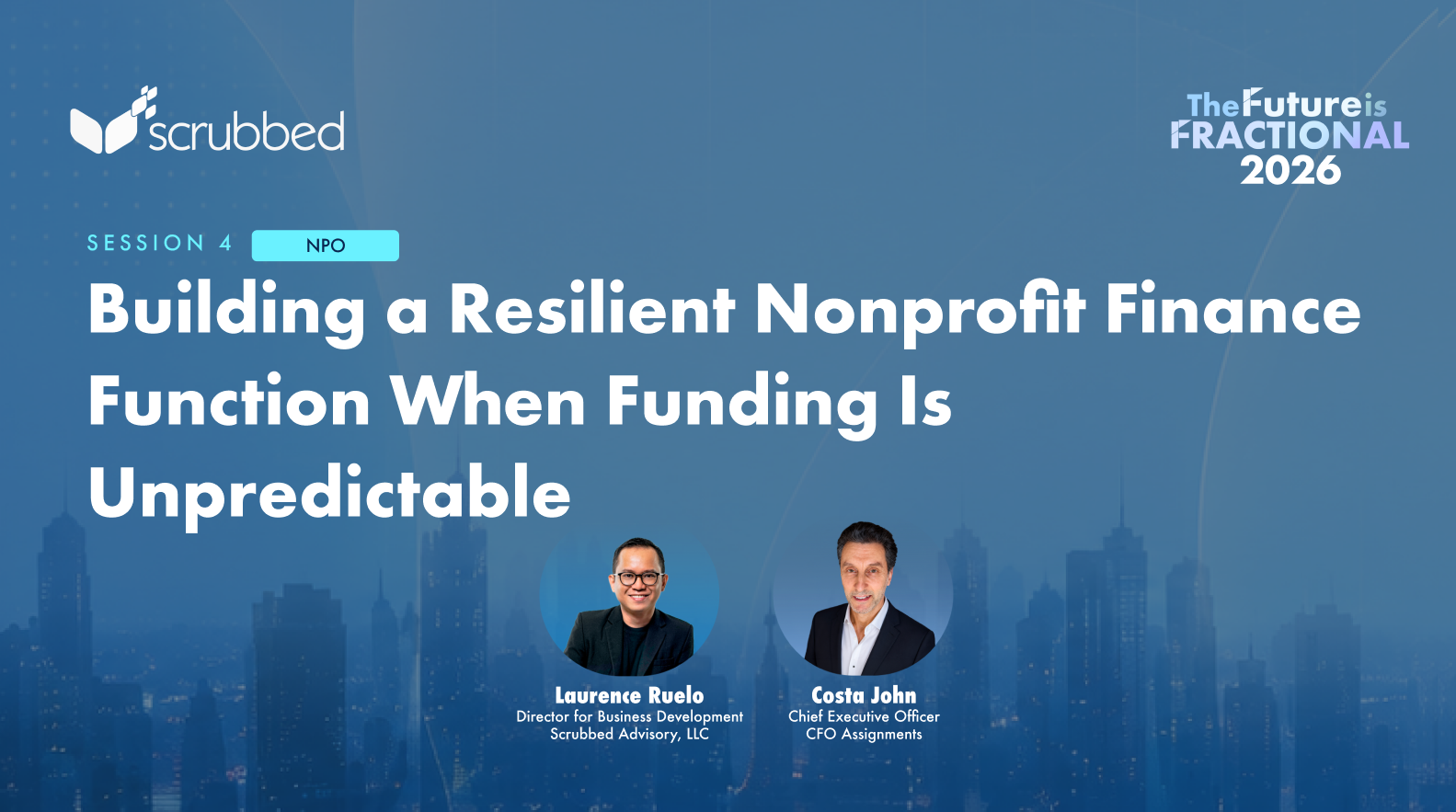
The Nonprofit Spotlight was one of three industry spotlights at The Future Is Fractional 2026, hosted by Scrubbed on September 24, 2026. Laurence Ruelo, Director of Business Development at Scrubbed, spoke with Costa John of CFO Assignments, who has decades of CFO experience across nonprofit and for-profit organizations. They covered the three pillars of financial resilience, tracking restricted funds, what to do when a major funder pulls out, board reporting, and how to build finance capacity without overbuilding. The short version: watch unrestricted cash, act early and in phases when funding is cut, and give your board the forward look rather than the history.
For many nonprofits, the funding hasn’t disappeared, but its timing has become harder to predict. Grants arrive late. Proposals take longer to secure. Visibility six or twelve months out is thin.
At The Future Is Fractional 2026, a virtual conference hosted by finance and accounting advisory firm Scrubbed on September 24, 2026, Session 4 split into three industry breakouts running at the same time: real estate, nonprofit and technology. In the nonprofit track, Scrubbed Director of Business Development Laurence Ruelo asked veteran CFO Costa John how nonprofits can build a finance function that is resilient, useful to leadership and scalable when resources are already stretched.
Key Takeaways:
- Resilience rests on three legs: liquidity, flexibility and the cash cycle.
- Timesheets and integration drive restricted fund tracking. Programs are delivered by people, so staff time is what releases restricted funds.
- When funding is cut, act early and in phases. The first cost reductions are the cheapest ones.
- Don't hire strategy to fix bookkeeping. Get the books closing cleanly before bringing in a fractional CFO, or the CFO gets pulled back into reconciliations.
- Give boards the forward look, not the history. Show the outlook, its impact and a range of decisions.
- Watch operating cash flow, and show days of cash. “Reserves and profits are a matter of opinion. Cash is a matter of fact.”
Meet the Speakers
- Laurence Ruelo (moderator): Director of Business Development, Scrubbed.
- Costa John: CEO CFO Assignments, with decades of CFO experience across nonprofit and for-profit organizations, including as CFO of Sapiens North America.
The Three Pillars of Nonprofit Financial Resilience
John frames resilience as a three-legged stool:- Liquidity: The level of unrestricted funds the organization can draw on.
- Flexibility: The cushion to absorb a delayed grant or a slow proposal. The board usually sets it with the CFO as a target number of months of cash operating expenses.
- The cash cycle: How many days the organization must cover rent, salaries, travel and office costs before funding arrives.
Together, they give the organization a stable footing. John acknowledged it’s hard for small nonprofits, but said building toward it should be a priority.
How to Track Restricted Funds without the Spreadsheet Wrestling Match
Restricted funds are grants or donations that can be spent only on a specific purpose or program.Start with timesheets. Nonprofit programs are delivered by people, so releasing restricted funds and matching expenses to grants comes down to how staff time is spent. “If you cannot have a good on-hand grip of where and how your program people are delivering against the mission, you’re already on a slippery slope."
Integrate the systems. The more the organization’s systems connect end to end, the less restricted revenue tracking becomes “a wrestling match between confusing and sometimes broken spreadsheets.” Affordable, easier-to-integrate software has made that more realistic than it used to be.
Contingency planning when a major funder pulls out
Stay close to funders. Organizations with strong funder relationships can often see cuts coming, whether funders planned them or are reacting to their own budget pressures.Have the outline of a plan ready. John described a phased response, from least to most disruptive:
- Delay contractors and capital spending not required this year.
- Delay replacements when people resign.
- Delay salary increases.
- Delay benefits such as 401(k) matches.
- Only if those steps don’t buy enough time, consider reductions in force.
Act early. Once you know funding is going away, move. “Your first cost reduction steps are ironically your cheapest ones.” Hesitating can make the eventual response more painful and more expensive.
Board Reporting: Forward-looking Information, Not just data
“Data is not the same as information,” John said. Boards can drown in numbers. He recommended spending little time on historical statements beyond a status update. “It’s hard asking a board to govern an organization looking in the rearview mirror.”Include in Board Updates What It Means The forward look The outlook for the coming period The impact If this happens, here's what it means financially Decisions,plural A range of choices and their impacts, not a single option to approve or reject
| Include in Board Updates | What It Means |
|---|---|
| The forward look | The outlook for the coming period |
| The impact | If this happens, here's what it means financially |
| Decisions,plural | A range of choices and their impacts, not a single option to approve or reject |
Non-financial metrics, with the CFO at the table
John pushed back on the idea that non-financial metrics are outside the CFO’s lane. Measures like schools reached, children served or outcomes achieved all have financial drivers underneath, and the CFO can help program leaders see the dollar value of their impact.
He sees a missed opportunity with funders: payback. In one illustration, a program costing about $72,000 per school produces an estimated $112,000 per school in lifetime health and education benefits. Framed that way, funders hear two things: the program pays for itself, and more money would do more good.
Aligning boards on cash reserves
Reserves aren’t shareholders’ equity. John warned that board members without a finance background shouldn't read nonprofit reserves that way. Restricted reserves reported under GAAP are, in economic substance, obligations to deliver future programs, and the cash to deliver them needs to be available.Deficits change the math. With $10 million in grant revenue and $12 million in expenses, every dollar of programming costs $1.20. Delivering more of it without a plan to close the gap can dig the hole deeper, so healthy-looking reserves can offer “a comfort that turns out to be razor thin.” Boards don’t need the calculations, he said, but they should know to ask.
Scaling Finance Capacity: Compliance vs. Value-added work
Executive directors already juggle fundraising, programs, people and operations. John divides finance into two parts, with different ways to resource each:| Non-negotiable: compliance and reporting | Value-added: strategy and planning | |
|---|---|---|
| What it covers | The Form 990, the audit, paying vendors, payroll | Forecasting, budgeting, support at the fundraising and budget tables |
| The risk | It “can become a self-consuming monster” without integration and automation | It gets crowded out if the CFO is pulled into bookkeeping |
| How John would resource it | Outsource it, or at minimum keep it separate from the CFO role | A part-time or fractional CFO, kept out of the bookkeeping weeds |
Don’t hire strategy to fix bookkeeping. Bringing in a fractional CFO for strategic work while the books still don’t close cleanly means the CFO gets dragged back into reconciliations, “the most expensive way to solve the wrong problem.” Messy reconciliations also pull program leaders away from the mission.
Start with the lightest system that works. John warned against buying the most sophisticated accounting system too early. A lightweight option such as QuickBooks with nonprofit modules usually serves growing organizations better, while complex systems can “grind the process to a halt.” Ruelo agreed, noting organizations that implement complex systems, don’t get the information they need and end up returning to simpler tools.
What to keep in-house
- A dedicated CFO role, even a part-time or fractional one, onshore or offshore, kept out of the bookkeeping weeds.
- Relationship-driven roles such as the grant accountant, who knows program leaders, funders and nuances that may not translate if outsourced.
The metric every Nonprofit leader should watch: Operating cash flow
“Reserves and profits are a matter of opinion. Cash is a matter of fact.” A balance sheet can look healthy while cash is tied up in grants not yet funded, and “you cannot make payroll with grant certificates or invoices.” John recommended practicing short-horizon cash forecasting, starting at 30 and 60 days, until it becomes muscle memory, especially as the funding environment for nonprofits shifts.
One Change to the Board packet: An Unrestricted Cash Schedule
What to cut: Liability-side schedules, such as an accounts payable aging report showing how long vendors have waited to be paid. John called that too operational to help a board make a decision.What to add: a schedule showing how many days the organization can run on unrestricted cash.
- Start with unrestricted reserves.
- Subtract amounts already committed.
- Divide by daily cash expenses.
The board then knows, at every meeting, how many days the organization can operate: 111 days, say, or 192. It's easy to focus on and easy to understand.
Ruelo’s summary of the conversation: resilience starts with visibility, good reporting translates information into decisions, and finance capacity is about access to the right expertise at the right time, whether internal, fractional, outsourced or a mix.
This session is part of The Future is Fractional 2026. For the themes that ran across every industry, read Own the Core, Access the Rest: What The Future is Fractional (TFIF) 2026 Revealed About How Finance Teams Are Being Rebuilt what finance leaders are rethinking about talent, AI and team structure.