Scrubbed Appoints Vince De Leon as Chief Executive Officer in Planned Leadership Transition

Scrubbed

Scrubbed

 Scrubbed Appoints Vince De Leon as Chief Executive Officer in Planned Leadership Transition
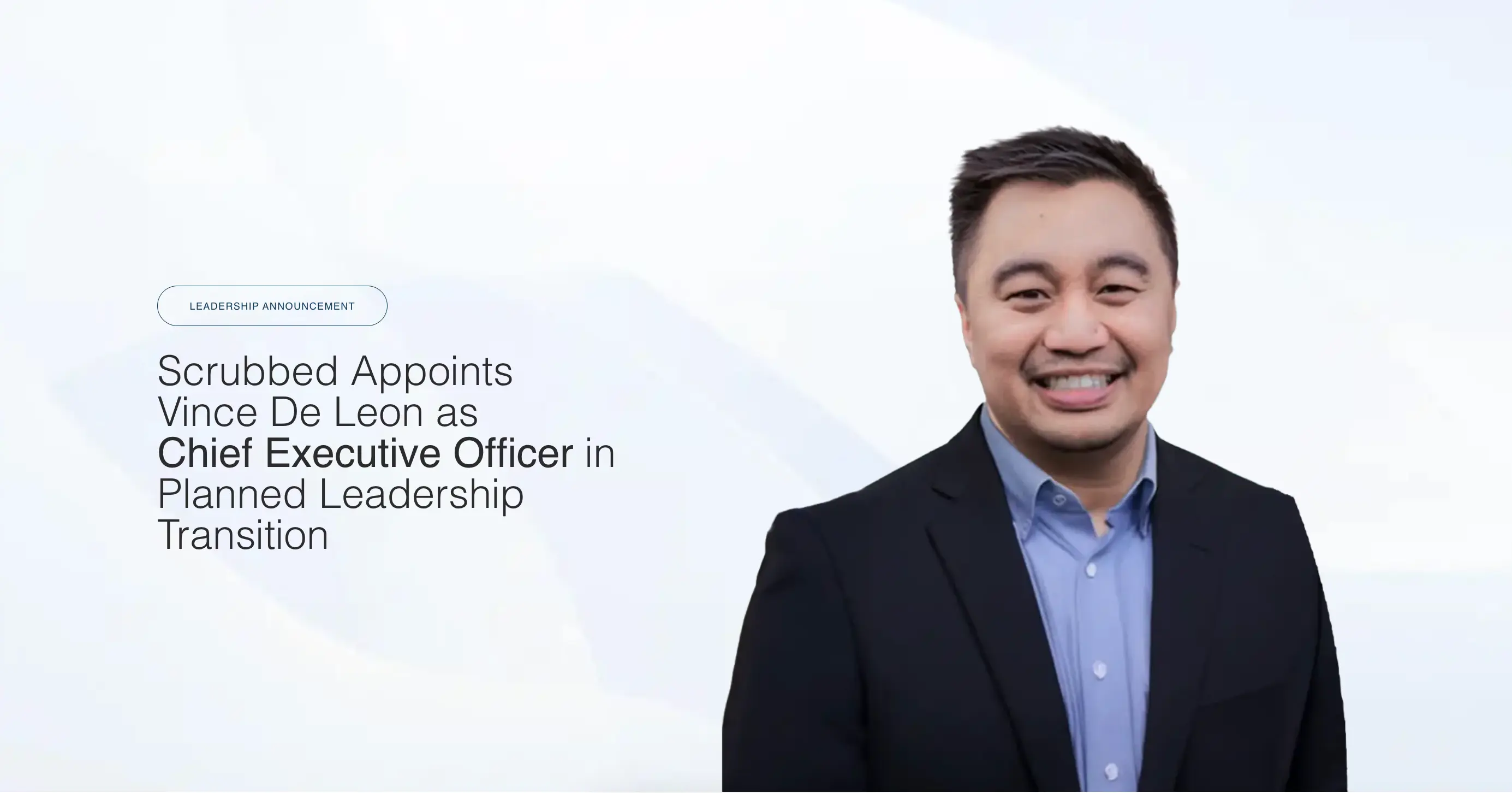
We’re excited to announce that Vince De Leon has been appointed as Scrubbed’s Chief Executive Officer.

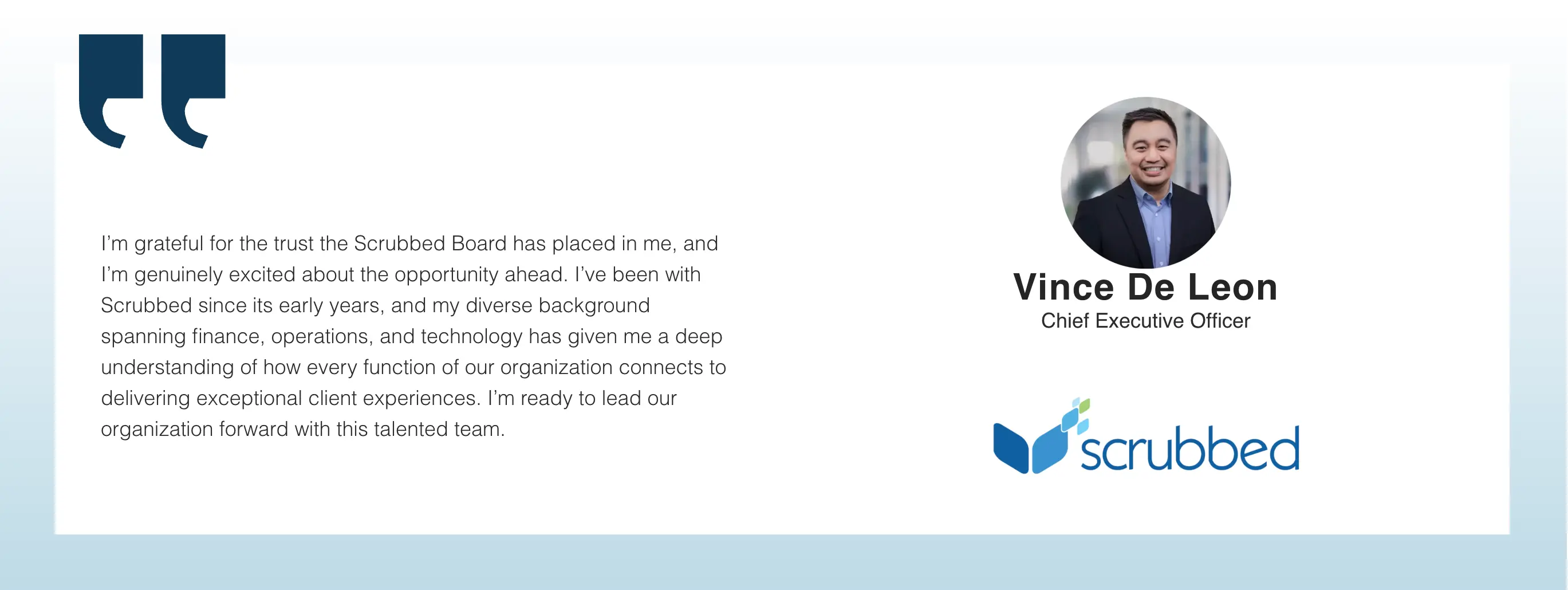
Vince has been with Scrubbed since the beginning, most recently serving as Chief Technology Officer. In that role, he was responsible for the firm’s infrastructure and technology and advised clients on systems that enable consistent execution at scale. He brings more than 20 years of experience across accounting, operations, and technology advisory.


Vince


 Co-founders Mark Pineda and Gani Laguisma will remain active on the board and continue to support Scrubbed’s growth.

“We’ve built Scrubbed into a stable, continuously growing organization that’s now poised for scale, and this is exactly the right moment to bring in someone with fresh energy to take us to the next level,” Pineda said. “Vince is the ideal choice because he’s been with us from the start, he understands our culture and our vision, and he’s proven himself as a leader within our ranks. He has our full support as a board, and I’m confident he’s going to supercharge our growth in a way that’s going to benefit everyone in this organization.”

“This leadership transition is intentionally a step forward to a new chapter in the evolution of Scrubbed. The purpose and mission to create a professional service firm from good to great in serving its people, market and the community at large will remain the same,” Laguisma said. “Vince is exceptionally well-positioned to lead this next phase, and I’m confident he’ll bring fresh perspective and energy to accelerate our growth. As one of the co-founders, I’m honored to support this transition and remain a strategic ally to Vince and the team as we continue building something exceptional.”

This transition reflects continuity, not a change in direction. Our commitment to a people-first culture, disciplined execution, and long-term client partnerships remains unchanged.We’re grateful for the trust our clients and partners place in us—and we’re excited about what’s ahead.

Related Content

Blogs

Redefining the Accounting Workforce: Finding the Right Talent Model for Your Firm

Redefining the Accounting Workforce: Finding the Right Talent Model for Your Firm

The accounting profession is currently going through major changes. With talent shortages, shifting client expectations, and growing competition, CPA firms are pressured to rethink how they build and manage their teams.In a recent webinar hosted by Dan Hood, the Editor-in-Chief at Accounting Today, industry experts Rizza De Guzman, the Lead Director for Firm Client Services at Scrubbed, and Jack Reagan, Partner at UHY Advisors, explored the recent shift in the industry and shared their thoughts on how firms can adjust to these challenges. They offered their expertise and strategies to help firms stay competitive and move forward with confidence.Why Firms Are Struggling With the Current Staffing ModelOne of the biggest challenges accounting firms face today is the growing gap between the demand for skilled professionals and the number of people available to do the work.Rizza highlighted several factors that could be causing this shortage, such as the retirement of experienced professionals, the lack of new professionals entering the field, and other industries attracting potential talent with competitive pay and more appealing career paths. As a result, many firms are finding their teams stretched thin. They’ve done all they can with the staff they have, and it’s becoming clear that relying solely on traditional hiring methods isn’t sustainable.Another challenge that Jack mentioned is how client needs have evolved. Work that used to be predictable and ongoing is now more project-based and specialized. So, the skills that you may need now might be different from the skills you need tomorrow. This unpredictability means that firms need to be able to quickly scale their teams up or down, and that kind of agility is hard to achieve with the current staffing model. For Jack, “having that flexibility to match not only the cycle but then the skill set that the project demands is critical.”Building Flexible Teams Through Hybrid and Outsourced StaffingOnce the challenges around talent became clear, the conversation shifted to what firms can do about it. One of the key solutions Rizza discussed was to explore other models, like outsourcing, to create a more agile and scalable workforce. She defines outsourcing as a situation when a company ”fully or partially delegates work to an external partner who becomes an extension of your team.”This kind of model helps firms stay agile and allows them to tap into specialized skills when needed, manage costs more effectively, and adjust quickly as workloads shift. Instead of trying to overload internal teams with work or hire full-time staff for short-term needs, firms can bring in the right expertise at the right time.How to Make Outsourcing Work for Your FirmOne of the most effective ways for firms to stay competitive is by bringing in outside expertise. But making that work takes more than just hiring a third party and hoping for the best. Successful outsourcing starts with clearly defined roles and expectations. Open communication is key, and the relationship needs ongoing attention, not just a one-time setup. Regular check-ins and performance reviews help keep everything on track.Rizza highlights that one of the first steps for companies to start exploring outsourcing or hybrid workforces is by taking a good look at where their team stands today. What skills are missing? What kind of work is piling up? From there, firms can start small. Try a hybrid model, see what works, and adjust as you go.Jack agreed, but noted that for these partnerships to work, firms need to treat outsourced professionals like true team members. According to him, it’s important that firms “…have a say on who is gonna be part of the team,” rather than just being assigned an employee, as this helps set the culture in the workplace.And while working remotely is nothing new, as necessitated by the recent pandemic, trust is another big piece of the puzzle. Beyond scheduled meetings, informal chats and the occasional in-person visit can go a long way in strengthening the connection between the firm and its external team and making the collaboration more effective.One example of this is leveraging fractional CFO services, which allows firms to access high-level financial expertise without the commitment of a full-time hire.Remember, there’s no single formula for success here. Every firm is different. The best approach is one that reflects your client’s needs, internal strengths, and long-term goals.Take Action TodayOne thing became clear throughout the discussion: doing nothing is not an option. For Rizza and Jack, the long-term sustainability, growth, and agility offered by outsourcing talent is the way to go.Competitors are already changing how they staff their teams, and firms that don’t adapt risk falling behind, both in terms of competitiveness and their ability to attract and retain top talent. It’s time for firms to rethink their workforce strategy, focusing on flexibility, building strong partnerships, and using technology along with specialized SaaS accounting expertise to their advantage.How can firms maintain quality control when outsourcing talent?This comes down to choosing the right partner from the start. Be sure to take the time to check their credentials and look into businesses that really understand the industry. Don’t be afraid to ask for references to make sure you find the right fit. Once you’re already working together, regular check-ins and clear communication go a long way in making sure everything stays up to your expectations.Can outsourcing help with seasonal workload spikes?One of the biggest advantages of outsourcing is the flexibility to scale up or scale down depending on your business needs. In fact, a lot of firms may bring in outsourced talent during peak times to help manage the extra workload and avoid overwhelming the internal team.Are outsourcing and hybrid models the same?While outsourcing and hybrid work environments both involve remote work, they are fundamentally different work models. Outsourcing involves bringing in external talent into the team while a hybrid set up has more to do with the location of the internal team. Hybrid can also include external talent, making it a mix of both internal and external resources.How can smaller firms start integrating an outsourced team without overextending the budget?The best thing to do is to start small; you don’t have to hire several people at once. Consider outsourcing time-consuming tasks first, like bookkeeping, to determine whether this staffing model works well for your organization. Over time, you can scale based on performance and necessity.How do I choose the right outsourced accounting provider for my biotech company?Start by identifying your company's accounting needs, such as bookkeeping, financial reporting, ASC 606 compliance, or managing R&D tax credits. Then, evaluate your potential providers based on how much experience they have in the biotech industry and with the unique challenges and regulatory requirements your business faces. Review client testimonials and references from similar biotech companies to get a sense of their track record and expertise. Finally, confirm that their services are scalable to support your business as it grows, and that budgets and service levels are in line with your goals.Connect With ExpertsThe landscape for CPA firms is shifting quickly; with fewer professionals entering the field and client needs becoming more complex, the traditional staffing model is becoming harder to sustain. Firms need more flexibility and access to high-level talent without overloading their internal teams.However, finding the right fit in a sea of talent can be difficult and overwhelming. That’s where Scrubbed comes in. We partner with CPA firms and provide outsourced accounting, finance, and audit services to help clients scale their organization smarter and more efficiently. Ready to explore alternative staffing solutions? Schedule a consultation with our team today and discover how smart outsourced accounting team can benefit you.If you missed the webinar, you can watch it here.

Read More >
Blogs

360° Approach to Libor Transition

360° Approach to Libor Transition

What you need to know:London Interbank Offered Rate (LIBOR) ends on December 31, 2021.ASU 2020-04 – Reference Rate Reform (Topic 848) provides temporary optional expedients and exceptions to the US GAAP guidance on contract modifications and hedge accounting. The ASU is effective immediately and all entities would be able to apply it until December 31, 2022.Cessation of LIBOR would expose businesses to various risks such as liquidity risk, technology risk, operational risk, and financial reporting and compliance risk.The U.S. Treasury Department and Internal Revenue Service (IRS) released the Proposed Interbank Offered Rate (IBOR) Regulations in October 2019 to address the tax treatment of alterations made to instruments to replace an IBOR-based rate with an alternative rate.LIBOR is currently produced in 7 tenors (overnight/spot next, one week, one month, two months, three months, six months, and 12 months) across 5 currencies. In the US and global markets, LIBOR is widely used as a reference interest rate in commercial agreements and a broad range of financial instruments. However, in 2017, the U.K. Financial Conduct Authority announced that all currency and term variants of LIBOR (IBORs) are expected to cease after the end of 2021. This decision was made due to the increasing absence of active underlying markets and the scarcity of term unsecured deposit transactions which led to serious questions about the future sustainability of the LIBOR benchmarks.FASB proposed optional expedients and exceptions to the guidance in U.S. GAAP to contracts, hedging relationships, and other transactions affected by reference rate reform.In March 2020, the Financial accounting Standards Board (FASB) released ASU No. 2020-04 in response to the cessation of the LIBOR. Several issues and challenges that are likely to arise due to this were raised by stakeholders:Voluminous contracts and other arrangements will need to be modified to replace reference rates.Application of existing accounting standards to contracts and other arrangements could be costly and burdensome. The inability to apply hedge accounting because of reference rate reform could result in financial reporting outcomes that do not reflect entities’ intended hedging strategies. Key Considerations Include:Affected ContractOptional Expedients and ExceptionsCriteria Contract Modifications —Allows an entity to account for and present the modified contract as a continuation of the contract that existed before the modification rather than a derecognition or extinguishment—The contract references LIBOR or another reference interest rate that is expected to be discontinued due to reference rate reform.—Consider embedded features to be clearly and closely related to the host contract without reassessment.—Any contemporaneous changes to other contract terms (i.e., those that do not directly replace or have the potential to replace a reference rate) that change, or have the potential to change, the amount and timing of contractual cash flows must be related to the replacement of the reference rate.  Hedging AccountingeCritical terms of hedging relationships—Provide optional expedients to enable entities to change critical terms and continue to apply hedge accountingFair value hedges—Allows an entity to change the designated benchmark interest rate documented at hedge inception to a different eligible benchmark interest rate under Subtopic 815-20—An entity may disregard certain qualifying conditions for the shortcut method that are not met because of reference rate reform and may continue to disregard those qualifying conditions for the remainder of the fair value hedging relationship (including for the remainder of hedging relationships that end after December 31, 2022).Cash flow hedges—Allows an entity to assert that it remains probable that the hedged forecasted transaction will occur.—Continue hedge accounting upon a change in the hedged risk as long as the hedge is still highly effective—Allows an entity may revert to hedge accounting requirements in Subtopics 815-20 and 815-30 without de-designating the hedging relationshipCritical terms of hedging relationships —Perform some effectiveness assessments in ways that disregard certain potential sources of ineffectiveness.Fair value hedges—The hedge is expected to remain highly effective—The optional expedients for fair value hedging relationships may be elected on an individual hedging relationship basisCash flow hedges—An entity may continue hedge accounting for a cash flow hedge for which the hedged interest rate risk changes if either the hedge is highly effective under an assessment method in Subtopics 815-20 and 815-30 or an optional expedient method in this Update is elected.—An entity should disregard the potential change in the designated hedged interest rate risk that may occur because of reference rate reform when the entity assesses whether the hedged forecasted transaction is probable in accordance with the requirements of Topic 815. Debt securities classified as Held-to maturity —An entity may make a one-time election to sell, transfer, or both sell and transfer debt securities classified as held to maturity that reference a rate affected by reference rate reform and that are classified as held to maturity before January 1, 2020. Contract modifications:  The following decision tree summarizes whether a contract modification is eligible to apply for the optional relief in ASC 848-20-55-1. ASU No. 2020-04 also provides optional expedients for applying the requirements of certain topics that require analysis of contract modification:Modifications of contracts within the scope of Topics 310, Receivables and Topic 470, Debt should be accounted for by prospectively adjusting the effective interest rate Modifications of contracts within the scope of Topics 840, Leases and Topic 842, Leases should be accounted for as a continuation of the existing contracts with no reassessments of the lease classification and the discount rate (for example, the incremental borrowing rate) or remeasurements of lease payments that otherwise would be required under those Topics for modifications not accounted for as separate contracts; and Modifications of contracts do not require an entity to reassess its original conclusion about whether that contract contains an embedded derivative that is clearly and closely related to the economic characteristics and risks of the host contract under Subtopic 815-15, Derivatives and Hedging— Embedded Derivatives.Changes that are related to the replacement of a reference rate To be eligible for the optional expedients in Subtopic 848-20, modifications of contractual terms that change (or have the potential to change) the amount or timing of contractual cash flows must be related to the replacement of a reference rate. Changes made to effect the transition for reference rate reform are considered related to replacement of the reference rate and, therefore, are in the scope of the ASU. Changes to terms that are the result of new business decisions separate from the transition for reference rate reform are not considered related and, therefore, are not in scope. The ASU includes examples of changes that are related and unrelated to the replacement of the reference rate.Tax Implications of Elimination of LIBORA.   Modification of Terms of Debt Instruments or Non-Debt Contracts.Under IRS proposed regulations, if the terms of a debt instrument or non-debt contract are modified to replace, or to provide a fallback to, a LIBOR-referencing rate and the modification does not change the fair market value, there is no gain or loss under the recognition of gain or loss rules. These rules apply regardless of whether the modification occurs by an amendment to the terms of the instrument or agreement or by replacing the existing debt instrument or contract with a new one.B.   Qualified RateThe proposed regulations also provide the rules for determining whether a rate is a qualified rate. The rules provide that the fair market value of a debt instrument or derivative may be determined by any reasonable valuation method, as long as that reasonable valuation method is applied consistently and takes into account any one-time payment made in lieu of a spread adjustment.The debt instrument or non-debt contract are considered equivalent in value after the modification if:at the time of the modification the historic average of the LIBOR-referencing rate is within 25 basis points of the historic average of the rate that replaces it; orthe parties to the debt instrument or non-debt contract are not related and, through bona fide, arm’s length negotiations, determine that the fair market value of modified instrument or contract is substantially equivalent to the fair market value prior to the modification.C.   Transactions and HedgesThe proposed regulations clarify that a taxpayer is permitted to alter the terms of a debt instrument or modify one or more of the other components of an integrated or hedged transaction to replace a rate referencing an IBOR with a qualified rate without affecting the tax treatment of either the underlying transaction or the hedge.D.   One-Time PaymentUnder the proposed regulations, the source and character of a one-time payment that is made in connection with a modification described above will be the same as the source and character that would otherwise apply to a payment made by a payor with respect to the debt instrument or non-debt contract that is altered or modified.E.    Grandfathered AgreementsBecause proposed regulations prevent debt instruments and non-debt contracts from being treated as reissued following a deemed exchange, the debt instrument or contract would not lose its grandfathered status as a result of any modifications made in connection with the elimination of LIBOR.F.    Original Issue Discount (OID) and Qualified Floating RateProposed regulations stipulate three special rules for determining the amount and accrual of OID in the case of a variable rate debt instrument that provides both for interest at a LIBOR-referencing qualified floating rate and for a fallback rate that is triggered when the LIBOR becomes unavailable or unreliable.G.   Real Estate Mortgage Investment Conduit (REMIC)Proposed regulations permit an interest in a REMIC to retain its status as a regular interest despite certain alterations and contingencies.H.   Interest in Foreign CorporationsThe proposed regulations amend the election to allow a foreign corporation that is a bank to compute interest expense attributable to excess U.S.-connected liabilities using a yearly average Secured Overnight Financing Rate (SOFR) in addition to the 30-day LIBOR.Applicability DateThis section applies to an alteration of the terms of a debt instrument or a modification of the terms of a non-debt contract that occurs on or after the date of publication of a Treasury decision adopting these rules as final regulations in the Federal Register. Taxpayers and their related parties may apply this section to an alteration of the terms of a debt instrument or a modification of the terms of a non-debt contract that occurs before the date of publication of a Treasury decision adopting these rules as final regulations in the Federal Register, provided that the taxpayers and their related parties consistently apply the rules of this section before that date.Risks Related to the Elimination of LIBORContract Risk:Risk that contracts which has stipulations dependent in LIBOR will be affected causing inconsistencies and disruption in the execution of it.To mitigate the risk, make a list of all the contracts that may be affected. However, for some it will be challenging if there is no repository of these contracts.Negotiate terms with counterparties for those stipulations relating to LIBOR, although some counterparties may be unknown or difficult to reach.Liquidity Risk:Risk that LIBOR cessation will make it more difficult for existing products to be traded, with more costs and uncertainties.Because of this, companies have to reassess their investment and financing strategies as soon as possible in order to prepare for the cessation of LIBOR.Basis Risk and Value TransferRisk that differences in the timing and terms for similar contracts will result in gaps and inconsistencies in the contracts and value transferSince there is a shift of basis for LIBOR-dependent contracts, the difference will cause value-transfer because of timing concerns, necessity for practical expedients, and differing term structures.To mitigate basis risk, the gaps may be hedged to additional derivatives.Reputational RisksThere is a risk that improper transition plans will result to besmirched reputation to important stakeholders.There should be clear communication with investors, creditors, customers, regulators and other counterparties of the extent of exposure, as well as transition plans that include controls as well as disclosures.Operational and Technology RiskRisk that modification to current operating models and systems that are heavily reliant on LIBOR will result to inaccurate inconsistent outputsDetermine all items that are affected by the cessation, including inventory, IT systems both internal and external, and other data and plan for the capabilities existing and needed for the transition, including control changes.Financial Reporting and Tax RiskRisk of incomplete and inaccurate reporting to accounting bodies and tax authorities.Certain financial reporting and tax reliefs are being proposed by regulators. Therefore, there is a need to study on how these reliefs can be infused in the transition plans.Certain financial instruments with dependence in LIBOR may need to reassess the fair value considerations due to changes in the observability of LIBOR transactions.Disclosures are necessary for all relevant items in the transition plan that have significant accounting impact to policies currently in place. Refer to the discussion above for more details on the accounting and Tax implications of LIBOR cessation.We’d love to help.To ensure that all factors are considered in the pursuit of reliable financial reporting, effective and efficient operations, and compliance with law and regulations, our services can be scaled to accommodate your business needs, especially in considering the impacts of LIBOR Transition. Our Corporate Finance Advisory services, together with our Technical accounting Group, provide a thorough of factors outside the normal course of business, with a strong emphasis on risk and SOX compliance.E-mail us at [email protected] for full consultancy assessment.About the AuthorsTo have a thorough discussion on the matter, please contact:Jezaniah Castro has extensive experience in preparation and filing of federal, state and local income tax returns for businesses and high net-worth individuals and other business-related filings, including sales and use tax in compliance with applicable US federal and state tax laws and regulations. She has also dealt with IRS and State tax notices, tax legislation, or audit workpapers in advocating taxpayer’s position to the taxing authorities.JM Miclat has years of Advisory experience with EY Philippines mainly focused on leading SOX 404 compliance and top-risk audit engagements from one of the largest Fast Moving Consumer Goods (FMCG) company. He has extensive knowledge in applying Topics 606 and 842 of US GAAP to business processes. He ranked 9th in the CPA Board Examinations (PH) in 2016.DisclaimerThe information contained herein is of a general nature and is not intended to address the circumstances of any particular individual or entity. It is not intended to be relied upon as accounting, tax, or other professional service. Please refer to your advisors for specific advice. Although we endeavor to provide accurate and timely information, there can be no guarantee that such information is accurate as of the date it is received or that it will continue to be accurate in the future. No one should act upon such information without appropriate professional advice after a thorough examination of the particular situation.

Read More >
Blogs

Empowering Finance Teams to Deliver Real-Time Insights

Empowering Finance Teams to Deliver Real-Time Insights

At A GlanceAn effective financial partnership requires more than just accurate reporting. It also requires the confidence to provide real-time insights. While rigid structures are necessary to protect time and data integrity, they can become bottlenecks if they prevent teams from communicating spontaneously. A partner-led engagement, where a senior professional owns the relationship, is what closes the gap between back-office execution and front-line decision-making.As a working mom with a two-year-old, I’ve learned that kids thrive on structure. Predictable mealtimes, predictable bedtimes, a rhythm to the day. That scaffolding is what lets a small child feel safe enough to actually be a kid.The same thing is true at work, though it took me longer to learn. If I don’t consciously block out 4:00 to 6:00 PM every weekday for focused work including reviews, end-of-day approvals, urgent client questions, that time gets eaten by everything else. That structure is non-negotiable.But structure can’t harden into rigidity. If every single thing inside those two hours has to be pre-planned and pre-approved, I miss the moments that actually matter. The unprompted question. The quick judgment call. The real-time answer a client needs right now.That same tension shows up across our work with growing companies. Clean reporting and clear processes are what make good decisions possible. But when that discipline hardens into too much process, it can quietly slow down the real-time insight our clients need most.When Strong Process Needs Clear JudgmentA while back, I visited a client to review our engagement. The work was clean. Reporting was on time. The team was following the review structure we had built to protect quality and consistency.That structure mattered. It still does.As engagements grow, process is what keeps the work reliable. It creates accountability. It protects the client. It gives the team a clear way to manage volume without depending on one person’s memory or judgment alone.But in this conversation, the client helped us see something important. The issue was not that the team was doing anything wrong. The issue was that our communication structure needed more clarity around timing and judgment.Over time, more review checkpoints had been added to make sure answers were accurate before they reached the client. The intention was right. But for some routine questions, where the answer was already clear and supported by the work, the extra layer was slowing down the conversation.The client did not want less quality control. He wanted the benefit of the team’s knowledge in the moment when he needed it.That distinction matters.Calibrating the StructureWhat we learned from that conversation was not that we needed less process. We needed to help the team use the process with more confidence.In finance, review matters. Quality control matters. Those layers are what protect accuracy, especially as a client relationship grows and the work becomes more complex. A strong process gives everyone the same foundation to work from.But process should not make a capable team feel like they have to pause on every answer, even when the work already supports it.That was the adjustment we needed to make.If a question involved risk, uncertainty, or a technical judgment call, it still needed review. That did not change. But when the question was routine, the data was clear, and the team knew the client context, we wanted them to feel confident responding in the moment.The difference may seem small, but it matters to the client.A delayed answer can make a team feel distant, even when they are doing excellent work behind the scenes. A timely answer, grounded in accurate work, helps the client feel that the team is close to the business and paying attention.The relationship improved because the team had clearer guidance. Not less structure. Better use of the structure we already had.Financial clarity is not created by reporting alone. It comes from accurate work, strong review, and people who know how to communicate what the numbers are already telling them.Why Partner-Led Engagements Make This PossibleThis is where the engagement model matters more than people realize. When a relationship is owned by a senior professional from day one, real-time insight is built into how the work happens. There’s no approval ladder to climb for routine questions. The person closest to the client is also the person with the expertise to answer.That’s by design at Scrubbed. Every engagement is led by a senior professional who knows the business, the industry, and what keeps the client up on a Sunday night before a Monday board meeting. The same person you talk to about a tax question is the one who saw your last close. The same person who reviewed your audit prep is the one you’ll call when an investor asks something hard.The strongest client relationships are not built on speed alone. They are built on reliable work, clear standards, and senior professionals who know when to pause, when to review, and when to answer with confidence.The TakeawayA real finance partnership is more than filling a reporting cycle. It’s having an experienced professional embedded deeply enough in your business to drop the formal script and give you a straight, confident answer.When workflows are clear, decisions become more reliable. Structure is what allows a finance function to scale reliably, but the confidence to provide real-time insights is what makes it a true partnership.

Read More >

Contact Information

SF Bay Area Headquarters
111 Anza Boulevard, Suite 320, Burlingame, CA 94010, United States

Phone: (800)837-5160
Email: [email protected]

"Scrubbed" is the brand name under which Scrubbed Advisory, LLC and Scrubbed Assurance LLP provide professional services. Scrubbed Advisory, LLC and Scrubbed Assurance LLP practice in an alternative practice structure in accordance with the AICPA Code of Professional Conduct and applicable law, regulations, and professional standards. Scrubbed Assurance LLP is a licensed independent CPA firm that provides attest services to its clients, and Scrubbed Advisory, LLC provides tax, finance, and support services to its clients. Scrubbed Advisory, LLC is not a licensed CPA firm.

Copyright © Scrubbed. All rights reserved.