
Sustainability Beyond Profit: ESG Trends for Nonprofit Organizations

John Mark Respeto

John Mark Respeto

Sustainability and Quality Director

Sustainability Beyond Profit: ESG Trends for Nonprofit Organizations

Environmental, Social, and Governance (ESG) principles have traditionally been associated with for-profit businesses. However, in recent years, there has been a growing recognition of ESG’s relevance for nonprofit organizations (NPOs) as well.


Why ESG Matters for NPOs

For NPOs, ESG can be a strategic opportunity. As businesses and investors become more ESG-focused, they will be more selective in choosing NPO partners. NPOs with strong governance frameworks and clearly defined ESG practices will be seen as more trustworthy and impactful.


ESG reporting also plays a role in enhancing transparency and accountability for NPOs, which can align well with your mission and reputation. Since following reporting standards also allows NPOs to be held to the same expectations as other sectors, it can also be seen as a way to strengthen your legitimacy and credibility. Internally, ESG reporting can also help focus your NPO constructively on self-assessment, measuring your impact, and continuously improving your practices.


ESG in Day-To-Day Operations

Some NPOs are already integrating ESG considerations into their day-to-day operations. Here are some ways they are doing this:


  • Aligning mission and action: By their nature, NPOs address social or environmental issues. Integrating ESG ensures your organization’s business practices directly support your goals. For example, an environmental NPO might adopt sustainable practices in its offices, like using recycled paper or energy-efficient appliances.

  • Proactive risk management: Thinking through ESG metrics helps NPOs identify and mitigate potential risks. This includes reputational risks tied to environmental practices, social justice concerns, or even regulatory compliance. Strong ESG practices can make your NPO more resilient.

  • Boosting efficiency: Sustainable operations can lead to cost savings. This could mean reducing energy consumption, minimizing waste, or implementing a recycling program. These practices not only benefit the environment but also free up resources that NPOs can then direct towards the core mission.

  • Building trust with stakeholders: A strong ESG commitment can increase donor and grantor confidence in your organization. Being transparent about your ESG practices fosters trust and credibility, leading to more fundraising opportunities and greater community involvement.

  • Strengthening governance: Clear policies, procedures, and reporting mechanisms around ESG enhance the smooth running of your organization and provide greater transparency and accountability. Demonstrating strong governance makes your organization more efficient and also improves stakeholder trust and public support for your mission.

  • Ensuring long-term viability: By embracing ESG, NPOs become more adaptable and sustainable in the long run. Strong ESG practices can help position your organization to navigate future challenges and continue delivering on your mission.


Navigating Guidance and Frameworks

Several frameworks have been developed to guide ESG reporting. While these tend to be aimed at the for-profit sector, they can still be valuable resources for NPOs.


  • Global Reporting Initiative (GRI): GRI offers general sustainability reporting guidelines that NPOs can adapt. These guidelines cover strategy, organizational profile, material aspects, stakeholder engagement, and more. The GRI website also provides implementation guidance.

  • GRI Sector Disclosure G4 for NGOs: This GRI guidance specifically addresses reporting for NPOs. It recommends focusing on disclosures most relevant to the NPO’s mission and activities.


The guidance suggests that specific standard disclosures per category should only be reported if they have been identified as material, in addition to the general standard disclosures mentioned.
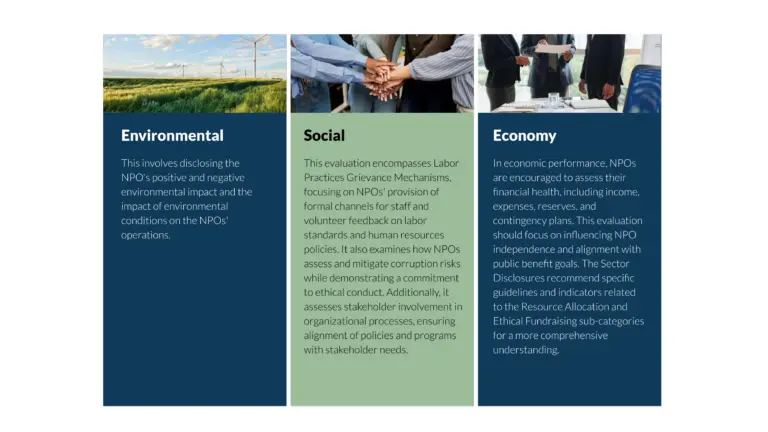

ESG Blog Table Image 768x432


  • Carbon Disclosure Project (CDP): The CDP platform encourages organizations to disclose environmental impacts, risks, and opportunities. While often used by corporations, it is also a valuable tool for NPOs seeking to be more environmentally transparent.


Industry-Specific Guidance

As non-profit organizations (NPOs) operate across various sectors, each catering to different societal needs, specific disclosure requirements are necessary, differing from the standard disclosures for the for-profit industry. The Sustainability Accounting Standards Board (SASB) delineates detailed requirements per sector, such as healthcare, education, home builders and more. For instance, in healthcare, additional disclosures focus on patient privacy, electronic health records, and quality of care, also necessitating qualitative descriptions of policies and practices for securing personal health data and quantitative data on data breaches and patient readmissions. Similarly, education sector disclosures cover the quality of education and gainful employment, mandating disclosure of graduation and job placement rates. Furthermore, the home-building sector demands disclosures on the community impacts of new developments, encompassing details such as the total number of controlled lots and delivered homes. These tailored requirements reflect the unique operational landscapes and stakeholder interests of NPOs in various sectors that are not typically seen in the same sectors in the for-profit industry.


We would also suggest following other NPOs that have already begun integrating ESG reporting into their work. For example, the American Red Cross has published a comprehensive ESG report that aligns with GRI standards and sets a baseline for the Red Cross to measure future progress.


Currently, NPOs are free to tailor the forms and content of reporting as long as they meet the minimum requirements of the standard they opt to use and disclose only credible and factual information.


ESG is no longer just a concern for for-profit businesses; it is becoming increasingly important for NPOs. By embracing ESG principles, NPOs can enhance transparency, strengthen stakeholder confidence, improve operational efficiency, and position themselves for long-term success.

How Scrubbed can help

At Scrubbed, we are passionate about helping you grow your nonprofit mission. Our highly trained professionals on Nonprofit and ESG complexities are staying updated with the emerging industry norms, best practices, and regulatory requirements affecting your organization, such as the concept of ESG, to ensure that we address your current and future needs. We can help educate your Board, Management, and Employees on global and regional ESG reporting nuances, prepare sustainability reports, and help address risks and seize opportunities in the sustainability space.

Beyond ESG, we can help streamline your processes, track your spending, and provide accurate reporting in line with your 501(c)3 status. With clear financial records, you have greater visibility into donor details, cash disbursements, and vital KPIs like how much you spend to raise each dollar donated.

While we specialize in nonprofit financial management, our expertise also extends to industries with complex reporting needs such as our real estate accounting solutions, which require the same level of precision, compliance, and strategic insight. Our team also provides technical accounting support to ensure accurate reporting and compliance across various industries. We can help prepare you for stress-free federal or state audits, provide essential documentation for board meetings, and generally take some of the hard work of managing nonprofit finances off your plate.

Learn more or contact us to see how we can help your nonprofit thrive.

CONTACT US
How Scrubbed can help

Related Content

Blogs

How SaaS CFOs Can Optimize Spending Without Compromising Growth

How SaaS CFOs Can Optimize Spending Without Compromising Growth

Investors are increasingly rewarding efficient growth over speed, and that means SaaS CFOs need to strike the right balance between fueling expansion and maintaining financial discipline. Cost optimization is the key to increasing operational efficiency, improving cash flow, and ensuring a sustainable path to profitability that satisfies investors and internal growth goals.At Scrubbed, we’ve worked with many SaaS businesses and have seen firsthand how smart financial management can drive profitability and keep growth on track. Here are a few of the successful strategies we’ve observed and supported.Build a Cost-Optimization MindsetProactive financial discipline rather than reactive budget cuts helps CFOs build relationships with department heads and team leads. With their help, you can create a culture of cost awareness and identify inefficiencies before they become major financial drains.Regularly review financials: Routine financial reviews will help you identify areas of excessive spending and potential inefficiencies so you can take corrective action before costs spiral.Leverage variance analysis: Comparing actual spending to budgeted figures helps CFOs pinpoint any unexpected deviations. Your forecasting and cost allocation will also benefit if you have greater visibility into variances.Prioritize value-generating investments: Assess spending to differentiate between necessary growth investments (e.g., product development, customer support) and expenses that don’t directly contribute to revenue or efficiency.Optimize Customer-Related CostsCustomer retention and acquisition are two of the biggest financial levers in a SaaS business. Minimizing your churn and reducing the cost of acquiring high-value customers to aim for a CAC payback period of 12 months or less can significantly improve your profitability.Reduce ChurnImplement Customer Health Scores: Satisfaction and usage data can help you identify at-risk accounts and proactively approach them.Improve Onboarding: Ensuring customers realize value quickly can measurably boost retention rates. For instance, providing new users with a guided walkthrough or interactive tutorial that highlights key features and helps them achieve their first success can reduce time-to-value and improve the likelihood that customers will stick with you.Enhance Engagement: Clear communication and value-driven support will help you build trust and stronger relationships.Lower Customer Acquisition Costs (CAC)Target the Right Customers: Creating an Ideal Customer Profile (ICP) helps focus marketing on the prospects most likely to convert and stay.Invest in Content Marketing: Reducing your reliance on paid ads with other forms of content ( Case studies, SEO, and thought leadership) can be an effective way to reach more potential customers earlier in the buying process.Leverage Referral Programs: Encourage referrals to generate high-quality leads at a lower cost.Improve Cloud and Infrastructure SpendingFor CFOs managing burn rates and investor expectations, cloud hosting is often one of the largest and most variable operational expenses. If you don’t monitor scope creep and spending closely, these costs can start to erode your margins.Review Your Cloud Usage: Regularly audit your cloud instances to identify and eliminate any unused resources, improve utilization, and reduce unnecessary spending.Explore Reserved Instances or Savings Plans: Consider committing to usage agreements with your cloud provider that allow you to access discounts, which will make your long-term cost savings more predictable.Adopt Auto-Scaling Practices: Auto-scaling dynamically adjusts your resource allocation based on demand. It’s a way for your firm to optimize performance while avoiding over or under-provisioning.Review Vendor Agreements: It’s a good idea to assess and renegotiate contracts with third-party vendors from time to time to align costs with current needs and uncover any opportunities for savings.Streamline Internal OperationsOperational inefficiencies can quietly drain your resources. Automating repetitive tasks and standardizing workflows can be the key to reducing overhead without compromising on agility.Automate Finance and Accounting Tasks: Cloud-based tools can help you simplify and streamline invoicing, reporting, and reconciliations.Standardize Workflows: Creating documented processes enhances efficiency and reduces the likelihood of errors in your accounting operations.Eliminate Redundant Tools: Conducting regular audits of your tech stack helps you find opportunities to consolidate overlapping software, reduce redundancies, and cut subscription costs.Additionally, CFOs can evaluate hiring efficiency:Align Headcount with ARR Growth: If you have uncertain sales cycles, it’s easy to hire more employees than you need. Tying hiring plans to revenue milestones or customer metrics can help you keep staffing levels under control. This is where outsourced services come in, helping SaaS teams scale efficiently without overextending internal resources.Use Data for Smarter Decision-MakingData-driven decision-making empowers CFOs to maintain flexibility and optimize costs in real-time.Conduct Financial Modeling and Scenario Planning: Use forecast cost scenarios to evaluate potential cost scenarios and prepare for various growth paths.Track Key SaaS Metrics: Metrics like CAC, LTV, burn rate, and ARR efficiency offer valuable insights to help guide strategic decision-making and align actions with long-term business goals.Deploy Business Intelligence Tools: Real-time dashboards can deliver the actionable insights CFOs need to make informed and timely decisions.Scrubbed supports CFOs with scenario planning, dashboard creation, and metric tracking to guide strategic direction.Scaling Sustainably with Cost OptimizationCost optimization means aligning spending with business priorities to drive sustainable growth. By embedding cost-conscious practices into financial strategy, SaaS CFOs can maximize efficiency, reduce risk, and ensure long-term success.At Scrubbed, we help SaaS businesses navigate financial complexities, from cost forecasting to revenue recognition. Our team specializes in optimizing financial operations so CFOs can focus on strategic growth. For more information, check out our post on Strategies for Cost Optimization in SaaS Businesses.Contact us, and let’s talk about how we can help your SaaS business achieve financial efficiency without compromising innovation.

Read More >
Blogs

Mitigating Risk in a Tight Market: The Compliance Advantage of Outsourced Accounting for Multifamily Properties

Mitigating Risk in a Tight Market: The Compliance Advantage of Outsourced Accounting for Multifamily Properties

The multifamily sector is facing major regulatory changes. From new HUD rules and FASB/GAAP updates to growing investor scrutiny around sustainability impacts and risks, regulatory requirements are becoming harder to navigate. At the same time, tighter margins and a tough lending environment are putting more pressure on financial operations.In response, many multifamily firms are turning to outsourced accounting partners to help streamline compliance processes, strengthen reporting, and improve cost control. Outsourcing is a strategic approach to building resilience and staying competitive in a more demanding market.Why compliance is getting harderEvolving regulations are nothing new for multifamily property managers, but right now, they’re happening on multiple fronts, including HUD changes and ongoing updates to FASB/ GAAP rules. On the ESG front, reporting expectations are no longer optional. Investors and lenders expect property owners to track, disclose, and back up their environmental risk management, social impact, and governance practices with solid data.Missing a deadline or misinterpreting a rule can lead to lost funding, investor lawsuits, or serious damage to a company’s reputation. With tighter margins and capital harder to access, the risks are higher than ever for multifamily businesses.Keeping up with all the regulatory changes and ensuring that financial operations and reports are accurate and compliant takes a skilled accounting team with in-depth knowledge, integrated systems, and the ability to produce accurate data on short timelines. And the truth is that many in-house teams are stretched thin and simply don’t have the capacity to do it all.Where outsourced accounting fits inFor many in the multifamily sector, the answer is to partner with an outsourced accounting team.Outsourcing has long been an option, of course, the growing number and complexity of HUD regulations, FASB updates, and sustainability impact and risks management requirements makes expert support and advice more valuable than ever. The evolving regulatory landscape demands specialized knowledge that can be difficult to develop and retain in-house.For operators also navigating digital finance platforms, access to SaaS accounting expertise through outsourced teams can further streamline compliance and reporting efforts.Because outsourced teams have experience across diverse portfolios and different regulatory environments, they bring a valuable perspective to multifamily businesses. That perspective can help operators maintain audit readiness, adapt financial workflows to new requirements, and reduce the risk of compliance issues. In a period of ongoing change, outsourced accounting is a practical tool for managing risk and improving data quality.Several factors are driving the shift toward outsourced accounting:Real estate-specific expertise: Teams specializing in multifamily property accounting bring a solid working knowledge of HUD standards, FASB and GAAP updates, and emerging ESG frameworks that can be difficult to maintain internally.Audit-ready processes: The experience of outsourced accounting teams in implementing and maintaining standardized workflows, automated reconciliations, and centralized reporting systems helps multifamily operators build stronger internal controls. In turn, this makes it easier to prepare for audits, respond to investor reviews, and meet regulatory inspection requirements more efficiently.Scalability: Outsourcing provides more operational flexibility to onboard new properties, respond to seasonal leasing cycles, or cover shifting reporting requirements.Cost control: Replacing fixed back-office overhead with a variable-cost model gives firms more breathing room. Outsourced accounting providers will often handle staffing, training, and software maintenance, lowering the cost of finance and accounting functions.How Sustainability Risk Management is accelerating the trendMultifamily operators are facing rising demands for transparency, including stricter requirements for managing sustainability impacts and risks. As institutional investors and lenders place greater weight on ESG performance, operators need to improve their ability to identify and manage sustainability impact and risks. Doing so can help multifamily businesses avoid unnecessary costs, reduce compliance risks, and strengthen the overall health of the company.Tracking environmental, social, and governance data alongside traditional financial information is an effective way to support this approach, but the additional pressure may stretch the capacity of an in-house accounting team. Bringing on an outsourced accounting team with expertise in sustainability impact and risk management and access to ESG reporting services allows multifamily businesses to stay ahead of investor and regulatory demands while maintaining the focus on core operations.Looking forwardManaging compliance, risk, and reporting demands aren’t getting any easier, but partnering with the right outsourced accounting partner could be the key to helping you stay ahead. Multifamily property companies that take proactive steps to reinforce their financial and compliance approaches will be better equipped to handle audits, meet investor expectations, and adapt to evolving standards.

Read More >
Blogs

360° Approach to Libor Transition

360° Approach to Libor Transition

What you need to know:London Interbank Offered Rate (LIBOR) ends on December 31, 2021.ASU 2020-04 – Reference Rate Reform (Topic 848) provides temporary optional expedients and exceptions to the US GAAP guidance on contract modifications and hedge accounting. The ASU is effective immediately and all entities would be able to apply it until December 31, 2022.Cessation of LIBOR would expose businesses to various risks such as liquidity risk, technology risk, operational risk, and financial reporting and compliance risk.The U.S. Treasury Department and Internal Revenue Service (IRS) released the Proposed Interbank Offered Rate (IBOR) Regulations in October 2019 to address the tax treatment of alterations made to instruments to replace an IBOR-based rate with an alternative rate.LIBOR is currently produced in 7 tenors (overnight/spot next, one week, one month, two months, three months, six months, and 12 months) across 5 currencies. In the US and global markets, LIBOR is widely used as a reference interest rate in commercial agreements and a broad range of financial instruments. However, in 2017, the U.K. Financial Conduct Authority announced that all currency and term variants of LIBOR (IBORs) are expected to cease after the end of 2021. This decision was made due to the increasing absence of active underlying markets and the scarcity of term unsecured deposit transactions which led to serious questions about the future sustainability of the LIBOR benchmarks.FASB proposed optional expedients and exceptions to the guidance in U.S. GAAP to contracts, hedging relationships, and other transactions affected by reference rate reform.In March 2020, the Financial accounting Standards Board (FASB) released ASU No. 2020-04 in response to the cessation of the LIBOR. Several issues and challenges that are likely to arise due to this were raised by stakeholders:Voluminous contracts and other arrangements will need to be modified to replace reference rates.Application of existing accounting standards to contracts and other arrangements could be costly and burdensome. The inability to apply hedge accounting because of reference rate reform could result in financial reporting outcomes that do not reflect entities’ intended hedging strategies. Key Considerations Include:Affected ContractOptional Expedients and ExceptionsCriteria Contract Modifications —Allows an entity to account for and present the modified contract as a continuation of the contract that existed before the modification rather than a derecognition or extinguishment—The contract references LIBOR or another reference interest rate that is expected to be discontinued due to reference rate reform.—Consider embedded features to be clearly and closely related to the host contract without reassessment.—Any contemporaneous changes to other contract terms (i.e., those that do not directly replace or have the potential to replace a reference rate) that change, or have the potential to change, the amount and timing of contractual cash flows must be related to the replacement of the reference rate.  Hedging AccountingeCritical terms of hedging relationships—Provide optional expedients to enable entities to change critical terms and continue to apply hedge accountingFair value hedges—Allows an entity to change the designated benchmark interest rate documented at hedge inception to a different eligible benchmark interest rate under Subtopic 815-20—An entity may disregard certain qualifying conditions for the shortcut method that are not met because of reference rate reform and may continue to disregard those qualifying conditions for the remainder of the fair value hedging relationship (including for the remainder of hedging relationships that end after December 31, 2022).Cash flow hedges—Allows an entity to assert that it remains probable that the hedged forecasted transaction will occur.—Continue hedge accounting upon a change in the hedged risk as long as the hedge is still highly effective—Allows an entity may revert to hedge accounting requirements in Subtopics 815-20 and 815-30 without de-designating the hedging relationshipCritical terms of hedging relationships —Perform some effectiveness assessments in ways that disregard certain potential sources of ineffectiveness.Fair value hedges—The hedge is expected to remain highly effective—The optional expedients for fair value hedging relationships may be elected on an individual hedging relationship basisCash flow hedges—An entity may continue hedge accounting for a cash flow hedge for which the hedged interest rate risk changes if either the hedge is highly effective under an assessment method in Subtopics 815-20 and 815-30 or an optional expedient method in this Update is elected.—An entity should disregard the potential change in the designated hedged interest rate risk that may occur because of reference rate reform when the entity assesses whether the hedged forecasted transaction is probable in accordance with the requirements of Topic 815. Debt securities classified as Held-to maturity —An entity may make a one-time election to sell, transfer, or both sell and transfer debt securities classified as held to maturity that reference a rate affected by reference rate reform and that are classified as held to maturity before January 1, 2020. Contract modifications:  The following decision tree summarizes whether a contract modification is eligible to apply for the optional relief in ASC 848-20-55-1. ASU No. 2020-04 also provides optional expedients for applying the requirements of certain topics that require analysis of contract modification:Modifications of contracts within the scope of Topics 310, Receivables and Topic 470, Debt should be accounted for by prospectively adjusting the effective interest rate Modifications of contracts within the scope of Topics 840, Leases and Topic 842, Leases should be accounted for as a continuation of the existing contracts with no reassessments of the lease classification and the discount rate (for example, the incremental borrowing rate) or remeasurements of lease payments that otherwise would be required under those Topics for modifications not accounted for as separate contracts; and Modifications of contracts do not require an entity to reassess its original conclusion about whether that contract contains an embedded derivative that is clearly and closely related to the economic characteristics and risks of the host contract under Subtopic 815-15, Derivatives and Hedging— Embedded Derivatives.Changes that are related to the replacement of a reference rate To be eligible for the optional expedients in Subtopic 848-20, modifications of contractual terms that change (or have the potential to change) the amount or timing of contractual cash flows must be related to the replacement of a reference rate. Changes made to effect the transition for reference rate reform are considered related to replacement of the reference rate and, therefore, are in the scope of the ASU. Changes to terms that are the result of new business decisions separate from the transition for reference rate reform are not considered related and, therefore, are not in scope. The ASU includes examples of changes that are related and unrelated to the replacement of the reference rate.Tax Implications of Elimination of LIBORA.   Modification of Terms of Debt Instruments or Non-Debt Contracts.Under IRS proposed regulations, if the terms of a debt instrument or non-debt contract are modified to replace, or to provide a fallback to, a LIBOR-referencing rate and the modification does not change the fair market value, there is no gain or loss under the recognition of gain or loss rules. These rules apply regardless of whether the modification occurs by an amendment to the terms of the instrument or agreement or by replacing the existing debt instrument or contract with a new one.B.   Qualified RateThe proposed regulations also provide the rules for determining whether a rate is a qualified rate. The rules provide that the fair market value of a debt instrument or derivative may be determined by any reasonable valuation method, as long as that reasonable valuation method is applied consistently and takes into account any one-time payment made in lieu of a spread adjustment.The debt instrument or non-debt contract are considered equivalent in value after the modification if:at the time of the modification the historic average of the LIBOR-referencing rate is within 25 basis points of the historic average of the rate that replaces it; orthe parties to the debt instrument or non-debt contract are not related and, through bona fide, arm’s length negotiations, determine that the fair market value of modified instrument or contract is substantially equivalent to the fair market value prior to the modification.C.   Transactions and HedgesThe proposed regulations clarify that a taxpayer is permitted to alter the terms of a debt instrument or modify one or more of the other components of an integrated or hedged transaction to replace a rate referencing an IBOR with a qualified rate without affecting the tax treatment of either the underlying transaction or the hedge.D.   One-Time PaymentUnder the proposed regulations, the source and character of a one-time payment that is made in connection with a modification described above will be the same as the source and character that would otherwise apply to a payment made by a payor with respect to the debt instrument or non-debt contract that is altered or modified.E.    Grandfathered AgreementsBecause proposed regulations prevent debt instruments and non-debt contracts from being treated as reissued following a deemed exchange, the debt instrument or contract would not lose its grandfathered status as a result of any modifications made in connection with the elimination of LIBOR.F.    Original Issue Discount (OID) and Qualified Floating RateProposed regulations stipulate three special rules for determining the amount and accrual of OID in the case of a variable rate debt instrument that provides both for interest at a LIBOR-referencing qualified floating rate and for a fallback rate that is triggered when the LIBOR becomes unavailable or unreliable.G.   Real Estate Mortgage Investment Conduit (REMIC)Proposed regulations permit an interest in a REMIC to retain its status as a regular interest despite certain alterations and contingencies.H.   Interest in Foreign CorporationsThe proposed regulations amend the election to allow a foreign corporation that is a bank to compute interest expense attributable to excess U.S.-connected liabilities using a yearly average Secured Overnight Financing Rate (SOFR) in addition to the 30-day LIBOR.Applicability DateThis section applies to an alteration of the terms of a debt instrument or a modification of the terms of a non-debt contract that occurs on or after the date of publication of a Treasury decision adopting these rules as final regulations in the Federal Register. Taxpayers and their related parties may apply this section to an alteration of the terms of a debt instrument or a modification of the terms of a non-debt contract that occurs before the date of publication of a Treasury decision adopting these rules as final regulations in the Federal Register, provided that the taxpayers and their related parties consistently apply the rules of this section before that date.Risks Related to the Elimination of LIBORContract Risk:Risk that contracts which has stipulations dependent in LIBOR will be affected causing inconsistencies and disruption in the execution of it.To mitigate the risk, make a list of all the contracts that may be affected. However, for some it will be challenging if there is no repository of these contracts.Negotiate terms with counterparties for those stipulations relating to LIBOR, although some counterparties may be unknown or difficult to reach.Liquidity Risk:Risk that LIBOR cessation will make it more difficult for existing products to be traded, with more costs and uncertainties.Because of this, companies have to reassess their investment and financing strategies as soon as possible in order to prepare for the cessation of LIBOR.Basis Risk and Value TransferRisk that differences in the timing and terms for similar contracts will result in gaps and inconsistencies in the contracts and value transferSince there is a shift of basis for LIBOR-dependent contracts, the difference will cause value-transfer because of timing concerns, necessity for practical expedients, and differing term structures.To mitigate basis risk, the gaps may be hedged to additional derivatives.Reputational RisksThere is a risk that improper transition plans will result to besmirched reputation to important stakeholders.There should be clear communication with investors, creditors, customers, regulators and other counterparties of the extent of exposure, as well as transition plans that include controls as well as disclosures.Operational and Technology RiskRisk that modification to current operating models and systems that are heavily reliant on LIBOR will result to inaccurate inconsistent outputsDetermine all items that are affected by the cessation, including inventory, IT systems both internal and external, and other data and plan for the capabilities existing and needed for the transition, including control changes.Financial Reporting and Tax RiskRisk of incomplete and inaccurate reporting to accounting bodies and tax authorities.Certain financial reporting and tax reliefs are being proposed by regulators. Therefore, there is a need to study on how these reliefs can be infused in the transition plans.Certain financial instruments with dependence in LIBOR may need to reassess the fair value considerations due to changes in the observability of LIBOR transactions.Disclosures are necessary for all relevant items in the transition plan that have significant accounting impact to policies currently in place. Refer to the discussion above for more details on the accounting and Tax implications of LIBOR cessation.We’d love to help.To ensure that all factors are considered in the pursuit of reliable financial reporting, effective and efficient operations, and compliance with law and regulations, our services can be scaled to accommodate your business needs, especially in considering the impacts of LIBOR Transition. Our Corporate Finance Advisory services, together with our Technical accounting Group, provide a thorough of factors outside the normal course of business, with a strong emphasis on risk and SOX compliance.E-mail us at [email protected] for full consultancy assessment.About the AuthorsTo have a thorough discussion on the matter, please contact:Jezaniah Castro has extensive experience in preparation and filing of federal, state and local income tax returns for businesses and high net-worth individuals and other business-related filings, including sales and use tax in compliance with applicable US federal and state tax laws and regulations. She has also dealt with IRS and State tax notices, tax legislation, or audit workpapers in advocating taxpayer’s position to the taxing authorities.JM Miclat has years of Advisory experience with EY Philippines mainly focused on leading SOX 404 compliance and top-risk audit engagements from one of the largest Fast Moving Consumer Goods (FMCG) company. He has extensive knowledge in applying Topics 606 and 842 of US GAAP to business processes. He ranked 9th in the CPA Board Examinations (PH) in 2016.DisclaimerThe information contained herein is of a general nature and is not intended to address the circumstances of any particular individual or entity. It is not intended to be relied upon as accounting, tax, or other professional service. Please refer to your advisors for specific advice. Although we endeavor to provide accurate and timely information, there can be no guarantee that such information is accurate as of the date it is received or that it will continue to be accurate in the future. No one should act upon such information without appropriate professional advice after a thorough examination of the particular situation.

Read More >

Contact Information

SF Bay Area Headquarters
111 Anza Boulevard, Suite 320, Burlingame, CA 94010, United States

Phone: (800)837-5160
Email: [email protected]

"Scrubbed" is the brand name under which Scrubbed Advisory, LLC and Scrubbed Assurance LLP provide professional services. Scrubbed Advisory, LLC and Scrubbed Assurance LLP practice in an alternative practice structure in accordance with the AICPA Code of Professional Conduct and applicable law, regulations, and professional standards. Scrubbed Assurance LLP is a licensed independent CPA firm that provides attest services to its clients, and Scrubbed Advisory, LLC provides tax, finance, and support services to its clients. Scrubbed Advisory, LLC is not a licensed CPA firm.

Copyright © Scrubbed. All rights reserved.