
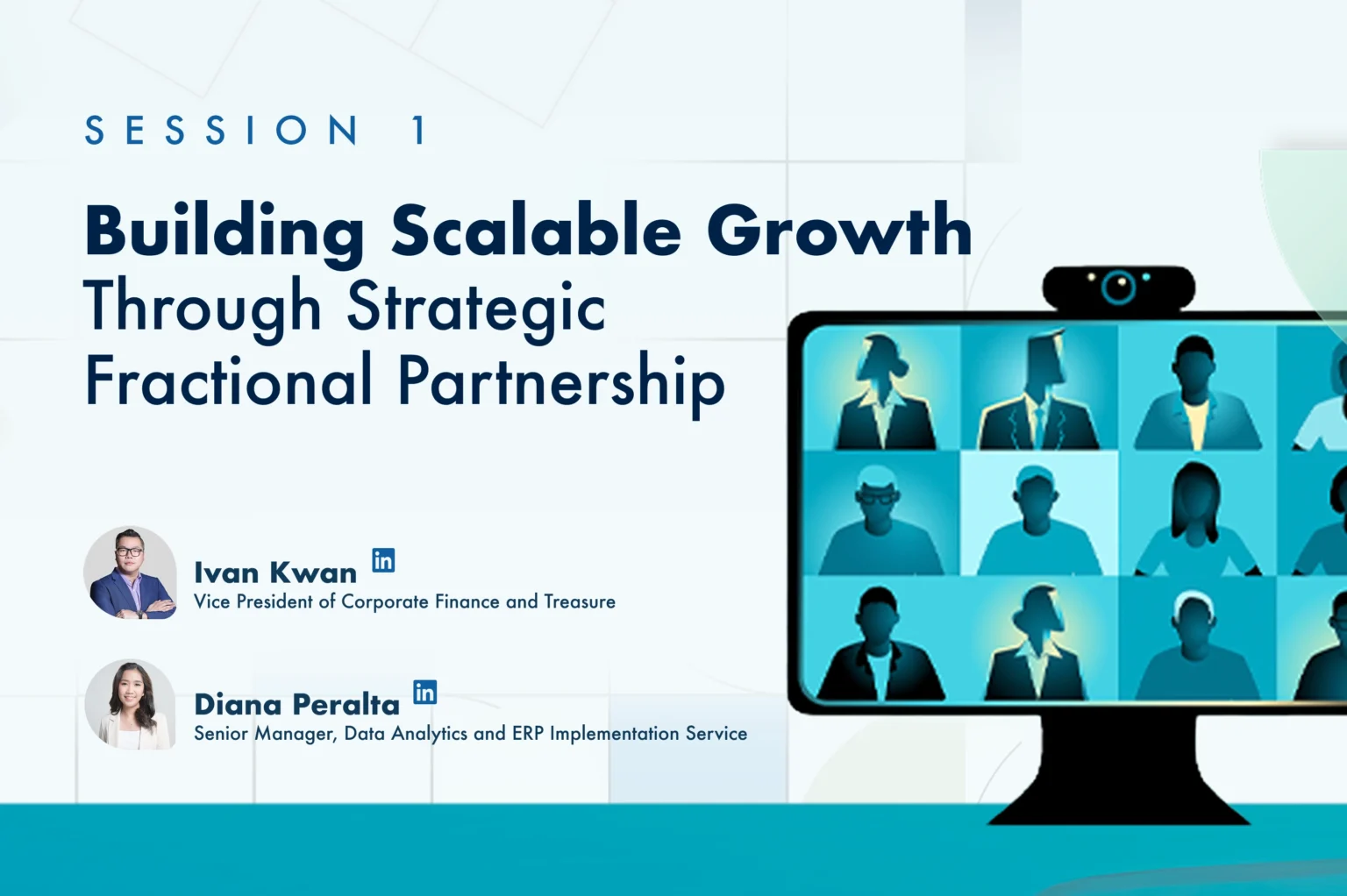
SESSION 1: Building Scalable Growth Through Strategic Fractional Partnership

Diana Marie Peralta

Diana Marie Peralta

Senior Manager, Data Analytics and ERP Implementation Services

SESSION 1: Building Scalable Growth Through Strategic Fractional Partnership

How Adapture Renewables Built Scalable Growth with Strategic Fractional Partnership

How do you keep operations ongoing… while doing a deep audit endeavor?

This was the critical question facing Ivan Kwan, VP of Corporate Finance at Adapture Renewables, as his company began to scale. It’s a classic high-growth dilemma: the core business is moving at top speed, but the finance team is stretched thin, facing strict deadlines and budgetary constraints.


In our recent “The Future is Fractional” virtual conference, Ivan sat down for a candid fireside chat with Diana Peralta from Scrubbed to share his playbook for solving this exact problem. He detailed how he moved from handling the company’s first audit by himself to building a scalable, resilient finance function through a strategic fractional partnership with Scrubbed.


If your business is struggling to balance growth and resources, here are the key highlights from his session.


How Adapture Renewables Built Scalable Growth with Strategic Fractional Partnership

Rectangle 897 768x392

This was the critical question facing Ivan Kwan, VP of Corporate Finance at Adapture Renewables, as his company began to scale. It’s a classic high-growth dilemma: the core business is moving at top speed, but the finance team is stretched thin, facing strict deadlines and budgetary constraints.


In our recent “The Future is Fractional” virtual conference, Ivan sat down for a candid fireside chat with Diana Peralta from Scrubbed to share his playbook for solving this exact problem. He detailed how he moved from handling the company’s first audit by himself to building a scalable, resilient finance function through a strategic fractional partnership with Scrubbed.


If your business is struggling to balance growth and resources, here are the key highlights from his session.


Building Trust with an Incremental Strategy

For leaders worried about a “loss of control,” Ivan detailed his deliberate, incremental strategy for engaging a fractional team. Instead of going all-in, Adapture Renewables started with hiring people from Scrubbed for foundational tasks like bookkeeping (AP/AR). This allowed them to build confidence in the process and establish approval workflows that maintained control.


This approach also opened the door to an unexpected benefit: the ability to “sample a buffet” of services. As Ivan explained, they could engage specialized expertise, like ESG reporting or technical tax, for a one-off engagement without having to hire a full-time, niche expert.


Integration is a Mindset, Not a Memo

I looked at the fractional staff as our staff, just housed elsewhere.

The session’s most powerful insights centered on how to make a fractional partnership work. For Ivan, success came from a crucial mindset shift. Ivan warned against treating fractional teams like “a 1-800 number… a black box you call.”


The key, he said, was a crucial mindset shift:


This meant investing in integration through frequent communication and, most importantly, face-to-face time. Ivan admitted he didn’t visit the Scrubbed office until 2022, already four years into the partnership. When talking about his experience, he shared that “I would often tell that in that 10 days or so, I felt more connected with the team than in the prior four years combined”


Achieving Flawless Compliance and Tech Adoption

The move paid off. When asked about the measurable impact, Ivan pointed to two key outcomes:

  • Flawless compliance:
    The session’s most powerful insights centered on how to make a fractional partnership work. For Ivan, success came from a crucial mindset shift. Ivan warned against treating fractional teams like “a 1-800 number… a black box you call.”
    The key, he said, was a crucial mindset shift:
  • Tech adoption:
    The fractional team, already adept with tools like Zoom, Slack, and Asana, helped speed up Adapture’s own tech adoption. When the pandemic hit, it “was not adopting something new or novel,” Ivan explained. “It was just scaling up what we already had, the ecosystem we already had with the Scrubbed team.”

Watch the Full Session

Ivan’s story is a masterclass in how to strategically leverage fractional talent to not only manage growth but also to build a more resilient and efficient operation.


To get all the insights, including Ivan’s advice on the single best role to start with and his hindsight on what he would do differently, you can watch the full session recording. 


GET YOUR ON-DEMAND ACCESS

Related Content

Blogs

Securing Your Web Applications: Understanding and Preventing Broken Access Control

Securing Your Web Applications: Understanding and Preventing Broken Access Control

Introduction Broken Access Control (BAC) might sound like a minor issue, something easily spotted, but it’s actually one of the most frequently overlooked security flaws. While many focus on threats like Remote Code Execution (RCE) or Cross-site Scripting (XSS), BAC silently allows unauthorized users to perform actions they shouldn’t, often without any complex attack. A simple forgotten backend check can lead to sensitive data exposure or elevated permissions, just by slightly modifying the target web address. In this post, we’ll walk through how you can test for Broken Access Control using Open Worldwide Application Security Project (OWASP) Juice Shop—an intentionally vulnerable web application that makes it easy (and safe) to demonstrate these issues in practice. Understanding Broken Access Control Access control directs who can do what in a system. When it’s broken, users can act outside their intended permissions. Users might be able to read other users’ data, modify other roles, or access administrative functionality without authorization. OWASP defines this category broadly and it includes: Vertical privilege escalation: Accessing higher privilege functions (e.g., a user accessing admin functions). Horizontal privilege escalation: Accessing same role resources (e.g., viewing another user’s order). IDOR (Insecure Direct Object Reference): Accessing data by manipulating object references like user IDs or filenames. Forced browsing: Accessing hidden resources or unlinked pages directly. While it might be hard to understand these concepts at first, Juice Shop does a great job showcasing these problems in a safe, intentionally vulnerable playground. Testing for Broken Access Control For this simulation, you will need to install Juice Shop in your local environment and use Burp Suite to capture traffic while interacting with it.Gaining Privileged Access Juice Shop is a deliberately vulnerable web application that exhibits the classic Forced Browsing and Vertical Privilege Escalation vulnerability. Imagine if someone could access admin functions by just visiting a URL; that would be a security nightmare. Fortunately, we can demonstrate this in Juice Shop without the risk. You can test this by attempting to access hidden resources or unlinked pages directly using keywords such as “admin,” “root,” or other common path names in the URL. In our case, the Administration page can be accessed by visiting the “/#/administration” path. This page was not linked anywhere in the standard UI, yet entering the URL directly allowed full access to the user listing and the ability to remove customer feedback.Note that this vulnerability is accessible if you are already logged in or tagged as an admin role user inside OWASP Juice Shop. However, given that this is hidden in the user interface even if you log in as an admin user, we can infer that it was not meant to be exposed to users (including admin users). In some real-world scenarios, some web applications allow access to the affected endpoint to all users as long as they enter the correct address. But you’re probably curious how we can access this page using a regular, low-privileged accountFirst, inspect how the authentication works. Upon logging in, a token will be sent to your browser and subsequently attached to every HTTP request made to Juice Shop.At this point, you will have to study JWT, but let’s assume that you already know it. What do you think would happen if we change the JWT role parameter or claim to something else, like “admin”?You guessed it right. Modifying the JWT and changing it to “admin” allowed us to access the “/#/administration” page while logged in as a regular user. All you need to do is use Burp Suite’s JWT Editor extension, modify the role parameter or JWT claim to “admin,” go to your browser’s local storage, and replace the token key with the modified JWT, and Voila! You now have access to the Administration page even as a regular user.Viewing and Tampering Another User’s Basket This is an example of Insecure Direct Object Reference (IDOR) and Horizontal Privilege Escalation. Imagine if you have an e-commerce site and anyone can add or delete items in another user’s shopping cart. That would leave your customers confused. To test this vulnerability, log in as a regular user and inspect HTTP requests and responses related to user basket actions. In Burp Suite, notice that visiting your own basket generates a “GET /rest/basket/6” request to Juice Shop. Immediately, you can see from that request that our basket has an ID of “6.” Out of curiosity, if we change the basket ID to another number, will we be able to access other users’ baskets? It turns out we can. There are a couple of ways to test this, but by going to the browser’s Developer Tools > Storage > Session Storage, we can see a “bid” parameter. Modifying it to another number, in our case “3,” and refreshing the page would let us access basket #3—with no ownership check, just the data. This is an example of a horizontal IDOR vulnerability, where users at the same privilege level can access each other’s data by simply modifying object references.Alternatively, the details for basket #3 can also be accessed by repeating the original HTTP request in Burp Suite and modifying the ID to “3”.We were able to see the details of the other user’s basket, but how do we tamper with it? Let’s go back to Burp Suite and study the HTTP request and response flow. Notice that, besides viewing your own basket, adding items to our basket requires a “BasketId” parameter. This is the key to the attack. What if we modify the “BasketId” before sending the request? Will we be able to modify another user’s basket successfully? The short answer is yes, but it is not as easy as it sounds. But before we do the attack, we have the following in basket #3. Remember, our basket is basket #6.Now, let’s modify the “add to basket” request and change the “BasketId” to a different number. However, you will notice that trying to change it won’t modify the basket content of our target.So, what should we do? There are many things you can try, but to cut a long story short, you might discover that adding a second “BasketId” would push the request and modify our target’s basket as well.This tells us that if the backend interprets the requests, and if it finds another “basketID,” it will apply the same action to it. Do you see where I’m going with this? Perhaps adding more “basketID” values would enable a multi-basket attack, but I will leave that for you to try. This means that ignoring access control measures can lead to numerous issues in your web application, potentially affecting multiple accounts by disclosing sensitive information or, as in our case, the contents of a user’s basket. Forged user reviews In Juice Shop, as with almost every e-commerce site, users are allowed to write and submit reviews. This generally benefits both the store owner and enhances the overall user experience. But what if someone could forge a user review? What if a customer review was written and attributed to someone else, perhaps a high-profile user of the site? That would greatly affect the product’s performance, right? This is what we wanted to achieve here: post a user review and attribute it to a different user. Now, you’ll notice that whenever you write and submit a product review, this PUT request is sent.Remember our previous attack that affected another user’s basket? How about the attack where we found the admin email address (see Gaining Privileged Access)? Let’s test that. What would happen if we modify the author before sending it to the endpoint? Would that change the author itself? Let’s see.And what do you know, we were able to post a review using a different user! And we can confirm that by browsing the exact product in the web application.So, the lesson here? Yes, broken access control also helps attackers forge account actions. Directory enumeration and restricted file download One common pitfall of improperly implemented access control is that restricted directories and their included files become accessible for download. This vulnerability is often found in applications rushed to production or those that don’t undergo regular security testing. While this may be harder to find in the real world today, this vulnerability still exists in some web applications. But fret not, Juice Shop exhibits this weakness. If you’ve explored Juice Shop before, you might have stumbled upon various directories, including the `/ftp/` directory. You’ll notice that accessing this directory reveals a number of files without requiring any additional authentication. You can even access some of the files enumerated.Clearly, some of these files are not intended to be accessed, which in itself indicates an access control violation. If you further explore the directory, you’ll discover that attempting to access files with extensions other than “.md” or “.pdf” results in a restriction notification. As curious individuals, we’ll want to bypass this. Fortunately, Juice Shop is vulnerable to null-byte injection.Null-byte injection is essentially an implementation-related vulnerability stemming from a weakness in the framework, underlying library, logic, or a combination of all these three. To perform a null-byte injection, we need to append a null-byte (`%00`) to the filename, hoping that the application won’t sanitize our request.Initially, adding `%00` to the end of the URL might not yield results, perhaps because the server expects a valid file extension. To address this, let’s append a `.pdf` extension.Still not working, right? Perhaps something is blocking our request. Let’s see if encoding will help us get through. Let us encode % and see what happens.Well, what do you know, it works! Now we can access the restricted file and see its content. Clearly this is a violation of access controls. How to Prevent Broken Access Control? If you’re building or maintaining web applications, Broken Access Control (BAC) is one of the most important risks to address. Here’s what you can do to avoid the issues above: Enforce Access Controls on the Server Side Don’t rely on client-side code or hidden links. Every sensitive operation should include server-side checks against the user’s authenticated identity and role. Use Context-Aware Authorization and Centralize Access Control Logic Implement logic that not only checks the user’s role but also whether the user owns the resource in the specific transaction context. For example, confirm “user.id == order.ownerId” before returning order data. Centralize your authorization logic into a single reusable library or service. This ensures that robust authorization rules are applied consistently. This also simplifies maintenance.Adopt a “Deny by Default” and Least Privilege Principle Don’t assign admin rights unless explicitly needed. Make roles granular and restrictive by default. Implement Indirect and Unpredictable Resource Identifiers Use randomly generated identifiers like UUIDs/GUIDs. Implement an indirect reference map that translates a public identifier to a real database ID only after the authorization check has passed. Apply Rate Limiting and Throttling Apply rate limiting to endpoints, especially to sensitive ones such as authentication and data access, to slow down attackers trying to bruteforce identifiers Block IPs or users that exhibit anomalous behavior or exceed reasonable request thresholds Implement a Secure Development Lifecycle (SDLC) Include security unit tests and access control checks as part of your CI/CD pipeline. Use test accounts with varying roles to test for both vertical and horizontal privilege escalation. Monitor and Log Access Violations Set up alerts for unusual access patterns or repeated unauthorized attempts. Log every access control failure, including the user, IP address, and specific resource they are trying to access. Perform regular security assessments Perform regular Web Application Penetration Tests (VAPT) against your web applications. Engage qualified professionals to perform penetration testing at least annually or after any significant changes to the environment. Final Thoughts Broken Access Control topped the OWASP Top 10 list for a reason: it’s one of the most common and dangerous issues that plague web applications. While OWASP Juice Shop is intentionally vulnerable, the lessons it teaches are very real. If you are a developer, product owner, or cybersecurity professional, the insights from Juice Shop offer a humbling reminder of why access controls must be built defensively and verified thoroughly. Looking for support to assess your web applications? If your goal is to get a real-world, adversarial assessment of your security posture, including your access controls, Scrubbed can help you perform Web Application Penetration Testing. We can test Broken Access Controls and other vulnerabilities to help you secure your applications. Not your cup of tea? We also offer other information security related services such as IT audit, Security Awareness Training, and SOC assessment support. Get started in securing your organization. Contact us at https://content.scrubbed.net/contact-us/ (Risk Advisory).

Read More >
Blogs

The Ink is Final: Why Technical Accounting Can’t Wait Until the Deal is Done

The Ink is Final: Why Technical Accounting Can’t Wait Until the Deal is Done

At A Glance Technical accounting review shouldn’t be a post-mortem. Whether it’s a financing round, a complex revenue contract, a licensing agreement, or other significant contracts, the accounting outcome is locked the moment the agreements are signed. A single clause on down-round protection, redemption, or variable share settlement can reclassify a capital injection as a liability under ASC 480 or ASC 815. For SEC-listed companies relying on those proceeds to meet equity thresholds, review timing determines the outcome. In SEC reporting and technical accounting, there is a distinct line between what we can advise on and what we simply have to record. That line is a signature. A few years ago, we were working with a publicly listed client in the life sciences sector. Like many companies in this industry, their core challenge was capital. They were deep into Research & Development, which meant they were pre-revenue but burning through cash. To fuel their operations, they were actively engaging in complex financing transactions. But as a publicly traded company on the US SEC, their pressure was both operational and regulatory. To maintain their listing, they were required to meet the equity threshold requirement. This is where the issue became clear. The Risks of Addressing Accounting After the Deal The client was finalizing their financing contracts, signing on the dotted line, and then handing the agreements over to our technical accounting team to record. Under US GAAP, financing transactions are not always classified as equity. Depending on the nuance of specific clauses, such as down-round protections, redemption features, or settlement in a variable number of shares, a capital injection intended to bolster the balance sheet can inadvertently trigger classification as mezzanine equity or a liability under ASC 480 or ASC 815. By the time the contracts reached my desk, the agreements had already been finalized. If the legal terms dictated a liability classification, the accounting treatment was path-dependent, meaning the legal form had already dictated the financial substance. For a company relying on that specific transaction to boost its equity and maintain its SEC listing, an unexpected liability classification poses a significant financial and regulatory risk. They were risking delisting not due to a lack of capital, but due to the specific syntax of their contracts. The issue wasn’t the accounting itself, but when the accounting was being applied: they were bringing us in too late in the process. Related: How Biotech Firms Prepare Financials for IPO Shifting Accounting Earlier in the Process We raised this issue with the management team and suggested a fundamental change to the workflow: shifting our involvement to before the contracts were finalized. By reviewing the agreements while they were still in draft form, we transformed our role from reactive reporters to proactive advisors. Instead of assessing the impact after the fact, we identified the exact triggers, the “indexation” or “settlement” traps, that would dictate equity vs. liability treatment. This allowed their leadership team to make an informed, strategic judgment. They could choose to tweak the key terms of their agreements to ensure the final contracts aligned with their financial goals and regulatory compliance. Of course, moving up the timeline introduced a new pressure: speed. Draft contracts in the middle of a financing round require immediate turnarounds. But because we had been working with this client since 2020, originally helping them remediate material weaknesses and control deficiencies reported by their auditors, we knew their business inside and out. We understood their historical transactions, their operational goals, and the specific mechanics of their industry. That deep familiarity allowed us to execute complex technical assessments rapidly, without slowing down their deal momentum. Designing the Future, Not Recording the Past Today, that client remains successfully listed. The control deficiencies that plagued their early audits are a thing of the past, and their Internal Controls over Financial Reporting are clean. When I look back on the evolution of this engagement, it reinforces a fundamental truth about our profession. Trust is not built by simply fulfilling the scope of work. It’s built by identifying the root cause of a client’s anxiety and taking ownership of the outcome. When a client views you as an outsourced vendor, you are just there to record their history. But when you operate as an integrated partner, you help them design their future. Compliance and technical accounting are most effective when addressed early in the process. When positioned correctly, they are the architectural foundation that keeps a growing business secure. Related: Scaling Financial Operations in Life Sciences and Biotech with Fractional Teams Key Takeaways Financing transactions are not automatically equity. Specific clauses such as down-round protections, redemption features, or variable share settlement can trigger liability classification under ASC 480 or ASC 815.For SEC-listed companies, an unexpected liability classification can put exchange listing requirements at risk. The exposure comes not from a lack of capital but from the syntax of the contracts.Once contracts are signed, technical accounting becomes path-dependent. The legal form has already dictated the financial substance. Reviewing agreements in draft form lets leadership adjust key provisions before execution, aligning the final contract with financial goals and regulatory requirements. The earlier technical accounting enters the process, the more strategic its value. Late involvement records history. Early involvement shapes the future.

Read More >
Blogs

Scaling Financial Operations in Life Sciences & Biotech with Fractional Teams

Scaling Financial Operations in Life Sciences & Biotech with Fractional Teams

Life sciences and biotech companies are increasingly seeing challenges in funding, resource management and compliance that affect their ability to succeed. In a recent webinar co-hosted by California Life Sciences and Scrubbed, our expert panel shared their insights on what is shaping financials in life sciences and biotech and how a fractional finance and accounting model can help firms grow without sacrificing quality or compliance. Industry Challenges The life sciences sector faces significant financial hurdles, particularly in funding and development costs. Access to Capital: According to Ismaila Sougoufara, Chief Accounting Officer, and Finance VP for Jaguar Health, “Venture capital funding dropped by 46% between 2021 and 2024,” making capital acquisition much more competitive. Gliezel David, Director of Technical Accounting Services at Scrubbed, pointed out that it is more important than ever for firms to develop “careful strategies to secure funding, identify the right partner, build that partnership and negotiate deals effectively.” This often requires specialized expertise such as technical accounting support to ensure accuracy during complex transactions. R&D Costs: The lengthy drug development process, from finding and enrolling patients to carrying out clinical trials, often means it can take a decade or more to bring a new product to market. Gliezel’s opinion is that firms need a strong team that can handle both the scientific and operational sides, including financial planning and monitoring. “Accurate accounting of transactions is crucial even at the initial stages of starting a company or a project,” she advised. Regulatory Compliance: “Keeping up with these rules is not just a box to check: It’s a must for getting products approved onto the market,” said Gliezel. “An effective risk management plan is key to staying in compliance, and failing to do so can lead to expensive penalties, delays, and damage to the company’s reputation.” How Fractional Finance Teams Can Help Fractional finance teams can provide valuable support and enhance in-house capabilities by offering tailored solutions, especially for small to mid-size biotech and life sciences companies. Cost-effective Expertise: A key advantage of fractional teams is their cost-effectiveness, especially in competitive markets. “If you are in California, biotech talent is extremely scarce,” said Ismaila. “Finding talented people comes at a very high cost.” Kevin Musni, Scrubbed’s Accounting Lead for the biotech and life sciences industries added, “Fractional support opens the door to the world; you can access talent from everywhere.” Because of this wider talent pool, fractional teams allow firms to access specialized knowledge at a fraction of the cost of full-time hires. Specific Expertise For Different Project Phases: A fractional finance team can bring specific expertise required for various phases, such as financial modeling help when accounting for a complex transaction or support for raising investor capital. This is especially valuable in industries like real estate, where tailored real estate accounting solutions can address project-specific financial needs. Companies can access the necessary high-level financial skills on demand without the long-term commitment of hiring full-time staff for whom there isn’t a permanent need. Scalable Solutions: The ability to access financial skills on demand allows firms to scale operations up and down as needed and focus internal resources on core activities. “Engaging a fractional finance team is a strategic decision,” said Gliezel. “By outsourcing finance functions, a company can concentrate and focus on their core activities, including drug development, clinical trials and regulatory approval.” This strategy also allows firms to pivot quickly to adapt to rapid changes in the market, outcomes of clinical trials, and changes in the regulatory environment without compromising quality or increasing costs. Success Story: Jaguar Health Jaguar Health’s experience with fractional finance teams demonstrates a compelling success story in the biotech sector. When their Chief Accounting Officer, Ismaila, inherited the partnership with Scrubbed, he had the option to move operations in-house a year later. However, the quality and value provided convinced him to maintain the fractional relationship. Working with Scrubbed, Jaguar Health transformed its financial reporting from below-average standards to SEC-equivalent quality across all levels. The relationship gradually expanded to include technical memo preparation, transactional support, tax services, and corporate finance functions. This comprehensive support enabled the company to focus more on strategic vision while improving operational excellence. The success of the partnership hinged on the Scrubbed team’s commitment to quality, accountability, and timely delivery. The fractional team provided consistent support and maintained operational stability even during internal staff turnover. This human capital aspect proved crucial, as the team demonstrated not just technical expertise but also a deep commitment to Jaguar Health’s goals and vision, going beyond traditional consultant relationships to become a true strategic partner. Forward-looking Trends and Predictions The industry is evolving with several key developments, particularly in AI and automation. As Ismaila emphasized: “AI is just the tool… companies need to start assessing right now… how they can implement AI right now as part of what I call IA – innovative automation”. Data visualization tools also help streamline the analytics process, bringing visibility to the patterns behind the data and enhancing financial analysis. Advances in Blockchain are making data security and transparency easier to maintain. Fractional finance teams will often have experience with different systems and how those systems interact and help firms create automated processes. How to Make the Most of Partnering with a Fractional Financial Team The success of fractional teams depends heavily on finding the right partner. According to Ismaila, “The most important part in being able to succeed is human capital… committed to quality, committed to accountability.” Start Early: Kevin stressed the importance of early financial planning: “It’s really important to set a solid financial foundation at the very beginning of the life of biotech and bioscience company because sometimes we tend to focus too much of our resources in the R&D forgetting that finance is something that’s going to help you get to the finish line.” The key is to start by defining the firm’s needs, whether that’s day-to-day bookkeeping, financial reporting, or tax compliance, and evaluating the experience of potential providers in meeting those needs. Start Small: Ismaila’s experience is that you can overcome fears about working with a fractional team and build a successful relationship by starting small. “For those who are reluctant to start hiring fractional support, you could hire gradually, start small, and then scale,” he said. “Find a fractional partner willing to provide a trial period that would not lock you in.” Think Strategically: The emphasis should be on sustainable practices that will help the company grow. “Ethical sourcing and patient access programs are important for ensuring fairness and responsibility,” said Gliezel. Integrating accurate sustainability and ESG reporting will also support the company’s goals. Following these tips will help firms find the right fractional team that can help the business control costs, tap into specialized knowledge, and streamline compliance. “Finding the right partner is super important, especially when it comes to complex accounting tasks that often pop up in this industry,” said Gliezel. Get Started with Your Fractional Finance Team, Fractional finance teams offer a strategic solution that combines expertise, flexibility, and scalability for life sciences and biotech companies who want to stay competitive while managing costs. The key lies in finding the right partner who understands industry-specific challenges and can deliver consistent quality.

Read More >

Contact Information

SF Bay Area Headquarter
111 Anza Boulevard, Suite 320, Burlingame, CA 94010, United States

Phone: (800)837-5160
Email: [email protected]

"Scrubbed" is the brand name under which Scrubbed Advisory, LLC and Scrubbed Assurance LLP provide professional services. Scrubbed Advisory, LLC and Scrubbed Assurance LLP practice in an alternative practice structure in accordance with the AICPA Code of Professional Conduct and applicable law, regulations, and professional standards. Scrubbed Assurance LLP is a licensed independent CPA firm that provides attest services to its clients, and Scrubbed Advisory, LLC provides tax, finance, and support services to its clients. Scrubbed Advisory, LLC is not a licensed CPA firm.

Copyright © Scrubbed. All rights reserved.