
The Extension and Phase-down of Investment Tax Credits for Cleantech

Esfer John Pamintuan

Senior Manager, Tax

The Extension and Phase-down of Investment Tax Credits for Cleantech
Traditionally, the Investment Tax Credit (ITC) for cleantech businesses has operated as a government-backed financial springboard designed to lower the upfront costs of adopting sustainable technologies. It’s a reimbursement program in which businesses receive a direct reduction in their federal tax bills—equivalent to a percentage of their capital investments in qualifying clean energy projects.

For decades, this incentive has targeted specific technologies like solar panels, wind turbines, and geothermal systems, effectively refunding a meaningful percentage of eligible expenditures to accelerate adoption. This targeted approach has been foundational in scaling renewable energy infrastructure.

However, the landscape of clean energy tax incentives is undergoing a significant transformation thanks to the Inflation Reduction Act of 2022. According to the EPA, Starting January 1, 2025, the Inflation Reduction Act replaces the traditional PTC with the Clean Energy Production Tax Credit (§1 3701) and the traditional ITC with the Clean Electricity Investment Tax Credit (§ 13702).

These tax credits are functionally similar to the ITC/PTC but are not technology-specific. The IRA has extended the PTC and ITC, introduced new provisions, and created sections 45Y for PTC and 48E for ITC, including additional provisions for clean energy investments.

In this article, we’ll cover the changes that affect Investment Tax Credits (ITC). Information about the changes to Production Tax Credits can be found in the companion article The Extension and Phase-down of Production Tax Credits for Cleantech

Key Changes and Extensions in the Investment Tax Credit


The following are key changes in the ITC that cleantech businesses need to be aware of, along with actions that companies can take to prepare for the introduction of the new credit:
1. Extension of Transition Processes:
  • Notice 2024-84: This notice extends the transition process for claiming statutory exceptions to the elective payment phaseouts for clean energy projects that fail to satisfy domestic content requirements. The deadline for beginning construction has been extended to January 1, 2027, or until further guidance is issued.
  • Action:
  • Submit Attestations: Ensure that attestations regarding the Increased Cost Exception and the Non-Availability Exception are submitted for projects beginning before the new deadline. These attestations must be signed by a person with the legal authority to bind the entity in federal tax matters and attached to the relevant forms (e.g., Form 8835, Renewable Electricity Production Credit; Form 3468, Investment Credit).
2. Beginning of Construction Requirements:
  • The Physical Work Test and Five Percent Safe Harbor: To establish the beginning of construction, businesses can either begin physical work of a significant nature or pay/incur 5% or more of the total project cost.
  • Action:
  • Document Construction Activities: Maintain detailed records, including contracts, physical work certificates, photographic evidence, and engineering reports to substantiate the beginning of construction before the deadline.
  • Meet Continuity Requirements: Ensure continuous efforts or progress towards completion once construction has begun. Projects must be placed in service by the end of the year that includes the fourth anniversary of the construction start date.
3. Domestic Content Requirements:
  • IRS Notices 2023-38 and 2024-41: These notices provide guidance on the domestic content bonus credit requirements, including classifying project components and calculating domestic cost percentages.
  • Action:
  • Elect Safe Harbors: Consider using the New Elective Safe Harbor to classify project components and calculate domestic cost percentages. This safe harbor simplifies compliance by providing predefined cost percentages for various components.
  • Certify Compliance: Submit a Domestic Content Certification Statement with the relevant tax forms to certify that the project meets the domestic content requirements.
4. Energy Community Bonus Credits:
  • The Inflation Reduction Act allows for increased credit amounts or rates if certain requirements pertaining to energy communities are satisfied. There are three categories of energy communities:
  • Brownfield sites
  • Certain metropolitan statistical areas and non-metropolitan statistical areas based on unemployment rates (MSA/non-MSA)
  • Census tracts where a coal mine closed after 1999 or where a coal-fired electric generating unit was retired after 2009 (and directly adjoining census tracts)
  • Action:
  • Identify Eligible Locations: If your project is located in an energy community, you might qualify for extra tax credits.
  • Document Eligibility: Maintain records to substantiate the project’s location in an energy community, including maps, employment data, and local tax revenue information.
5. Prevailing Wage and Apprenticeship Requirements
  • The prevailing wage requirements of the IRA provide that taxpayers must ensure that all laborers and mechanics employed by the taxpayer (or any contractor or subcontractor) on the construction, alteration, or repair of a qualified facility are paid wages at rates that are not less than the prevailing rates determined by the Department of Labor.
  • The apprenticeship requirements of the IRA include three components — a labor hours requirement, a ratio requirement, and a participation requirement. Under the labor hours requirement, the taxpayer must ensure that a minimum percentage of the total labor hours performed on the construction, alteration, or repair of a facility are performed by qualified apprentices from a registered apprenticeship program.
  • Action:
  • Ensure Compliance with Wage Rates: Verify that laborers and mechanics are paid wages at rates not less than the prevailing rates for construction, alteration, or repair in the locality as determined by the Secretary of Labor.
  • Meet Apprenticeship Requirements: Ensure that a specified percentage of total labor hours are performed by qualified apprentices and that the project complies with apprentice-to-journey worker ratios.
  • Maintain Records: Keep detailed records of wage payments and apprenticeship participation to demonstrate compliance with these requirements ​.
6. Direct Pay and Transferability
  • As part of the IRA’s overhaul, direct pay is now available for tax-exempt entities, such as state and local governments, rural electric cooperatives, and tribal communities. This allows these entities to claim ITC without needing to pay taxes. Additionally, businesses can transfer their credits to other taxpayers (e.g., investors), improving liquidity and financing options​.

ITC Transitions to Zero-emission Provisions

The introduction of zero-emission provisions in 2025 will significantly change how ITC operates compared to the current system. Here are the key differences:
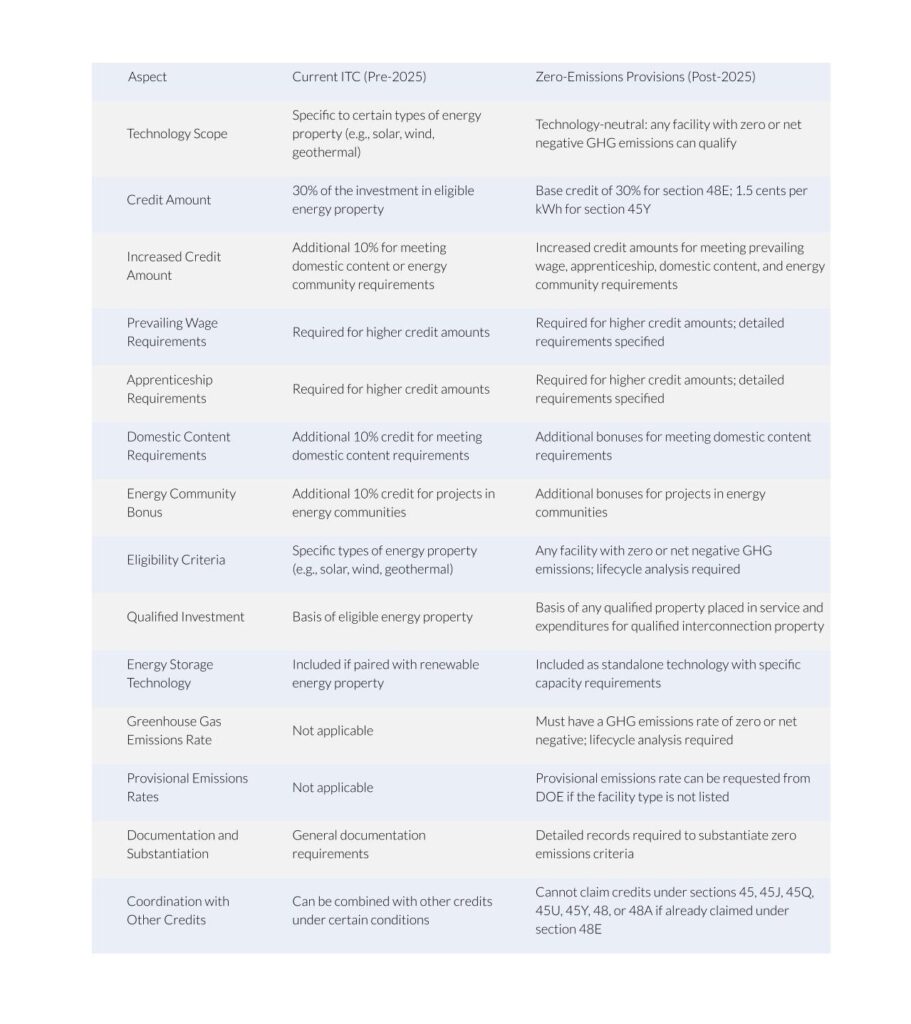
ITC table 911x1024

Technology-Neutral Framework

Starting in 2025, the system will transition to a technology-neutral model. This new framework focuses on zero-emission facilities rather than specific technologies. Projects must demonstrate zero greenhouse gas emissions to qualify, with special provisions for facilities using combustion or gasification technologies.

Impact Across Sectors

Energy Production
  • Eligibility for Credits: Energy production businesses must ensure their facilities have a greenhouse gas (GHG) emissions rate of zero to qualify for the clean electricity investment credit. This includes facilities that generate electricity through combustion or gasification, which must account for lifecycle GHG emissions as described in the Clean Air Act.
  • Expansion and Incremental Production: Businesses can expand existing facilities or add new capacity to qualify for the credits.
  • Credit Phaseout: The credit phaseout begins in the later of either 2032 or the year in which the Secretary determines that annual GHG emissions from electricity production in the U.S. are equal to or less than 25% of the 2022 levels.
Waste Management
  • Carbon Capture and Sequestration: Waste management businesses involved in energy production through waste-to-energy processes must ensure that any GHG emissions are captured and sequestered to meet the zero-emissions requirement. Section 45Y(b)(2)(D) specifies that GHG emissions do not include any qualified carbon dioxide that is captured and disposed of in secure geological storage or utilized in a manner described in section 45Q.
  • Lifecycle Emissions: For facilities producing electricity through combustion or gasification, the GHG emissions rate must account for lifecycle emissions, which include emissions from feedstock generation or extraction through the point of production.
Electric Vehicle (EV) Manufacturing
  • Supply Chain and Critical Minerals: EV manufacturers are impacted by the requirements for critical minerals in battery production. Section 45X(c)(6) outlines the need for critical minerals to meet certain purity levels, and manufacturers must ensure that these minerals are sourced and processed in compliance with the statutory requirements.
  • Consumer Education and Market Impact: The transition to new credits under sections 45Y and 48E may require consumer education to help buyers understand how these credits affect their purchase decisions. This is particularly relevant for EV manufacturers who need to communicate the benefits of the credits to potential customers.

Opportunities for Cleantech Companies

The new production and investment credits significantly enhance project valuations and financial viability. The ability to transfer credits or receive direct payments provides additional flexibility for project financing.
  • Increased Investment in Clean Technologies: The broad applicability of the credits to various clean technologies can drive increased investment and innovation in the sector, providing opportunities for businesses to develop and deploy new clean energy solutions.
  • Expansion and Retrofitting of Existing Facilities: The credits allow for expanding and retrofitting existing facilities to increase electricity production, which can be a cost-effective way for businesses to enhance their clean energy output.
  • Leveraging Bonus Credits: Projects located in energy communities, low-income communities, or on tribal land and those meeting domestic content requirements can benefit from additional credit amounts, making these projects more financially attractive.: Projects located in energy communities, low-income communities, or on tribal land and those meeting domestic content requirements can benefit from additional credit amounts, making these projects more financially attractive.


Looking Ahead How 

The phaseout of these credits is scheduled for 2032 or when U.S. electricity sector emissions fall by 75% from 2022 levels, whichever occurs later. Companies should plan their project timelines accordingly to maximize available benefits.
The transformation of clean energy tax credits represents a significant shift toward technology-neutral, emissions-based incentives. Success in this new framework requires careful planning, thorough documentation, and strategic positioning of clean energy projects.
Scrubbed Can HelpThis article outlines the changes and potential opportunities brought about by the new framework, but it isn’t comprehensive, and each business will have to evaluate its own eligibility for the revised credit. At Scrubbed, we have deep experience in the cleantech and renewable energy industries, as well as offering specialized biotech accounting services and fractional CFO services, and have helped clients establish a firm financial foundation and maximize credits and incentives.

Contact us to discuss how we can help your cleantech business prepare for the changes to the ITC with our SaaS accounting expertise.
Key TakeawaysInvestment Tax Credits (ITC) are Changing: Starting January 1, 2025, the traditional ITC will be replaced by the Clean Electricity Investment Tax Credit (§13702) and the Clean Energy Production Tax Credit (§13701). These new credits are technology-neutral and include additional provisions for clean energy investments.

Significant Changes and Extensions:
  • Extension of Transition Processes: The transition process for claiming statutory exceptions to the elective payment phaseouts for projects that fail to satisfy domestic content requirements has been extended. The deadline for beginning construction has been extended to January 1, 2027, or until further guidance is issued
  • Beginning of Construction Requirements: To establish the beginning of construction, businesses can either begin physical work of a significant nature or pay/incur 5% or more of the total project cost.
  • Domestic Content Requirements: New elective safe harbors simplify compliance by providing predefined cost percentages for various components.
  • Energy Community Bonus Credits: Increased credit amounts are available for projects in energy communities.
  • Prevailing Wage and Apprenticeship Requirements: Compliance with wage rates and apprenticeship participation is necessary for higher credit amounts.
  • Direct Pay and Transferability: Tax-exempt entities can now claim ITC without needing to pay taxes, and businesses can transfer their credits to other taxpayers, improving liquidity and financing options.
  • ITC Transitions to Zero-emission Provisions: Introducing zero-emission provisions in 2025 will significantly change how ITC operates compared to the current system across multiple aspects.
  • Technology-Neutral Framework: Starting in 2025, the system will transition to a technology-neutral model, focusing on zero-emission facilities rather than specific technologies.
  • Opportunities for Cleantech Companies:
  • Increased Investment in Clean Technologies: The broad applicability of the credits can drive increased investment and innovation in the sector.
  • Expansion and Retrofitting of Existing Facilities: The credits allow for expanding and retrofitting existing facilities to increase electricity production.
  • Leveraging Bonus Credits: Projects in energy communities, low-income communities, or on tribal land can benefit from additional credit amounts.
  • Looking Ahead: The phaseout of these credits is scheduled for 2032 or when U.S. electricity sector emissions fall by 75% from 2022 levels, whichever occurs later.
  • Further Guidance and Updates
  • Detailed Regulations and Guidance: The IRS and Treasury are expected to issue further detailed regulations and guidance on various aspects of sections 45Y and 48E, including the calculation of emissions rates, the specifics of the direct pay and transfer options, and the procedures for petitioning for provisional emissions rates.
  • Public Comments and Hearings: The IRS has requested public comments on the implementation of these credits and has scheduled public hearings to gather input from stakeholders. This ongoing dialogue may result in further refinement to the regulations.
  • Annual Updates to Emissions Rates: The annual publication of emissions rates for different facility types will be a critical component of the ongoing implementation of these credits, providing taxpayers with the necessary information to determine their eligibility


Sources:IRS Domestic Content Bonus Guidelines:

Related Content

Blogs

September 15 Estimated Tax Deadline: Strategies for Pass-Through Entities

September 15 Estimated Tax Deadline: Strategies for Pass-Through Entities

For growing pass-through entities, the September 15 tax deadline often creates a collision between cash flow and internal capacity. Guessing at estimated payments leaves companies vulnerable to IRS penalties or unnecessarily traps critical working capital meant for Q4 growth. By establishing a Safe Harbor floor and utilizing the Annualized Income Installment Method, companies can align tax outlays directly with actual revenue. When this execution is handled proactively, finance leaders stop playing defense against deadlines and reclaim their time for strategic planning. When a high-growth pass-through entity, such as an S-Corp or a Partnership, comes off an unexpectedly strong summer, revenue is up. This should be a moment for leadership to celebrate and plan their Q4 investments. Instead, the internal finance team often finds themselves staring down a cash crunch they didn't anticipate. The pressure point is September 15. For growing operations, this date is often a collision course. It is not only the deadline for Q3 estimated tax payments, but it is also the extended filing deadline for Forms 1065 and 1120-S . When you have an internal team trying to finalize the previous year's historical data while simultaneously projecting the current year's performance, the structure usually begins to strain. This isn't about a team dropping the ball. It's simply what happens when internal workflows haven't scaled up to match a company's growth. When two major deadlines collide, and the volume is too high, a stretched team has no choice but to improvise. The Cost of "Guesstimating" In a pass-through entity, the business itself generally does not pay federal income tax. Because income from partnerships and S corporations generally passes through to their owners, owners may need to make individual estimated tax payments based in part on their share of the entity’s taxable income When internal teams don't have a dedicated workflow for this, they often get bogged down trying to predict exact year-end profits during a busy quarter. Without a clear mechanism to manage this, I frequently see companies do one of two things: they either underpay and leave themselves vulnerable to IRS penalties, or they overpay to "be safe." Overpaying might feel like the responsible choice in the moment, but it unnecessarily ties up working capital. When these distributions are sized off gross revenue rather than a projection that accounts for deductions or state-level elections, the company pulls more cash out of the operating account than the owners actually owe. That excess traps liquidity that could have been used to fund critical Q4 growth initiatives—like a marketing push or inventory expansion—without seeking outside financing. Establishing an Estimated-Tax Safe Harbor  When our tax professionals step in to manage this process, the very first thing we do is establish a predictable foundation. We immediately build a "Tax Compliance Calendar" integrated with a "Safe Harbor Floor." A useful starting point is determining which estimated-tax safe harbor applies. For many taxpayers, one option is to base required annual payments on 100% of the prior year's tax, increasing to 110% for certain higher-income taxpayers. The current-year 90% test may also apply. Meeting the applicable requirements through timely payments can generally reduce exposure to estimated-tax underpayment penalties. Once that floor is established, we can adjust for the reality of the current year. Aligning Outlays with Actual Cash Flow If a company sees a massive spike in revenue during Q3, the standard installment method might demand a payment that creates a sudden cash flow imbalance. Good intentions won't balance the cash flow at this stage; you need a precise mathematical approach. To stabilize cash flow during a sudden revenue surge, one strategy to consider is the Annualized Income Installment Method . Instead of assuming income is earned evenly throughout the year, the Annualized Income Installment Method determines the owner's required installments based more closely on income earned during the applicable annualization periods State-level PTE tax elections may also provide federal tax benefits by allowing qualifying state income taxes to be paid and deducted at the entity level rather than being subject to the individual SALT deduction limitation. The result? Depending on the state's PTE tax regime, entity-level payments may reduce the state estimated-tax payments otherwise required from individual owners. A deductible PTE tax payment may also reduce the taxable income passed through to owners for federal purposes, which can affect their projected federal estimated-tax liability. Restoring Strategic Headspace When tax planning is handled consistently throughout the year, it changes how a leadership team operates. It can significantly reduce the risk of an "April Surprise." When Q3 estimates are calculated accurately and tied to a deliberate strategy, leadership knows exactly how much capital is truly theirs to spend. Tax shifts from a looming, unpredictable liability into a manageable line item. Just as importantly, the internal finance leader gets their time back. Instead of spending the first two weeks of September finalizing and issuing K-1s, calculating thresholds, and worrying about penalties, they can focus on high-level financial modeling and operational efficiency. A strong tax partner doesn't just run the numbers; they take the friction out of the process so your team can focus forward. When an experienced team handles the heavy lifting behind the scenes, you stop playing defense against IRS deadlines and start using tax strategy as a genuine tool to fund your growth. See how our tax professionals support growing operations and keep execution predictable. Let's talk through how we can support your finance function. Comparing Q3 Tax Strategies: Safe Harbor vs. Annualized Method vs. PTE Strategy Ideal for Primary Benefit Risk Level  100%/110% Safe Harbor  Rapidly growing companies  Provides protection from estimated-tax underpayment penalties when applicable safe-harbor requirements are satisfied  Low (May temporarily tie up cash if revenue drops)  Annualized Method  Seasonal or late-year spiking revenue Align tax outlays directly with timing of taxable income  Moderate (Requires meticulous record-keeping) PTE Tax Election Entities in high-tax states May provide an entity-level federal deduction for qualifying state income taxes while providing state tax benefits to eligible owners Low (Requires state-specific eligibility and election compliance) Key Takeaways: The Deadline Collision: The simultaneous timing of Q3 estimates and extended historical filings places severe strain on internal finance teams when workflows haven't scaled. The Cost of "Guesstimating": Overpaying estimated taxes based on gross revenue ties up liquidity that could otherwise fund critical Q4 growth initiatives without requiring outside financing. Building a Safe Harbor Floor: Establishing a baseline payment based on 100% or 110% of the prior year's tax liability can provide protection from estimated-tax underpayment penalties when the applicable safe-harbor requirements are satisfied. Aligning Cash Flow: The Annualized Income Installment Method stabilizes cash positions by calculating tax based on income earned during the applicable annualization periods rather than an arbitrary quarterly fraction. Restoring Strategic Headspace: When tax planning is handled reliably behind the scenes, internal finance leaders get their time back to focus on high-level financial modeling instead of chasing K-1s.

Read More >
Blogs

The ESG Translation Gap: Why Good Accounting Data Fails Sustainability Audits

The ESG Translation Gap: Why Good Accounting Data Fails Sustainability Audits

If I had to name the first common mistake I see growing companies make when they tackle ESG reporting, it is foundational: They don’t know if the data they are using is complete and accurate. More than that, they often don’t even know if it is the data they should be using. For years, ESG reporting was largely voluntary, a way to answer the public’s demand for accountability and show investors you were responsible. But as optional guidelines transition into emerging laws and requirements, the landscape shifts. Investors and regulators no longer want marketing campaigns. They want accurate data provided with assurance. This brings us to a harsh reality I share with teams newly subject to these regulations: If you are required to file a report in 2027 based on 2026 data, and you wait until 2026 to start preparing, you are already late. Leaders often assume their existing accounting systems are naturally ready to handle ESG reporting. They almost never are. The Illusion of Alignment I see leadership teams fall into this trap constantly. They look at their organizational chart, see a separate Finance team and a separate ESG team, and assume they are covered. But in practice, these two teams are working in silos, speaking entirely different languages. I see this pattern constantly with companies that have been publishing ESG reports voluntarily for a number of years. As they prepare for mandated regulatory reporting, leadership feels secure because their ESG team is getting the exact reports they requested from Finance. But the moment you dig into the architecture and bridge the two teams, the gaps become obvious. Here is how the breakdown usually happens: The Ask: The ESG team needs data to calculate emissions, so they ask Finance for certain reports. The Hand-off: Finance, wanting to be helpful, pulls the data and hands it over. The Gap: Finance teams are wired to be compliant with accounting standards, but they aren’t trained to understand ESG reporting. ESG teams are great at translating finance data into emissions, but they don’t have the concept of an audit. Because the ESG team didn’t have an audit background, they didn’t know how to establish completeness and accuracy. They didn’t know how to look for certain accounting transactions that would otherwise be considered emission or non-emissive (i.e., advance or duplicate payments, reversed entries in the vendor reports). They were running calculations on raw data. The people didn’t fail: the structure simply wasn’t built to translate between the two departments. The Reality of Retroactive Cleanup The true operational complexity of ESG reporting reveals itself when you try to force accounting data into sustainability buckets. Take something as standard as a growing portfolio of leased facilities. From a purely financial perspective, a company might have these perfectly recorded. But you cannot translate that 1:1 to ESG data. For ESG, you have to review the business structure to see who actually holds ‘operational control’ so you can assign those facilities to the proper emissions categories.. When a company’s data architecture isn’t set up for this level of granularity, teams are forced to go back and manually revisit hundreds of outstanding contracts. What should take a minute to encode upfront easily turns into a multi-month project just to find the proper data sources. When you wait to build the system, you force your teams to look backward instead of forward. What You Need to Check Today The fix is actively bridging the technical gap. You need professionals who can translate complex sustainability metrics into an accounting standard, and vice versa. If you are a CFO or sustainability leader reading this today, before making your next public ESG commitment, take a hard look at your architecture. Ask yourself these three questions: Are my on-book activities scoped properly? Check if all financial transactions have been mapped to the appropriate ESG requirement. Are my off-book activities accounted for? Ensure your people management, technology, and operational data are fully captured. Are all stakeholders involved? If ESG reporting is falling entirely on your Finance team, or solely on your ESG team without Finance’s oversight, you have a translation gap. Operations, HR, and Tech must understand the why and the how of the data they are providing. A calm, predictable reporting cycle is designed, never improvised. Build the data architecture a year or two before the regulations hit, and ensure your financial execution naturally supports confident sustainability reporting.

Read More >
Blogs

Sustainable Spaces: From Compliance to Commitment

Sustainable Spaces: From Compliance to Commitment

Climate change is a pressing issue, and the building and construction sector is a major contributor. A staggering 40% of energy-related CO2 emissions come from buildings, and, according to the UN Environment Programme’s 2022 Global Status Report for Buildings and Construction, the industry falls short of decarbonization targets, with CO2 emissions currently reaching new highs. From materials used to construction practices and daily operations, traditional methods take a toll on the environment. Sustainable building—architecture focusing on environmental responsibility—offers a solution. Looking for Innovative Solutions for a Rapidly Changing ESG Landscape? Click here! Building Green: A New Approach Sustainable design is about creating buildings that meet the needs of the present without compromising the ability of future generations to meet their own needs. Its key principles include: Eco-friendly materials: Responsibly harvested wood, recycled steel, and locally sourced materials reduce embodied carbon and transportation emissions. Innovations like carbon-neutral concrete further reduce environmental impact. Energy-efficient glasses in façades minimize heat gain and reliance on cooling and lighting. Passive & active design strategies: Passive strategies utilize natural elements for energy efficiency and comfort. Daylighting, natural ventilation, and well-insulated walls and roofs improve energy efficiency and resource optimization. On the other hand, active design utilizes technologies like solar panels and wind turbines to generate electricity, working alongside passive strategies for a more sustainable future. Water conservation: Rainwater harvesting systems, low-flow fixtures, and efficient irrigation minimize freshwater demand and water wastage, preserving resources and cutting costs. Sustainable Leaders Around the Globe Many companies are embracing sustainable practices, showcasing the power of green building. Some prominent examples are: Apple Park (Cupertino, California): Features one of the largest on-site solar installations globally, alongside natural cooling systems and extensive green spaces. Googleplex (Mountain View, California): Utilizes solar power, recycled water for irrigation, and a building management system that monitors energy use. Pixel Building (Melbourne, Australia): Australia’s first carbon-neutral office building boasts efficient daylighting, wastewater processing, and a recycled aluminum façade. Bank of America Tower (New York City, New York): Uses 32% less energy than a typical office tower. Abundant daylighting, district-chilled water for cooling, and a green roof prioritize energy efficiency and resource conservation. The Edge (Amsterdam, Netherlands): Cutting-edge energy efficiency and occupant comfort technologies include a “digital ceiling” with sensors optimizing lighting and an aquifer-based temperature regulation system. Global Standards and Certifications Transitioning to sustainable spaces can unlock exciting opportunities, such as attracting investment from environmentally conscious businesses and consumers. Sustainable building practices are not just good for the planet but also good for business and several frameworks exist to guide the design and construction of sustainable spaces: LEED (Leadership in Energy and Environmental Design): A comprehensive framework for designing, constructing, and operating green buildings. It evaluates energy efficiency, water conservation, and indoor environmental quality. BREEAM (Building Research Establishment Environmental Assessment Method) : Evaluates energy, materials, ecology, and water usage, promoting sustainable material usage and energy-efficient systems. WELL Building Standard: Prioritizes air and water quality, user well-being, and environmental sustainability for healthier buildings. Living Building Challenge: The most rigorous standard for sustainability, it emphasizes regenerative design principles, reducing energy consumption, and promoting on-site water harvesting. By prioritizing sustainable design principles, utilizing innovative materials and technologies, and adhering to global green building standards, we can transform our physical environment into a responsible and regenerative force for a healthier planet. This transition not only benefits the environment but fosters economic growth in new and innovative ways.

Read More >

Contact Information

SF Bay Area Headquarters
111 Anza Boulevard, Suite 320, Burlingame, CA 94010, United States

Phone: (800)837-5160
Email: [email protected]

"Scrubbed" is the brand name under which Scrubbed Advisory, LLC and Scrubbed Assurance, LLP provide professional services. Scrubbed Advisory, LLC and Scrubbed Assurance, LLP practice in an alternative practice structure in accordance with the AICPA Code of Professional Conduct and applicable law, regulations, and professional standards. Scrubbed Assurance, LLP is a licensed independent CPA firm that provides attest services to its clients, and Scrubbed Advisory, LLC provides tax, finance, and support services to its clients. Scrubbed Advisory, LLC is not a licensed CPA firm.

Copyright © Scrubbed. All rights reserved.