
The Extension and Phase-down of Production Tax Credits for Cleantech

Esfer John Pamintuan

Senior Manager, Tax

The Extension and Phase-down of Production Tax Credits for Cleantech

For cleantech businesses, the Production Tax Credit (PTC) has operated as a performance-based subsidy for renewable energy producers. The PTC rewards clean energy projects—such as wind, solar, or geothermal facilities—based on the kilowatt-hours (kWh) of electricity they produce and supply to the grid over their first decade of operation.


Established under Section 45 of the U.S. tax code, the PTC has supported large-scale projects by reducing federal tax liabilities in proportion to energy output, with higher credits for technologies like wind and closed-loop biomass. By linking financial benefits directly to production, the PTC encourages efficient, long-term operation of renewable infrastructure rather than upfront investment.


Following the introduction of the Inflation Reduction Act of 2022, the traditional landscape of clean energy tax incentives is undergoing a significant transformation. According to the EPA, “Starting January 1, 2025, the Inflation Reduction Act replaces the traditional PTC with the Clean Energy Production Tax Credit (§1 3701) and the traditional ITC with the Clean Electricity Investment Tax Credit (§ 13702).


These tax credits are functionally similar to the ITC/PTC but are not technology-specific. The IRA has extended the PTC and ITC, introduced new provisions, and created sections 45Y for PTC and 48E for ITC, which include additional provisions for clean energy investments.


In this article, we’ll cover the changes that affect Production Tax Credits (PTC). Information about the changes to Investment Tax Credits can be found in the companion article The Extension and Phase-down of Investment Tax Credits for Cleantech.


Key Changes and Extensions in the Production Tax Credit

The key changes in the PTC that cleantech businesses need to be aware of are:

  • Extension of Transition Process for Elective Payment Phaseouts: RS Notice 2024-84 extends the transition process for claiming statutory exceptions to the elective payment phaseouts for clean energy projects that fail to satisfy domestic content requirements. This extension allows attestations to be submitted for construction projects that begin before January 1, 2027, instead of the previous deadline of January 1, 2025.
  • Clarification and Modification of Beginning of Construction Requirements: IRS Notice 2021-41 clarifies and modifies the beginning of construction requirements for the renewable electricity production tax credit. This includes extending the Continuity Safe Harbor for projects affected by COVID-19, allowing projects that began construction in 2016 through 2020 to qualify if placed in service within six years (five years for projects starting in 2020).
  • Proposed Regulations on Energy Credit: IRS Proposed Regulations REG-132569-17 update the types of energy property eligible for the energy credit, clarify the application of new credit transfer rules, and include qualified interconnection costs on the basis of some lower-output energy properties. These regulations also address the increased credit amount available if prevailing wage and registered apprenticeship requirements are met.

Specific Provisions and Requirements

  • Domestic Content Requirements: Projects must meet domestic content requirements to qualify for certain bonus credits. The IRS has provided safe harbors and specific guidelines for determining the domestic content of project components.
  • Energy Community Bonus Credit: The IRS has expanded the rules for determining whether a facility, energy project or energy storage technology is in an energy community that qualifies for increased credit amounts or rates.
  • Prevailing Wage and Apprenticeship Requirements: Projects must meet prevailing wage and apprenticeship requirements to qualify for higher alternative credit amounts. The IRS has issued detailed guidance on these requirements, including the conditions under which projects can be eligible for the increased credit amounts.

What are the Critical Deadlines for Changes in the PTC?

Each extension or provision has specific rules related to timing and deadlines:

  • Commencement of Construction Requirement:
    Notice 2021-41 clarifies and modifies the beginning of construction requirement for the PTC. The notice extends the Continuity Safe Harbor for projects that began construction in 2016 through 2020, allowing them to be placed in service by the end of a calendar year that is no more than six calendar years after the year construction began. For projects that began construction in 2020, the Continuity Safe Harbor is extended to five calendar years.
  • Placed-in-Service Deadlines:
    Credits apply once facilities are placed in service, with standard rules for solar, wind, geothermal, and other eligible technologies.
    New technology-neutral credits phase out by 2032 or when U.S. electricity sector emissions fall by 75% from 2022 levels, whichever comes later.
  • Bonus Credit Conditions:
    Prevailing Wage and Apprenticeship Requirements: Full credit values apply to projects starting construction on or after January 29, 2023, if these labor conditions are met.
    Domestic Content Bonus: Applies to projects initiated after May 2023, offering up to 10% additional credit.
  • Transition to Technology-Neutral Credits:
    From 2025, facilities will qualify under new frameworks if they achieve zero greenhouse gas emissions, broadening eligibility to various technologies.
  • Direct Pay and Transferability Elections:
    Eligible entities (e.g., tax-exempt organizations) must elect the Direct Pay or Transferability option during the first year they claim the credit to monetize the incentives efficiently.


What should cleantech businesses be doing to prepare for changes in PTC?

At Scrubbed, we are working with cleantech clients to prepare for the changes in the requirements. Our advice is that affected firms follow several steps:

  • Assess Eligibility and Compliance with New Requirements:
    Starting in 2025, the PTC will transition to a technology-neutral model (Section 45Y), so cleantech businesses should ensure their projects meet the emissions standards for zero-emission criteria. Projects should also evaluate the use of domestically produced materials to qualify for additional credits.
  • Focus on Labor Standards and Apprenticeship Programs
    Companies must meet prevailing wage and apprenticeship requirements for projects initiated after January 2023 to qualify for the full value of the credit. This may require partnerships with apprenticeship programs and compliance with labor standards.
  • Engage with Energy Communities
    Cleantech businesses should explore developing projects in energy communities—areas impacted by the decline of the fossil fuel industry or that meet certain economic distress criteria. Projects in these areas can receive up to a 20% bonus.
  • Utilize Direct Pay and Transferability Options:
    The IRA allows Direct Pay for tax-exempt entities and enables the transfer of credits to other taxpayers. Cleantech businesses should explore these options, especially if their projects involve non-profits or local government entities.
  • Plan for the Long-Term Phaseouts
    The new PTC and ITC incentives are scheduled to phase out by 2032 or when the U.S. electricity sector reduces emissions by 75%, whichever comes first. Cleantech companies should prioritize projects that will be eligible for the full benefit before this phaseout occurs.
  • Monitor and leverage IRS/State Guidance and Regulatory Changes
    Reassess project financing strategies considering PTC changes. Projects with higher credits could be more attractive to investors or lenders. Work with financial professionals to update projections and financing models based on the impact of the PTC.

Impact Across Sectors

The changes to the PTC will affect different industries in different ways. Some of the expected impacts include:

  • Energy Production: The transition mainly affects energy producers, who must ensure their facilities meet strict zero-emission requirements. The framework includes provisions for facility expansion and incremental production capacity.
  • Manufacturing and Supply Chain: Manufacturers must adapt to domestic content requirements and new supply chain considerations. This especially impacts EV manufacturers who are dealing with critical minerals requirements.

Opportunities for Cleantech Companies

The new production and investment credits significantly enhance project valuations and financial viability. The ability to transfer credits or receive direct payments provides additional flexibility for project financing.


Looking Ahead

The phaseout of these credits is scheduled for 2032 or when U.S. electricity sector emissions fall by 75% from 2022 levels, whichever occurs later. Companies should plan their project timelines accordingly to maximize available benefits.


The transformation of clean energy tax credits represents a significant shift toward technology-neutral, emissions-based incentives. Success in this new framework requires careful planning, thorough documentation, and strategic positioning of clean energy projects.


How Scrubbed Can Help

This article outlines the changes and potential opportunities brought about by the new framework, but it isn’t comprehensive, and each business will have to evaluate its own eligibility for the revised credit. At Scrubbed, we have deep experience in the cleantech and renewable energy industries, and we also provide real estate accounting solutions and technical accounting support to help clients establish a firm financial foundation and maximize credits and incentives.


Contact us to discuss how we can help your cleantech business prepare for the changes to the PTC, including guidance on nonprofit financial reporting when applicable.


Key Takeaways

Production Tax Credits (PTC) are Changing: The traditional PTC for cleantech businesses operates as a performance-based subsidy for renewable energy producers, rewarding projects based on the kilowatt-hours (kWh) of electricity they generate and deliver to the grid over their first decade of operation.


Significant Changes and Extensions:

  • Extension of Transition Processes: The transition process for claiming statutory exceptions to the elective payment phaseouts for clean energy projects has been extended to January 1, 2027.
  • Clarification of Construction Requirements: The beginning of construction requirements for the renewable electricity production tax credit has been clarified and modified, including extensions for projects affected by COVID-19.
  • Domestic Content Requirements: New elective safe harbors simplify compliance by providing predefined cost percentages for various components.
  • Energy Credit Regulations: Updates to the types of energy property eligible for the energy credit and new credit transfer rules have been proposed.

Specific Provisions and Requirements:

  • Domestic Content Requirements: Projects must meet domestic content requirements to qualify for certain bonus credits.
  • Energy Community Bonus Credit: Expanded rules for determining whether a facility qualifies for increased credit amounts or rates.
  • Prevailing Wage and Apprenticeship Requirements: Detailed guidance on these requirements to qualify for higher alternative credit amounts.


Critical Deadlines:

  • Commencement of Construction Requirement: Extended Continuity Safe Harbor for projects that began construction in 2016 through 2020.
  • Placed-in-Service Deadlines: Credits apply once facilities are placed in service, with standard rules for various technologies.
  • Bonus Credit Conditions: Full credit values apply to projects starting construction on or after January 29, 2023, if labor conditions are met.
  • Transition to Technology-Neutral Credits: From 2025, facilities will qualify under new frameworks if they achieve zero greenhouse gas emissions, broadening eligibility to various technologies.
  • Direct Pay and Transferability Elections: Eligible entities (e.g., tax-exempt organizations) must elect the Direct Pay or Transferability option during the first year they claim the credit to monetize the incentives efficiently.

Looking Ahead: The phaseout of these credits is scheduled for 2032 or when U.S. electricity sector emissions fall by 75% from 2022 levels, whichever occurs later.


Further Guidance and Updates

  • Detailed Regulations and Guidance: The IRS and Treasury are expected to issue further detailed regulations and guidance on various aspects of sections 45Y and 48E, including the calculation of emissions rates, the specifics of the direct pay and transfer options, and the procedures for petitioning for provisional emissions rates.
  • Public Comments and Hearings: The IRS has requested public comments on the implementation of these credits and has scheduled public hearings to gather input from stakeholders. This ongoing dialogue may result in further refinement to the regulations.
  • Annual Updates to Emissions Rates: The annual publication of emissions rates for different facility types will be a critical component of the ongoing implementation of these credits, providing taxpayers with the necessary information to determine their eligibility


Sources:

IRS Guidance on Inflation Reduction Act

U.S. Treasury IRA Resource Hub

Section 45

Section 48

Section 45Y

Section 48E

https://www.taxnotes.com/tax-notes-federal/code-and-regulations/itc-proposed-regs-bring-sweeping-updates-and-new-questions/2023/12/18/7hp39

https://www.taxnotes.com/tax-notes-federal/credits/what-will-tech-neutral-credit-regs-look/2024/03/18/7j9l8

https://www.taxnotes.com/tax-notes-federal/credits/tech-neutral-energy-credits-get-jolt/2024/06/10/7k986

https://www.taxnotes.com/tax-notes-federal/energy-taxation/irs-guidance-amps-clean-electricity-tax-credit-flexibility/2024/06/03/7k80q

https://www.irs.gov/pub/irs-drop/n-24-48.pdf

https://www.federalregister.gov/documents/2024/06/03/2024-11719/section-45y-clean-electricity-production-credit-and-section-48e-clean-electricity-investment-credit

https://www.irs.gov/pub/irs-drop/n-22-49.pdf

Related Content

Blogs

How to Scale a Fractional CFO Practice: Infrastructure, AI, and Execution

How to Scale a Fractional CFO Practice: Infrastructure, AI, and Execution

At A GlanceFractional CFOs scale by separating strategy from daily execution. At the CFO Leadership Conference in Boston, panelists outlined the model: a three-part team structure, AI tools for repetitive analysis, and strict scope boundaries. The common thread is that strategic capacity depends on reliable accounting operations underneath it.Fractional CFOs operate in a fundamentally different model, balancing multiple clients and shifting priorities without the benefit of deep organizational embedding. You are hired to provide altitude, clarity, and rapid impact. But when a client lacks a mature finance operation, that executive focus is quickly consumed by operational cleanup.This exact tension took center stage at the CFO Leadership Conference in Boston. During our morning panel discussion, The Multi-Business Executive: How Fractional CFOs Scale Leadership Across Clients, moderated by Scrubbed’s Accounting Director Arian David, Triangle Coffee founder and fractional CFO Ottavio Siani and Scrubbed’s CFO Aira Pineda detailed how fractional CFOs build capacity to avoid this operational trap. They mapped out the real-world infrastructure and AI practices required to support multiple fast-moving client environments.Here are the operational realities shared in the room.The Infrastructure Blueprint for Scaling a Fractional CFO PracticeA primary challenge for scaling organizations is the gap between strategic desires and foundational accuracy. Volume increases faster than structure, and founders frequently bottleneck their own operations by micromanaging the finance function.As Aira shared with the room, stepping into a fractional role often means untangling founder-led accounting and directly telling the CEO, "you're not supposed to do this". Once leaders step back from the daily execution, "suddenly they have time" to actually focus on growing their business.Successful practitioners build a deliberate team architecture to handle the volume. To build a sustainable infrastructure, Ottavio explained that a fractional CFO setup requires three key elements:A fractional CFO to provide strategic direction.A trusted internal employee to manage sensitive operational context.An external accounting firm to run the daily numbers.This structure prevents the CFO from becoming the operational bottleneck.Read: Are Fractional CFOs the Future for Growing Companies?Navigating Risk in Founder-Led EnvironmentsThe most pointed friction in a fractional role often comes from enforcing structure. During the session, an audience member challenged the panel on how to balance strict risk controls with the commercial reality of working for independent founders who operate as the "gods of their own businesses".Aira addressed this tension directly, clarifying that operational controls and commercial growth do not have to collide. "I don't think it's contradictory, to be honest. I think it's complementary," she explained. "I think you make better decisions as a CFO, having kind of just at the back of your mind that risk mindset."Taking calculated risks is necessary to create shareholder value. However, a fractional CFO can only support that aggressive growth when the foundational accounting operations are secure enough to absorb the complexity.Building Fractional CFO Capacity with AI ToolsTechnology accelerates this architecture when carefully managed. Ottavio shared how he uses Claude to generate monthly financial statement analyses based on tested templates, reducing a repetitive task to minutes. Arian detailed using Claude to abstract private equity contracts, while Aira highlighted using NotebookLM to summarize 50-page forensic documents.However, systems create results, but human professionals must validate them. Aira illustrated the danger of false confidence by testing a complex revenue recognition issue across Claude, Gemini, and ChatGPT. Although all three models provided the exact same answer, they failed the final human review when "A big CPA firm comes and says, no, that's not the accounting treatment."Designing Aligned Execution and Preventing Scope CreepGrowth adds complexity. Strong execution ensures that complexity remains manageable. When fractional leaders possess a reliable accounting layer, closes become predictable and strategic conversations gain traction.Without this layer, scope creep inevitably takes over. "I think a challenge with being a fractional CFO is having to limit your scope, right?" Ottavio noted. "I typically dedicate like a day a week, and I need to keep myself from spending too much time outside of the original scope that we, we agreed upon, so that I can make sure that I'm kind of meeting all my clients".Key Takeaways:A sustainable fractional CFO practice separates strategy from execution: the CFO, a trusted internal employee, and an external accounting team each hold a distinct role.Founders bottleneck their own operations by staying in the daily accounting. Helping them step back frees time for growth.Risk mindset and commercial growth are complementary. Calculated risks require stable accounting operations underneath them.AI tools like Claude and NotebookLM compress repetitive analysis from weeks to minutes, but experienced professionals must verify every output against source documents.Scope discipline holds only when a reliable accounting layer runs the day-to-day work.About the PanelistsArian David | Accounting Director, Scrubbed Arian serves as the Accounting Director for Retail and Distribution at Scrubbed. She brings over 12 years of specialized execution experience managing complex accounting operations across the distribution, e-commerce, and retail sectors. Aira Pineda | CFO, Scrubbed Aira directs financial strategy and operations as the Chief Financial Officer at Scrubbed. She brings over a decade of hands-on experience operating as a fractional CFO for small to medium-sized enterprises.Ottavio Siani | Fractional CFO & Founder, Triangle Coffee Ottavio is the founder of Triangle Coffee, a multi-location café business operating in Boston and Washington, D.C. As an active fractional CFO, he advises a portfolio of clients, including Hon, CN Naturals, and Port of Mocha, on building and restructuring finance teams. 

Read More >
Blogs

Scaling Your Finance Function: When to Hire a Fractional Finance Team

Scaling Your Finance Function: When to Hire a Fractional Finance Team

At A GlanceAs noted at the CFO Leadership Conference, volume often outpaces structure, quietly straining finance execution. To scale capacity, growing companies can integrate partner-led finance teams anchored by an internal liaison. By taking responsibility for this daily execution, these professionals restore predictable reporting and give leaders their focus back.For many middle-market companies, there is a distinct moment when the finance function shifts from supporting the business to struggling to keep up. Transaction volume increases. Deadlines tighten. The close starts taking longer, and reviews feel rushed. Internal teams spend more time fixing issues than moving forward.During our afternoon panel at the CFO Leadership Conference in Boston, How CFOs Use Fractional Talent to Scale the Finance Function, Triangle Coffee founder and Fractional CFO Ottavio Siani, Scrubbed’s CFO Aira Pineda, and Accounting Director Arian David unpacked a critical reality for growing organizations. Building a finance organization that can flex with the business requires deliberate structural choices.Here is a closer look at how to architect that structure by integrating partner-led finance teams.When to Hire: The 160-Hour ThresholdPrompted by Arian to define the trigger point for bringing on fractional help, Scrubbed CFO Aira Pineda highlighted a practical threshold: evaluating whether a role truly demands a full-time, 160-hour-per-month commitment. This evaluation is a cornerstone strategy for companies navigating new growth stages. Fast-moving projects often require immediate, specialized execution. "Sometimes I need a project very quickly done, and I need someone experienced already," Aira explained. "I don't want to go through the headache [of hiring full-time]. A fractional team just makes it faster for me."Partner-led finance teams offer a cost-effective alternative to full-time hiring, providing the exact capacity needed without the overhead of onboarding. They take responsibility for the work behind your numbers, allowing the internal team to focus on strategic growth.Full-Time vs. Fractional Finance Team ComparisonFeatureFull-Time Finance HireFractional Finance TeamCapacity CommitmentOnboarding & Ramp TimeBilling ModelSpecialization160+ hours/month (Fixed)60–90 daysAnnual Salary + Benefits + EquityGeneralist executionFlexible / Scalable capacityImmediate deploymentFlat Monthly RetainerMulti-disciplinary experts Best Used For Continuous daily operations Fast growth, specialized projects, scalingThe Architecture of Integration: The "Bridge" PersonA fractional finance team cannot work effectively in isolation.Fractional CFO Ottavio Siani, who systematically leverages these exact structures across multiple ventures to scale his own executive leadership,  identified a critical requirement for successful integration: designating an internal "bridge" person.This full-time employee acts as the primary point of contact between the company and the fractional team. They do not need deep accounting expertise. Their value lies in providing internal context and answering day-to-day questions while the company operates. When communication paths and responsibilities are clearly defined, fractional professionals can operate as an extension of the internal finance function rather than as a disconnected outside vendor.Best Practices for Integrating a Fractional Finance TeamA fractional finance function only succeeds when it is treated as an integrated part of the business.The Standard of Accuracy: Accuracy is a non-negotiable requirement. As Aira noted during the panel discussion, "We work with numbers, and accuracy matters. If we end up, as a CFO, presenting a wrong number to our board... that is grounds for termination."Match the Billing Model to the Engagement: While hourly billing is common for initial testing, Ottavio strongly advocated for flat-fee models to maintain strategic alignment. "The problem with hourly billing is the company ends up being pretty precious with your time, and you'll often be held out of important meetings," Ottavio noted. "Retainer-based [billing] leads to a much healthier relationship."Demand Verified Data Controls (SOC 2): Handing over financial workflows requires absolute trust. Middle market businesses must partner with CPA firms that maintain rigorous, verified controls, such as a SOC 2 audit, to guarantee data security.Scaling with Technology and Distributed TalentA fractional model also allows companies to broaden the talent pool available to the finance function.Distributed teams can provide access to specialized skills, additional coverage, and capacity that adjusts as the business changes. However, location alone does not determine whether the model will work.Quality depends on how the team is managed, how communication is structured, how the work is reviewed, and whether the provider understands the company’s accounting requirements and operating environment.Technology can further expand the team’s capacity.During the panel, Aira described analytics teams using AI-assisted tools to write Python code and process data more efficiently than manual Excel workflows would allow. The value is not simply that the technology moves faster. It reduces repetitive work, so finance professionals can spend more time reviewing outputs, investigating exceptions, and applying judgment.Technology can accelerate the work. Accountability remains human.Building the Right Finance StructureFractional support works best when it solves a defined structural need. The company must still establish internal ownership. Responsibilities must be clear. Workflows must be documented. Review standards must be understood by both teams. When those elements are in place, a fractional finance team can help the business:Add capacity without immediately adding permanent headcount.Access specialized expertise.Support periods of rapid growth or transition.Make the close and reporting process more predictable.Reduce pressure on internal finance leaders.Create a stronger foundation for future hiring.The objective is not to outsource responsibility. It is to build a finance function with the right capacity, expertise, and structure for the company’s current stage of growth.About the PanelistsArian David | Accounting Director, Scrubbed Arian serves as the Accounting Director for Retail and Distribution at Scrubbed. She brings over 12 years of specialized execution experience managing complex accounting operations across the distribution, e-commerce, and retail sectors. Aira Pineda | CFO, Scrubbed Aira directs financial strategy and operations as the Chief Financial Officer at Scrubbed. She brings over a decade of hands-on experience operating as a fractional CFO for small to medium-sized enterprises.Ottavio Siani | Fractional CFO & Founder, Triangle Coffee Ottavio is the founder of Triangle Coffee, a multi-location café business operating in Boston and Washington, D.C. As an active fractional CFO, he advises a portfolio of clients, including Hon, CN Naturals, and Port of Mocha, on building and restructuring finance teams. 

Read More >
Blogs

Exclusive Survey Insights 2024: Accounting Staffing Strategies Research with the Center for Accounting Transformation

Exclusive Survey Insights 2024: Accounting Staffing Strategies Research with the Center for Accounting Transformation

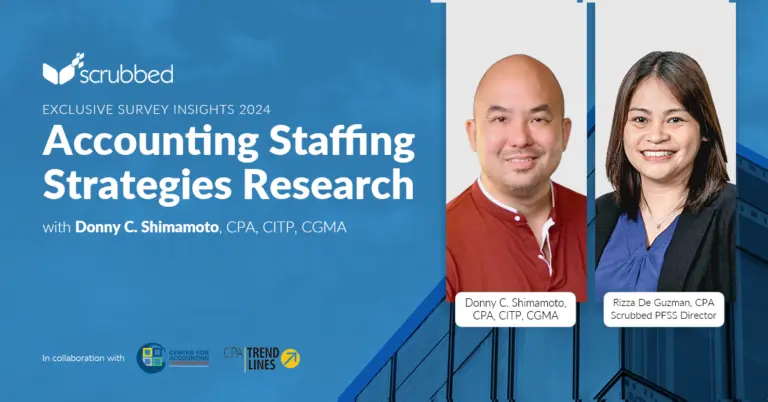
We’re excited to share exclusive insights from our recent webinar on “Accounting Staffing Strategies Research,” hosted by Donny C. Shimamoto, CPA, CITP, CGMA, and Rizza De Guzman, CPA, Scrubbed PFSS Director.Scrubbed partnered with Donny C. Shimamoto ,the Center for Accounting Transformation  to survey CPA firms and with Dr. Bryan Coleman leading the research. The aim was to understand the significant challenges posed by staffing shortages and the innovative strategies firms are employing to address them.Missed the webinar? Watch it here.Recap: Overcoming Staffing ChallengesIn today’s dynamic market, CPA firms encounter notable obstacles in acquiring qualified talent. Our webinar delved into these challenges head-on, highlighting:Shortage of Skilled Candidates: Finding skilled individuals can be a significant hurdle.Rising Salary and Benefit Costs: Offering competitive compensation packages is essential for attracting and retaining top talent.Increased Competition from Other Firms: Fierce competition among firms intensifies as they compete for the same pool of qualified professionals.The Power of Outsourcing with ScrubbedScrubbed offers a powerful solution to these staffing challenges through our outsourced accounting and finance services. Partnering with us can help you:Bridge Talent Gaps: Fill staffing gaps seamlessly and efficiently.Access a Wider Talent Pool: Tap into a diverse network of qualified professionals with experience in key areas such as risk and SOX compliance , and corporate finance advisory.Free Up Internal Resources: Empower your in-house team to focus on core business activities.Watch the On-Demand WebinarExciting news! We’ve made the recording of our webinar available for you to watch. Now you can revisit the valuable insights and information shared during the session at your convenienceWatch: Accounting Staffing Strategies Research

Read More >

Contact Information

SF Bay Area Headquarters
111 Anza Boulevard, Suite 320, Burlingame, CA 94010, United States

Phone: (800)837-5160
Email: [email protected]

"Scrubbed" is the brand name under which Scrubbed Advisory, LLC and Scrubbed Assurance LLP provide professional services. Scrubbed Advisory, LLC and Scrubbed Assurance LLP practice in an alternative practice structure in accordance with the AICPA Code of Professional Conduct and applicable law, regulations, and professional standards. Scrubbed Assurance LLP is a licensed independent CPA firm that provides attest services to its clients, and Scrubbed Advisory, LLC provides tax, finance, and support services to its clients. Scrubbed Advisory, LLC is not a licensed CPA firm.

Copyright © Scrubbed. All rights reserved.