
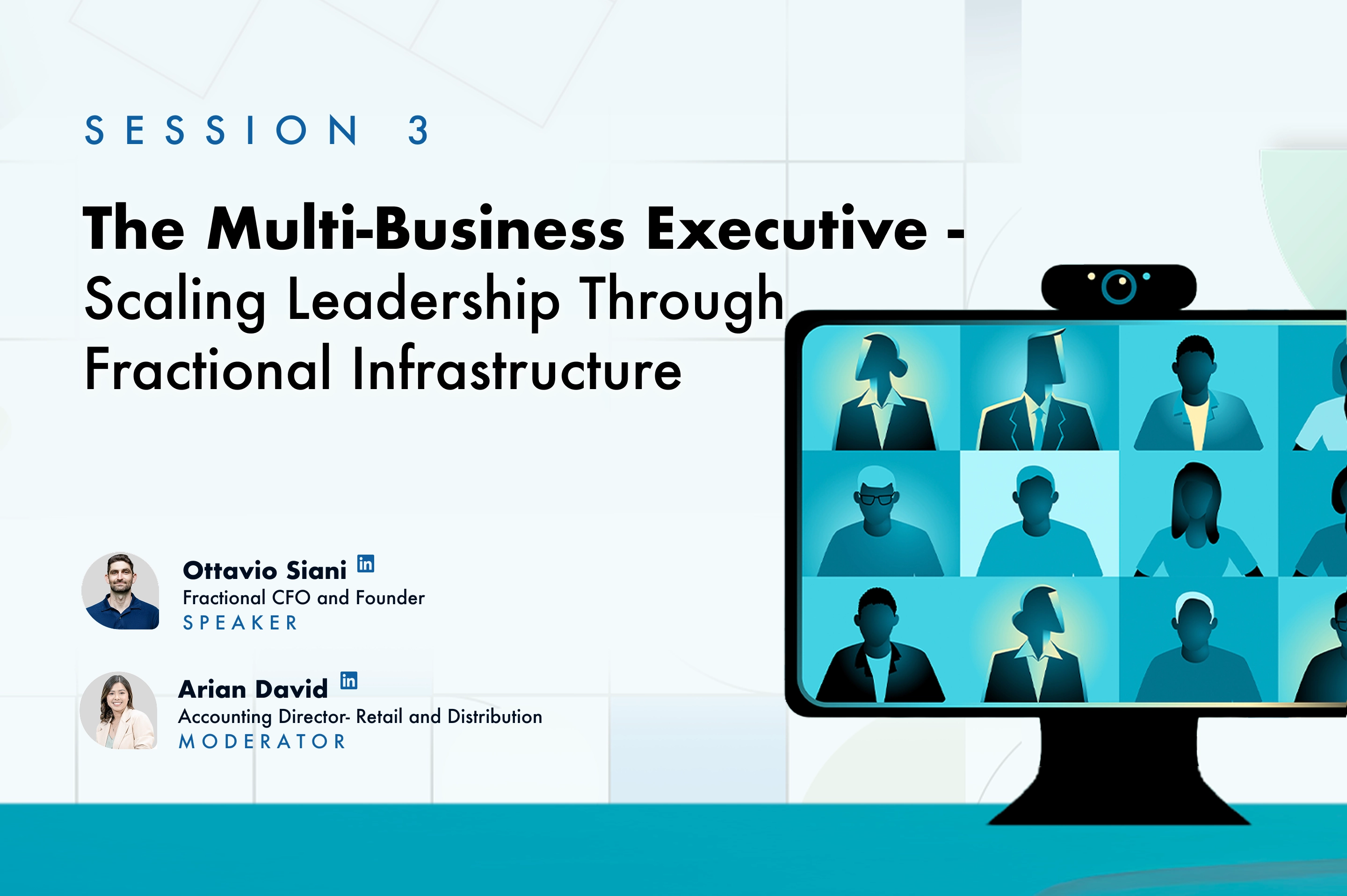
The Multi-Business Executive - Scaling Leadership Through Fractional Infrastructure

Arian David

Director, Distribution and Retail

The Multi-Business Executive - Scaling Leadership Through Fractional Infrastructure

Building The 'Fractional Dream Team' and Scaling Leadership Across Multiple Businesses

How does a single leader scale their financial expertise across multiple companies? The answer, as we learned in a recent session at “The Future is Fractional,” is by building a “fractional infrastructure.”

In this insightful session, Scrubbed’s Arian David was joined by Ottavio Siani, a fractional CFO and the owner of Triangle Coffee. Ottavio lives this model from two perspectives: as a business owner who uses fractional services (including Scrubbed) and as a fractional CFO who builds financial teams for his clients.

He shared his playbook for designing scalable financial systems, which all starts with what he calls the “fractional dream team.”

Here are the key highlights from their conversation.

The "Fractional Dream Team" Model

When Ottavio engages with a new client, he doesn’t just offer his own services. He presents a “full solution” to their entire finance problem. This solution, his “Dream Team,” consists of three key parts:
  • The Fractional CFO (Himself): The high-level strategist, relationship manager, and leader who designs the systems.
  • The External Execution Team (Scrubbed): The reliable, expert team that handles the core bookkeeping and accounting
  • The Internal Coordinator: A full-time employee at the client’s company who acts as the reliable, trustworthy bridge between operations and the finance team.
“In about 75% of my engagements,” Ottavio explained, “they’re also deciding to work with Scrubbed, so that they can get not just my work, but this full team.”

Creating a Self-Sustaining System

Ottavio’s primary goal is to create a finance function that can operate independently. His process is simple and effective:
  1. PHASE 01 BUILD  Ottavio’s primary goal is to create a finance function that can operate independently. His process is simple and effective:
  2. PHASE 02 DELEGATE In the following months, he is “less hands-on,” training the internal coordinator to take a “first pass” at the analysis.
  3. PHASE 03 SCALE  As the core processes become self-sustaining, he steps back.
The ultimate goal, he says, is to transfer ownership. “That’s often what I’m selling my clients,” Ottavio shared. “I will build this… set of processes, I will train the people necessary to do them, and then when I’m at the end of the scope… you, the company, will own this.”

Earning Board and Auditor Buy-In

Ottavio often enters companies where the founders are “product people,” not finance people, and are disconnected from their financial information.

His model works by building trust in the data. His goal is to “Take the way that they think about the business, and connect it to the presentation of their financial information.”This leads to a key leadership lesson: focus on the fundamentals first.

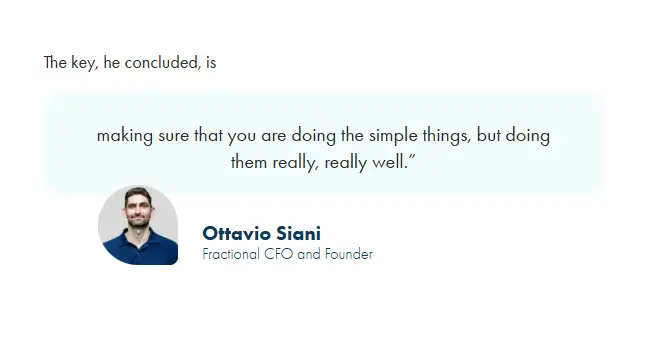
Ottavio explained that he often has to “manage up” and tell a CEO they can’t work on a “really interesting question” until the basic data, like an accounts receivable aging report, is accurate. Oftentimes, he noted, complex, one-off analyses are only needed because the leadership can’t trust the rest of their financial information. Once you build a great process with accurate data, many of those complicated questions fall away.
New Project (2)

Why Reliability Is Worth Paying For

When clients ask why they should use his recommended team versus a cheaper alternative, Ottavio’s answer isn’t about cost, it’s about reliability.

He noted that he often enters companies that have already worked with third-party bookkeepers, and is often skeptical of it because it hasn’t worked out for them.

“You really want to get… what you’re promised on time, and you need it to be accurate,” he stressed.

He also highlighted the value of Scrubbed’s scale. He explained that if his team encounters a complex or niche accounting issue, they can tap into the collective expertise of Scrubbed’s larger organization. This internal “knowledge base” means there is almost always an expert who has handled a similar situation and can provide the necessary guidance, a resource he described as “enormously helpful.”

Watch the Full Session

To hear all of Ottavio’s insights on his “fractional dream team” model, how he prices his services, and how he avoids burnout, you can watch the full session recording.

GET YOUR ON-DEMAND ACCESS
Watch the Full Session

Related Content

Blogs

The New Playbook for Growth: Key Insights from Scrubbed’s “The Future is Fractional”

The New Playbook for Growth: Key Insights from Scrubbed’s “The Future is Fractional”

Scrubbed’s recent virtual conference, “The Future is Fractional”, brought together top finance executives, fractional leaders, and AI experts to discuss one pressing question: “ How can businesses scale smarter in an age of talent scarcity and rapid change? ” This discussion has never been more urgent. Since 2020, the fractional workforce has exploded by 57%, while 83% of enterprises have turned to AI to bridge talent gaps. The old models of hiring simply aren’t keeping up. Held last October 30, 2025, this virtual conference provided a powerful roadmap for the future of finance. From real-world case studies in scalable growth to a practical framework for AI adoption, here are the most important takeaways from the event: From Fractional Staff to Integrated Partner The conversation around “outsourcing” has fundamentally changed. As Ivan Kwan, VP of Corporate Finance at Adapture Renewables , shared in his session, the old model of failed temp hires and disjointed contractors is dead. The new model is about deep, strategic integration. Kwan, who scaled his finance team from just himself and a CFO to a robust, compliance-driven department, attributed his success to a mindset shift. “I looked at the fractional staff as our staff, just housed elsewhere,” he explained. This sentiment was echoed by Ismaila Sougoufara , CAO of Jaguar Health, a public company navigating complex SEC and SOX compliance. He explained that building trust with auditors and the board was possible for one reason: “Quality speaks for itself.” The key takeaways were: Treat partners like team members: True integration, including face-to-face visits and inclusion in company culture, is non-negotiable. Ismaila noted, “Scrubbed is not seen as fractional. We refer to Scrubbed as our company in the Philippines. It’s an integral part of Jaguar.” Start with incremental trust: Both leaders advised starting with core tasks like bookkeeping and AP to build confidence before expanding to more complex areas like technical accounting and FP&A. Unlock unexpected value: For Adapture Renewables, the partnership drove an unintended, highly positive consequence: it forced early adoption of cloud-based tech (like Zoom and Asana), making them fully resilient when the pandemic hit. Designing Your "Dream Team" Once the foundation is set, how do you scale leadership? The panels on fractional executive performance provided a clear blueprint. Chris Cook of FLG Partners framed the value proposition perfectly: “One of the biggest misconceptions about fractional work is that it’s primarily a cost-saving move… The real value is strategic leverage. ” Companies get access to a “full stack” of expertise: payroll, compliance, inventory, on a part-time basis, precisely when they hit key “inflection points,” as Nicole Tall of Tall Tax noted. But how do you structure this? Ottavio Siani, fractional CFO and owner of Triangle Coffee , offered his “Dream Team” model: This “Dream Team” model has a clear endgame: building a self-sustaining system . Ottavio’s goal is to create durable processes and train the internal team, ensuring the company “owns” the finance function long after his day-to-day involvement ends. This approach is designed to deliver what Nicole called the ultimate metric for fractional leadership. It moves beyond just a clean audit to build lasting “founder confidence”, giving leaders the trust and visibility they need to make better, faster decisions. The Future-Ready Edge: Your AI Roadmap The final and most forward-looking session tackled the biggest topic in business today: Artificial Intelligence. Led by Scrubbed CTO Vince De Leon, the panel featuring experts from SADA, Marketri, and Altiora Advisory laid out a simple “Start, Build, Scale” framework. Brady Lewis of Marketri advised against tackling core accounting immediately. Instead, start with high-visibility, low-risk, “annoying” tasks. START: Start Where It Won't Hurt Quick Wins: Use AI for meeting intelligence (using tools like Fathom or Otter), proposal generation, and drafting internal documentation. The 80/20 Rule: Follow a simple “80/20” model: Use AI for the drafts; use your human experts for the decisions, the polish, and the strategy. Measure Success: Forget complex ROI. Track “time saved” and team “adoption rate.” BUILD: Customize and Integrate Then, Michael Williams of SADA explained that the next step is moving beyond off-the-shelf tools when those once-annoying tasks become genuine blockers to growth. Build vs. Buy: “Building” doesn’t mean creating your own LLM. It means customizing and integrating a powerful, secure AI model with your company’s proprietary data. Grounded AI: The key trend is “grounded AI,” which cites its sources. This allows the AI to move from guessing to knowing, confidently telling you it found a specific number “on page 5 of the Q3 board deck.” Agentic AI: The next wave is AI that completes a task, not just answers a question, like receiving a vendor invoice, performing a three-way match against the PO, and drafting an email to flag a discrepancy for human approval. SCALE: Embrace Change or Become Irrelevant Finally, Felix Dela Rea, formerly of Meta and Google , provided a powerful lesson on scaling AI and culture, centered on the idea that “if you want to go far, build together.” At Meta, this meant creating a “Finance Academy” to upskill everyone and celebrate small wins to get company-wide buy-in. He closed with the powerful story of Meta’s headquarters, which famously features the old, rusting sign of the building’s previous tenant, Sun Microsystems, on its back. It serves as a constant, powerful reminder of what happens to industry giants who fail to embrace change. The lesson for every finance leader is clear: embrace technology and new models of working, or risk becoming a relic.

Read More >

Contact Information

SF Bay Area Headquarters
111 Anza Boulevard, Suite 320, Burlingame, CA 94010, United States

Phone: (800)837-5160
Email: [email protected]

"Scrubbed" is the brand name under which Scrubbed Advisory, LLC and Scrubbed Assurance, LLP provide professional services. Scrubbed Advisory, LLC and Scrubbed Assurance, LLP practice in an alternative practice structure in accordance with the AICPA Code of Professional Conduct and applicable law, regulations, and professional standards. Scrubbed Assurance, LLP is a licensed independent CPA firm that provides attest services to its clients, and Scrubbed Advisory, LLC provides tax, finance, and support services to its clients. Scrubbed Advisory, LLC is not a licensed CPA firm.

Copyright © Scrubbed. All rights reserved.