
The Outsourced Accounting and Finance Advantage: How Companies Are Using It to Gain a Competitive Edge

Rizza De Guzman

Rizza De Guzman

Lead Director, Firm Client Services

The Outsourced Accounting and Finance Advantage: How Companies Are Using It to Gain a Competitive Edge
It’s a challenging time for CPA firms. With 75% of CPAs nearing retirement age this decade and a 7.4% drop in US accounting graduates, the talent crunch and increasing burnout among top performers are pressing issues. Yet only 50% of accounting firms leverage outsourcing to address these challenges.

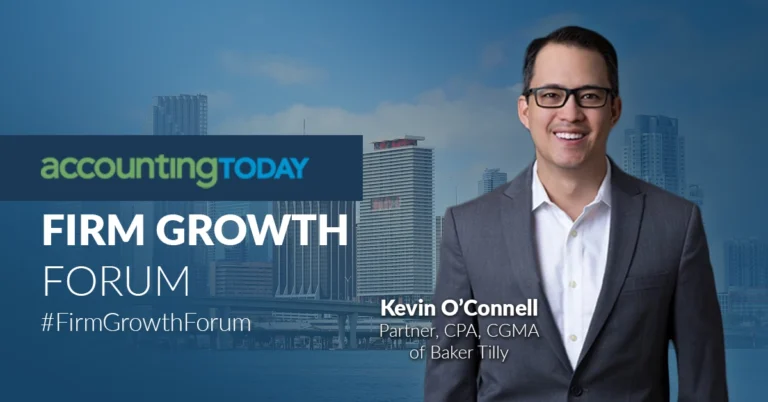
Kevin O’Connell, Audit Partner at Baker Tilly, sat down with Scrubbed’s Chief Revenue Officer, Youni Kim, at a recent Accounting Today forum to discuss how outsourcing with Scrubbed is helping Baker Tilly with its plans to scale, tap into specialized talent and broaden service offerings.

Here are five key takeaways they shared that can help CPA firms grow sustainably with an outsourced accounting provider:

Looking for trusted growth partners for your CPA firm? Click here.

Think Strategically About Outsourcing

The basic strategy that CPA firms are using to tackle their talent pool concerns is hiring college graduates,” says Youni. “But, if you’re not one of the big four, then how do you fight for the best talent coming out of college?” Typically, firms consider options including workload reduction, demand reduction by trimming clients, and outsourcing to address the challenge. Outsourcing accounting and finance can help CPA firms to scale and address capacity challenges, talent shortages, and broaden service offerings and outsourcing partners can be exactly the strategic allies that you need to achieve planned growth.

Kevin agrees, “One of Baker Tilly’s top three priorities over the next five years is to make sure we’re outsourcing the work that makes sense to be outsourced,” he says. “But we don’t want to work with a faceless organization; we want to work with a real partner who understands our needs and how we intend to grow so they can help us with that vision and goal.”

As an example, he describes first working with Scrubbed. “I started with some discussions about doing audit support for me and my clients, and, over a two year period, I more than doubled my book of business. I would never have even been close to that without the help of Scrubbed.”

The focus is on being transparent about how the firm would like to grow and choosing a partner that understands the strategy and can complement the firm’s strengths to help them achieve that growth. In Youni’s view, that investment in the relationship and effort to understand the unique needs of each client is at the heart of Scrubbed’s mission. “You don’t just get staff; you get supervisors, directors, senior managers, and a whole suite of services focused on supporting your growth. We like to call it the right fit at the right time, “she says. “You have to choose what works for your firm’s growth and how you like to work. “

Choose Experience Across Industries

When choosing an outsourcing partner, it’s important to look for firms with a full suite of services and experience in various industries and specializations. This ensures that you’re not just hiring bodies but building a team that can supervise and manage complex tasks for a wider range of your clients.

“We have partners and directors that are experienced in e-commerce and retail, media and entertainment, and many more different industries,” explains Youni.” So, you can find auditors, tax specialists, or technical accountants for whatever your client needs.” For clients like Baker Tilly, that means an easy way to offer more services to existing clients or attract new ones without having to forge new relationships or audition new partners. For example, Kevin focuses mainly on the audit practice, but Baker Tilley’s relationship with Scrubbed has gone beyond that single function. “I’m not a benefit plan expert, but we’ve used Scrubbed on our benefit plans, and you know how specialized that is,” he says. “It’s very unique, very specific, but Scrubbed is able to take our engagements from start to finish.”

In reality, successful outsourcing is about more than simply delegating tasks; partnering with an outsourcing firm with multiple strings to its bow can lead to stronger relationships and better outcomes. “What we do as accountants to build relationships with clients is also what we do with our outsourcing partners,” says Kevin. “We have dedicated relationship managers who meet with them weekly and discuss how we can improve the process for both parties.” Regular communication and collaboration help both parties continuously work towards improvement and alignment, leading to a more successful outsourcing arrangement.

Take Advantage of Specialized Talent

One advantage of outsourcing is the access to specialized talent that may be difficult to hire or retain, particularly in a tight talent market. This can be critical for firms looking to broaden their services or enter new markets without the overhead of hiring full-time specialized staff. At Scrubbed, this is a key priority. “A lot of times people think, Oh, let me just get some more bookkeepers, or people that can do bank reconciliations – they think that the most basic transactional part is where you start,” says Youni. “Our approach is that we offer on demand, very high quality labor with specialized talent that is harder and much more expensive to find. It’s a much smaller pool and a much more dedicated type of resource.”

That’s exactly what firms like Baker Tilly need to offer broader services to clients and grow the business. “It’s high-level work here. It’s not a processing center, and these are highly talented individuals who can take our engagements from start to finish,” says Kevin. “There’s a myth with outsourcing that, somehow, talent stops at the US border. And that’s ridiculous.”

As well as talented audit, tax, and technical accounting professionals, outsourcing firms like Scrubbed will also include hyper-specialized staff well-versed in advanced tools, including AI-driven solutions. These professionals bring a wealth of experience from working with different firms and a wide range of software and tools. “An organization like Scrubbed, where they’re working with different firms, sees so many more AI tools and other types of software than we ever will at Baker Tilly,” Kevin says. “That’s an incredible resource for us.”


Consider Workload Management

Another effect of the talent crunch is that senior accountants often have to cover routine work as well as their supervisory or managerial responsibilities, leading to more burnout among top performers. Bringing on an outsourced accounting partner can help CPA firms offer new services while also becoming more efficient and allowing senior internal resources to spend more time on client-focused activities that contribute to the firm’s strategic objectives and success.

While outsourced accounting firms provide the flexibility to right-size the workload for everyone, Kevin also emphasizes the importance of considering the outsourced partner’s workload. “At Baker Tilly, we treat our complementary workforce as an extension of our team. We’re also making sure their workload is not too heavy, just like we do with our internal team members.” This balanced approach can improve retention and job satisfaction which both enhance overall firm productivity.

It’s a goal shared by Scrubbed, where the focus is not just on recruiting top talent to crunch through work but also on creating real career opportunities and progression for the team. “We have our own internal growth plan,” says Youni. “So, when you are with Scrubbed, there are real career paths from staff to director and beyond. As a result, our retention rates are very high, and our team is very dedicated. That’s different from some of our competitors, and it translates into higher quality services for our clients.”


Balance Cost and Quality Considerations

Another effect of the talent crunch is that senior accountants often have to cover routine work as well as their supervisory or managerial responsibilities, leading to more burnout among top performers. Bringing on an outsourced accounting partner can help CPA firms offer new services while also becoming more efficient and allowing senior internal resources to spend more time on client-focused activities that contribute to the firm’s strategic objectives and success.

While outsourced accounting firms provide the flexibility to right-size the workload for everyone, Kevin also emphasizes the importance of considering the outsourced partner’s workload. “At Baker Tilly, we treat our complementary workforce as an extension of our team. We’re also making sure their workload is not too heavy, just like we do with our internal team members.” This balanced approach can improve retention and job satisfaction which both enhance overall firm productivity.

It’s a goal shared by Scrubbed, where the focus is not just on recruiting top talent to crunch through work but also on creating real career opportunities and progression for the team. “We have our own internal growth plan,” says Youni. “So, when you are with Scrubbed, there are real career paths from staff to director and beyond. As a result, our retention rates are very high, and our team is very dedicated. That’s different from some of our competitors, and it translates into higher quality services for our clients.”

Embracing Outsourcing for Strategic Growth

Kevin and Youni’s discussion shows how outsourcing accounting and financial services for CPA firms goes beyond cutting costs; it can be a catalyst for strategic expansion. Choosing the right partner and accessing specialist talent can help CPA firm owners navigate the talent crunch and broaden their service offerings such as ESG reporting services and biotech accounting services without compromising on quality or client service. This makes outsourcing a winning proposition for firms looking to enhance their capabilities and achieve sustainable growth.

Reach out to Scrubbed today

learn how they can help you transform your business and drivestrategic success.

REACH OUT FOR A CONVERSATION
Reach out to Scrubbed today

Related Content

Blogs

The Strategic Balance: Scaling Your CPA Firm with In-House Talent and Outsourcing

The Strategic Balance: Scaling Your CPA Firm with In-House Talent and Outsourcing

One of the critical decisions you make as the owner of a CPA firm is whether to invest in building an in-house finance and accountancy team or using the flexibility of outsourced expertise. Both approaches can be beneficial, but what you choose depends on your firm’s goals and circumstances. Let’s take a closer look at how to strike the right balance.When to Invest in In-House TalentIn-house hiring is often best suited for roles requiring strong client relationships and strategic influence. Key positions might include:Lead accountants who manage primary client engagementsPartners and senior managers responsible for setting the firm’s visionStrategic advisors shaping long-term directionHiring might also make more sense for long-term essential operations such as:Ongoing tasks requiring regular attentionRoles where the cost of repeated outsourcing exceeds employee salaryFunctions that need direct oversight and quality controlWhen Outsourcing Makes SenseOutsourcing offers a strategic advantage for CPA firms dealing with seasonal demands, specialized projects, or turnover. Firm leaders can enhance operational efficiency, maintain service quality, and reduce stress on the in-house team by knowing when and how to bring in outsourced support. One of our clients, Stacey Massa, Managing Director at UHY reported that they were able to grow their practice by 10% annually by outsourcing to our team.When to Start OutsourcingFirms typically explore outsourcing when facing capacity constraints, specialized project needs, or the growth trajectory is likely to exceed the current team’s capacity or expertise. Outsourcing allows the firm to scale without overextending permanent hires.If your firm needs specialized assistance for a client or project, or if you need extra support at peak times, outsourcing is a useful option. Some key scenarios where outsourcing works well include:Busy SeasonsDuring peak seasons, outsourcing gives you the flexibility to cover increased workloads without overextending your in-house team. You can avoid burnout and turnover because outsourcing allows you to:    - Add resources to match the demand    - Maintain service quality without committing to permanent hires    - Free in-house staff to concentrate on strategic priorities and client relationshipsSpecialized ExpertiseOutsourcing can give you access to the right expertise when projects call for advanced skills or niche knowledge or when a client needs something that is outside of your regular services. This is especially helpful for:    - Complex tax compliance cases    - Compilation preparation for financial statements    - Specialized audit requirements, such as Healthcare and nonprofit audits    - Technical accounting challenges or specialized financial analysis, including Employee Benefit Plan (EBP) compliance    - Corporate finance advisory projects requiring deeper financial expertiseWe also support firms with industry-focused expertise, including real estate accounting solutions, helping you address complex property-related transactions with confidence.Staffing GapsTemporary staffing gaps are easily covered with access to trained and experienced professionals, and you don’t have any of the lead time needed for hiring and onboarding a new staff member.Routine TasksRepetitive tasks that don’t need strategic input are well-suited for delegating to an outsourced team. Outsourcing these routine accounting duties frees up your in-house team to focus on higher-value or more strategic tasks. Routine accounting work might include:   - Bookkeeping and payroll processing   - Data entry and transaction recording   - Project-based financial analysisTime-Sensitive NeedsWhether you need to meet a tight deadline or address an urgent client need, outsourcing to an expert can save the day. Working with an international partner can be especially useful here as different time zones allow for a 24-hour working day, giving you a faster turnaround.For more information on assessing whether outsourcing could work for your firm and to ensure a successful partnership, take a look at our CPA Firm’s Guide to Outsourced Finance and Accounting.Addressing Common Concerns with OutsourcingOutsourcing can be a great strategy to help CPA firms manage workload and expand offerings, but CPA leaders still express some common concerns:Time Zone DifferencesCPA firms sometimes worry that working with a team in a different time zone will slow the work process down. In fact, many outsourcing firms, including Scrubbed, ensure there is some time overlap for essential meetings but also work through the US nighttime to give your firm what amounts to a 24-hour workday.Training and OnboardingThere is a concern that training and onboarding will be too time-consuming. However, your outsourcing partner will provide dedicated account managers and well-trained and experienced professionals familiar with CPA firm processes. With the right people in place, it is easier to integrate outsourced teams into the firm’s day-to-day operations.Knowing When to OutsourceSometimes, CPA firms feel they’re “not ready” for outsourcing, feeling that they must reach a particular size or level of sophistication before outsourcing becomes appropriate. In reality, firms of all sizes can gain from outsourcing accounting or financial tasks, whether that means handling busy seasonal periods or expanding the firm’s client offerings. Firms can begin with low-risk functions like bookkeeping or tax preparation to get a sense of how outsourcing could work for them.Data PrivacyData privacy and security are vital, and it is understandable that CPA firm leaders might be hesitant to share financial data with a third party. However, professional outsourcing companies put in place rigorous security measures, including SOC 2 reporting, data encryption, and access controls.Key Factors to ConsiderChoosing between hiring in-house staff and outsourcing your accounting and financial operations depends on your firm’s goals, capacity, and long-term vision. Along with assessing the current bottlenecks and inefficiencies and defining the tasks to be outsourced, you’ll need to think through some key considerations:Cost EfficiencyOutsourcing often provides a more cost-effective solution to in-house hiring or traditional firms. This can benefit firms looking to lower costs without compromising service quality.Quality AssuranceReputable outsourcing providers ensure their teams meet rigorous qualifications, but it’s essential to screen providers thoroughly to ensure their standards match yours.Data SecurityVet your potential provider for SOC compliance and encryption standards. You’ll need someone who can support and enhance your data privacy and security processes while also helping you stay aligned with risk and SOX compliance requirements.Aligning with Your Firm’s VisionSustainable growth goes beyond the immediate need to complete a project or the demands of this year’s tax season. The most effective strategy is the one that helps your firm deliver consistently high-quality service, adapt to changes in the market, and build operational flexibility in case of changes in workload or staffing.

Read More >
Blogs

Considerations for the 2022 Inflation Reduction Act

Considerations for the 2022 Inflation Reduction Act

On August 16, 2022, the H.R. 5376 or Inflation Reduction Act of 2022 was recently signed and passed into law by US President Joe Biden. Calling the Act as “one of the most significant laws in our history”, it covers numerous provisions to address energy security and climate change programs, deficit reduction, prescription drug pricing, and healthcare premiums. This Act is a significant piece of legislation that fulfills some initiatives that have been embroiled in congressional debates for decades and is said to be the largest congressional action and investment in fighting climate change in US history, as of date. The Act also has a provision that raises taxes on wealthy corporations and makes prescription drugs and healthcare more accessible and affordable. Industry update: If Your Company is Involved in Leasing, Have You Met the Requirements of ASC 842? What’s in the Inflation Reduction Act? If you are already familiar with the Build Back Better bill, the Inflation Reduction Act is a ‘slimmed-down’ version of such, in which is aimed to make significant investments in the US’ “social safety net” (programs that will benefit the low-income or vulnerable individuals and communities) as part of the budget reconciliation process. The Act is meant to aid inflation by reducing the US national debt, healthcare, and energy costs over the years. Below is the summary of the Act’s salient provisions:Climate change and energy security provisionsNumerous investments in climate protection, including tax credits and rebates aimed at reducing carbon emissions and offsetting energy costs for households; investments in clean energy production such as research, loans, grants, and also tax credits to increase domestic manufacturing capacity for solar panels, wind turbines, batteries, and other integral components of clean energy production and storage; programs to decrease the environmental impact of agriculture; and more.With the new law comes the extensions of green energy tax credits ranging from 2024-2032. In addition, Green Energy Credits was added to promote sustainable growth.Aside from the credits, the US Government also made investments to address climate issues and encourage the citizens to switch to renewable energy. It is believed that this change will reduce climate pollution by up to 40% until 2030.This provision will cause a significant shift in customer demands which can affect traditional companies’ profitability, particularly those in the energy and automotive industry, in which products are based and reliant on fossil fuels and products with excessive carbon footprints. Unless companies adapt to these demand changes, inventories can be rendered obsolete, assets rather impaired, and businesses going under. Consideration should also be taken on how Green Energy Credits should be accounted for.Extension of Affordable Care Act (“ACA”) subsidiesExtends the temporary expansion of Premium Tax Credits for additional two years through 2025. Under the current law, the expansion offers eligibility to households with incomes between 100% to 400% of the federal poverty level.Under ACA, medical insurance premiums are currently subsidized by the US federal government to lower premiums. But these are scheduled to expire at the end of 2022, if not extended, which could cause millions of Americans to lose their health insurance, according to the U.S. Department of Health and Human Services.This will continue to affect the cash flows for certain companies, especially those mandated by the ACA to provide affordable healthcare to their full-time employees since noncompliance could result in hefty annual fines.International Revenue Service ("IRS") fundingInvestment of approximately $80 billion over the next 10 years for IRS enforcement activities, including IT Systems modernization, taxpayer services, and the hiring and training of new auditors.Stringent enforcement of IRS audit and filing is expected. Thus, companies should be more vigilant in compliance with rules and regulations and be audit-ready to avoid assessments, penalties, or even litigation. In addition, companies must carefully account for uncertain tax positions and follow the guidance of ASC 740. Corporate Alternative Minimum Tax (CAMT)Creates a 15% corporate alternative minimum tax rate for corporations with average annual earnings that exceed $1 billion over three taxable years. While tax rates on individuals and households will remain the same.CAMT-exempt are companies with combined income with unrelated businesses of shared ownership of an investment fund/partnership even if it exceeds the threshold and corporate subsidiaries of private equity firms.Affected companies should consider the impact of increased tax liability on their cash flows, forecasts, and investment/growth strategies. Excise Tax on Stock Buybacks or RepurchasesImposes a 1% excise tax on domestic publicly-traded corporations when it buys back its own shares directly or through a more than 50% owned subsidiary corporation or partnership.This can impact companies as to their corporate buyback transactions, including those with outstanding shares subject to repurchase rights, stock issued in the initial public offerings of special purpose acquisition companies, and redeemable preferred stocks.Prescription drug price reformsAllows Medicare to negotiate the price of certain prescription drugs to bring down the price beneficiaries will pay for their medications and limits the price growth of certain drugs due to inflation by having a $2,000 cap on the annual out-of-pocket prescription drug costs for Medicare recipients starting in 2025.It also repeals the implementation of the “rebate rule,” which is scheduled to increase drug-related Medicare costs beginning in 2027, and redesigns the Medicare Part D benefit formula.This can impact the bottom line and cash flow projections of various healthcare, pharmaceutical, and other life sciences and drug related companies. This can also affect pricing schemes and inventory valuation to Net Realizable Values.Other Provisions:Research Tax Credit – Beginning after December 31, 2022, the Research & Development (R&D) tax credit limit of $250,000 for qualified small businesses can now be applied against payroll tax liability up to $500,000.Passthrough Loss Limitations – IRA included a two-year extension of the deductibility of the excess business losses limitation to pay for the late changes to the CAMT of partnerships and S corporations until 2028.You may refer to this link for the full legislative text of the Inflation Reduction Act of 2022. We’d love to help. This summarizes the significant provisions in the Act. To ensure that all factors are considered in the pursuit of reliable financial reporting, effective and efficient operations, and compliance with law and regulations, including risk and SOX compliance and corporate finance advisory, our services can be scaled to accommodate your business needs.Visit Tax Compliance and Advisory Page

Read More >
Blogs

From the Gym Floor to the Finance Floor: How Trust Becomes the Ultimate Metric of Scale

From the Gym Floor to the Finance Floor: How Trust Becomes the Ultimate Metric of Scale

At A GlanceWhether you are running a local coffee shop or a massive B2B finance operation, the core of client service remains exactly the same: connection and client satisfaction. But in complex accounting, sustaining that connection requires extreme operational reliability. By creating a safe internal environment where teams are supported and can speak up about issues, finance leaders ensure flawless execution, which is the ultimate driver of client trust and scale.My day usually starts at 5:00 AM. Before I even log on to review financials or check in with my teams, I am already thinking about operations.My husband and I run a local gym and a coffee shop, and at home, we have seven dogs. On any given morning, that means people, schedules, service, expectations, and the small details that determine whether the day runs smoothly.At first, those worlds may seem far from corporate finance. But the more I’ve grown as a leader, the more I’ve realized the fundamentals are not that different.Whether someone is walking into a gym, ordering coffee, or trusting a finance team with the operations behind their business, they want to feel confident that someone is paying attention. They want consistency. They want follow-through. They want to know the work will be handled with care.That kind of trust doesn’t happen by accident. In finance, especially at scale, it has to be built through structure, reliability, and teams that feel supported enough to do the work well.When I started growing my finance teams, that lesson became clear quickly. Client connection matters. Client satisfaction matters. But in a complex accounting environment, those outcomes depend on the internal engine behind the work.The True Driver of GrowthWhen I first started building my team at Scrubbed, we had just five people. Today, that team has grown to over 130 professionals handling complex accounting systems for clients across multiple industries.As we grew, I learned that you cannot scale a client relationship without deep operational trustI saw this clearly with one of our most successful clients. When we started our partnership, they trusted us with just two team members. Over time, that engagement grew to 44 professionalsHow we executed that scale came down to three operational pillars:Predictable Manpower: Maintaining a strict 30-to-45-day onboarding lead time.Buffer Capacity: Intentionally applying excess capacity so client needs were covered.Radical Quality Control: Consistent standards that never dipped, regardless of team size.But how do you manufacture that level of reliability at scale? It starts internally.The Internal Engine of ConfidenceAs my team scaled past 130 professionals, I realized my role as a Director had shifted: I was no longer just managing financial outputs; I was designing an ecosystem of trust.If your team doesn’t feel safe, they won’t tell you what is wrong or what has happened behind the scenes. But when they trust you, they speak up sooner. They surface issues early.They give leaders the chance to fix small problems before those problems reach the client.That is where internal trust becomes client trust.When people feel supported, they do better work. When ownership is clear, quality becomes more consistent. When the environment allows for honesty, the team can protect theclient relationship before there is ever a visible issue to solve.I see that same principle in the gym and coffee shop. People trust you when the experience is consistent. They trust you when the details are handled. They trust you when they knowsomeone is paying attention, even when they are not watching every step.Finance works the same way.Clients may first come to us because they need capacity, technical support, or a more reliable way to manage the work behind the numbers. But they stay, and grow with us, when theysee that the structure holds. The team is steady. Issues are surfaced early. Quality does not depend on one person carrying too much alone.For finance leaders, protecting that internal engine is not separate from client service. It is client service.Because scale is not just about adding more people. It is about building a team, a structure, and a culture that can keep delivering with care as the work becomes more complex.That is how trust becomes measurable: through consistent execution over time.Key Takeaways:Th e core of service is universal: Whether in retail or complex accounting, making sure the client is satisfied and connected is the foundation of the business.Reliability drives scale: A successful engagement often starts small. Scaling from 2 to 44 professionals requires proving operational reliability, such as maintaining strict 30-45 day onboarding lead times and managing excess capacity.Client confidence starts internally: It is a balance between being client-centric and people-centric. You cannot deliver excellent work to a client if you ignore the needs of the team executing that work.Internal Engine of Confidence: A safe working environment ensures teams trust leadership enough to speak up when things go wrong, allowing issues to be fixed before they reach the client.Protect the engine: A finance leader s primary job is to support their people. Supported, happy people execute flawlessly, which naturally generates client trust.

Read More >

Contact Information

SF Bay Area Headquarter
111 Anza Boulevard, Suite 320, Burlingame, CA 94010, United States

Phone: (800)837-5160
Email: [email protected]

"Scrubbed" is the brand name under which Scrubbed Advisory, LLC and Scrubbed Assurance LLP provide professional services. Scrubbed Advisory, LLC and Scrubbed Assurance LLP practice in an alternative practice structure in accordance with the AICPA Code of Professional Conduct and applicable law, regulations, and professional standards. Scrubbed Assurance LLP is a licensed independent CPA firm that provides attest services to its clients, and Scrubbed Advisory, LLC provides tax, finance, and support services to its clients. Scrubbed Advisory, LLC is not a licensed CPA firm.

Copyright © Scrubbed. All rights reserved.