

Unlocking Success in your M&A Strategy: Why Having Reliable Numbers Matter, and Key Financial Factors to Consider

Anna Margarita Fernando

Anna Margarita Fernando

Unlocking Success in your M&A Strategy: Why Having Reliable Numbers Matter, and Key Financial Factors to Consider
Picture this:  You’re a business owner who founded, nurtured, and grew your business from operating in a coworking space to a million-dollar enterprise headquartered in one of the fanciest business districts among your peers/competitors. You’re even dubbed as one of the visionaries in your field, spearheading cutting-edge innovation in the industry that pushed your business to heights you never dared to imagine when you were starting. Eventually, you’ve come to a point where you find yourself at a crossroads – either you continue to reinvest the company’s earnings to fuel growth, find a partner or investor who can support your plans, and maybe even go the distance with you via an IPO, or maybe you’re ready to cash in on all that hard work and turn the reins over to a new owner. Going through the M&A route means bringing your company under the microscope to these potential investors – you need to convince them your company is worth the money they’ll put in.

While your finances certainly aren’t the only aspect of your business a potential buyer will evaluate, several financial measures are especially important for determining how your business is valued; hence your company’s selling price. For the most effective negotiations and the best possible deal outcome, you need to be ready to present reliable and audit-ready data.

Need help with your M&A Deals ? Visit our page for free consultation.

How Buyers Assess Your Finances During a Deal

A buyer expressing interest in acquiring your business will want to evaluate it from every angle before proceeding, through a rigorous process called due diligence. They’ll want to understand your product/service, technology, intellectual property, management team and staff, competitive position, contracts, legal matters—and of course, your current financial position and your future financial prospects.

Having reliable financial data influences two key aspects of the M&A transaction:

  • It affects whether a buyer will be willing to purchase your company. Before moving ahead, a buyer will need to know that your company is financially sound and is on a sustainable growth trajectory. To gain that assurance, they’ll expect to review your financial statements—including income statements (also called the P&L), balance sheets, and cash flow statements for multiple periods—as well as several years of tax returns. Having your numbers ready to be reviewed with all the supporting documentation you can think of will be extremely helpful in the sale process. Your potential investors and their people doing the due diligence will certainly appreciate it, and it can also help expedite the process for you. In certain cases, they might also ask for your company’s financial forecasts, which may entail you sitting down with a corporate finance advisory expert to help build the financial model you’ll present to investors.

  • It influences how much a buyer is willing to pay for your company. One of the key metrics that will drive the offer price and ensuing negotiations is your business valuation. Notwithstanding other factors, a reasonable valuation relies on your financials faithfully representing the state of your business.
If you expect to negotiate a deal from a position of strength and arrive at the best sale price and deal terms, you must be able to depend on sound, reliable, and verifiable financial data during the M&A process.

The Financial Metrics That Matter in an M&A Deal

When an investor is considering acquiring your business and determining how much they’re willing to pay for the company, they’ll find several financial metrics especially important to the decision. While a potential buyer will scrutinize your financial statements and other financial data in their entirety before agreeing to proceed and committing to a purchase price, the following metrics tend to top the list of financial measures that influence the deal.
  • EBITDA (Earnings Before Interest, Taxes, Depreciation, and Amortization). EBITDA helps a buyer gauge how much cash profit the business is generating from its operations. And since a lot of investors value companies using EBITDA multiples, you must demonstrate strong, steady, and sustainable EBITDA.
  • Revenue. Ideally, your financial data will show that your revenues are growing consistently and in a sustainable manner. Investors also prefer businesses that have steady, recurring revenue coming from a diversified base of clients or customers, or large, long-term contracts—both of which reduce your revenue risk. Revenue is also another metric used for valuation in certain situations.
  • Working Capital. Working capital represents the difference between your company’s current assets (such as cash, accounts receivable, and inventory) and its current liabilities (such as accounts payable and short-term debt). A positive working capital suggests that the company has enough resources to meet its current obligations, which can indicate financial stability. On the other hand, a negative working capital might suggest that a company is struggling to meet its short-term obligations, potentially indicating financial distress.
  • Gross Profit Margin. Gross profit margin is found on the income statement and is a widely used measure of financial health. It shows what you have made after paying your direct costs, and tells us how the company can effectively price its product or service and how it’s able to efficiently manage its direct costs.
  • Operating Income. This metric provides insights into the core operations of a business before considering non-operational factors such as interest and taxes. It’s seen as a good indicator of what you have left to invest in growing the business. Thin margins tell potential buyers you have little to invest in growth and not much room for error in operating the company. A higher operating margin suggests better cost control and pricing power, which can be indicative of a well-managed and competitive business. Lastly, understanding the company’s cost structure enables you to ascertain if there are any economies of scale that the company has capitalized on, or is yet to take advantage of.
  • Debt-to-Equity Ratio. Your debt-to-equity ratio gives buyers a sense of how your business is using debt to finance its operations. If your company is highly leveraged, potential buyers will also review other metrics to see if you get better financial performance (i.e., better revenue, margins, EBITDA than w/o debt). Buyers will also consider debt service metrics to see if the cash you generate from the business translates to better operations and better returns to shareholders, or just goes to debt servicing (i.e., payment of loans).


How Scrubbed Can Support Your M&A Process

To maximize the benefits of your M&A deal, it’s vital to provide reliable, professionally prepared financials that instill trust in prospective buyers. Being well-prepared for the transaction is equally important, and that’s where Scrubbed comes in!

Our team of finance and accounting professionals is highly experienced in developing financial statements for companies at all stages in their lifecycle, including businesses that are ready to be acquired. We know what potential buyers expect to see during the due diligence phase of an M&A deal, especially when it comes to financial data.

We also provide a broad range of corporate finance services that help you prepare for the M&A transaction, including financial due diligence, vendor assistance, financial modeling, and valuation services, preparing your pitch decks and information memos as well as supporting you in other facets of the deal process. In addition to M&A advisory, we offer real estate accounting solutions and other specialized financial services tailored to meet the needs of businesses in highly regulated and capital-intensive industries. 

Contact Scrubbed to learn how we can work with you to attract buyers, obtain a reasonable valuation, and achieve your desired deal outcome.


Contact Scrubbed to learn how we can work with you to attract buyers, obtain a reasonable valuation, and achieve your desired deal outcome.
Ready to prepare your business for a successful transaction? Contact Scrubbed today to learn how our experienced finance professionals can help you build investor-ready financials and achieve the best possible deal outcome.

CONTACT US
Contact Scrubbed to learn how we can work with you to attract buyers, obtain a reasonable valuation, and achieve your desired deal outcome.

Related Content

Blogs

Mitigating Risk in a Tight Market: The Compliance Advantage of Outsourced Accounting for Multifamily Properties

Mitigating Risk in a Tight Market: The Compliance Advantage of Outsourced Accounting for Multifamily Properties

The multifamily sector is facing major regulatory changes. From new HUD rules and FASB/GAAP updates to growing investor scrutiny around sustainability impacts and risks, regulatory requirements are becoming harder to navigate. At the same time, tighter margins and a tough lending environment are putting more pressure on financial operations.In response, many multifamily firms are turning to outsourced accounting partners to help streamline compliance processes, strengthen reporting, and improve cost control. Outsourcing is a strategic approach to building resilience and staying competitive in a more demanding market.Why compliance is getting harderEvolving regulations are nothing new for multifamily property managers, but right now, they’re happening on multiple fronts, including HUD changes and ongoing updates to FASB/ GAAP rules. On the ESG front, reporting expectations are no longer optional. Investors and lenders expect property owners to track, disclose, and back up their environmental risk management, social impact, and governance practices with solid data.Missing a deadline or misinterpreting a rule can lead to lost funding, investor lawsuits, or serious damage to a company’s reputation. With tighter margins and capital harder to access, the risks are higher than ever for multifamily businesses.Keeping up with all the regulatory changes and ensuring that financial operations and reports are accurate and compliant takes a skilled accounting team with in-depth knowledge, integrated systems, and the ability to produce accurate data on short timelines. And the truth is that many in-house teams are stretched thin and simply don’t have the capacity to do it all.Where outsourced accounting fits inFor many in the multifamily sector, the answer is to partner with an outsourced accounting team.Outsourcing has long been an option, of course, the growing number and complexity of HUD regulations, FASB updates, and sustainability impact and risks management requirements makes expert support and advice more valuable than ever. The evolving regulatory landscape demands specialized knowledge that can be difficult to develop and retain in-house.For operators also navigating digital finance platforms, access to SaaS accounting expertise through outsourced teams can further streamline compliance and reporting efforts.Because outsourced teams have experience across diverse portfolios and different regulatory environments, they bring a valuable perspective to multifamily businesses. That perspective can help operators maintain audit readiness, adapt financial workflows to new requirements, and reduce the risk of compliance issues. In a period of ongoing change, outsourced accounting is a practical tool for managing risk and improving data quality.Several factors are driving the shift toward outsourced accounting:Real estate-specific expertise: Teams specializing in multifamily property accounting bring a solid working knowledge of HUD standards, FASB and GAAP updates, and emerging ESG frameworks that can be difficult to maintain internally.Audit-ready processes: The experience of outsourced accounting teams in implementing and maintaining standardized workflows, automated reconciliations, and centralized reporting systems helps multifamily operators build stronger internal controls. In turn, this makes it easier to prepare for audits, respond to investor reviews, and meet regulatory inspection requirements more efficiently.Scalability: Outsourcing provides more operational flexibility to onboard new properties, respond to seasonal leasing cycles, or cover shifting reporting requirements.Cost control: Replacing fixed back-office overhead with a variable-cost model gives firms more breathing room. Outsourced accounting providers will often handle staffing, training, and software maintenance, lowering the cost of finance and accounting functions.How Sustainability Risk Management is accelerating the trendMultifamily operators are facing rising demands for transparency, including stricter requirements for managing sustainability impacts and risks. As institutional investors and lenders place greater weight on ESG performance, operators need to improve their ability to identify and manage sustainability impact and risks. Doing so can help multifamily businesses avoid unnecessary costs, reduce compliance risks, and strengthen the overall health of the company.Tracking environmental, social, and governance data alongside traditional financial information is an effective way to support this approach, but the additional pressure may stretch the capacity of an in-house accounting team. Bringing on an outsourced accounting team with expertise in sustainability impact and risk management and access to ESG reporting services allows multifamily businesses to stay ahead of investor and regulatory demands while maintaining the focus on core operations.Looking forwardManaging compliance, risk, and reporting demands aren’t getting any easier, but partnering with the right outsourced accounting partner could be the key to helping you stay ahead. Multifamily property companies that take proactive steps to reinforce their financial and compliance approaches will be better equipped to handle audits, meet investor expectations, and adapt to evolving standards.

Read More >
Blogs

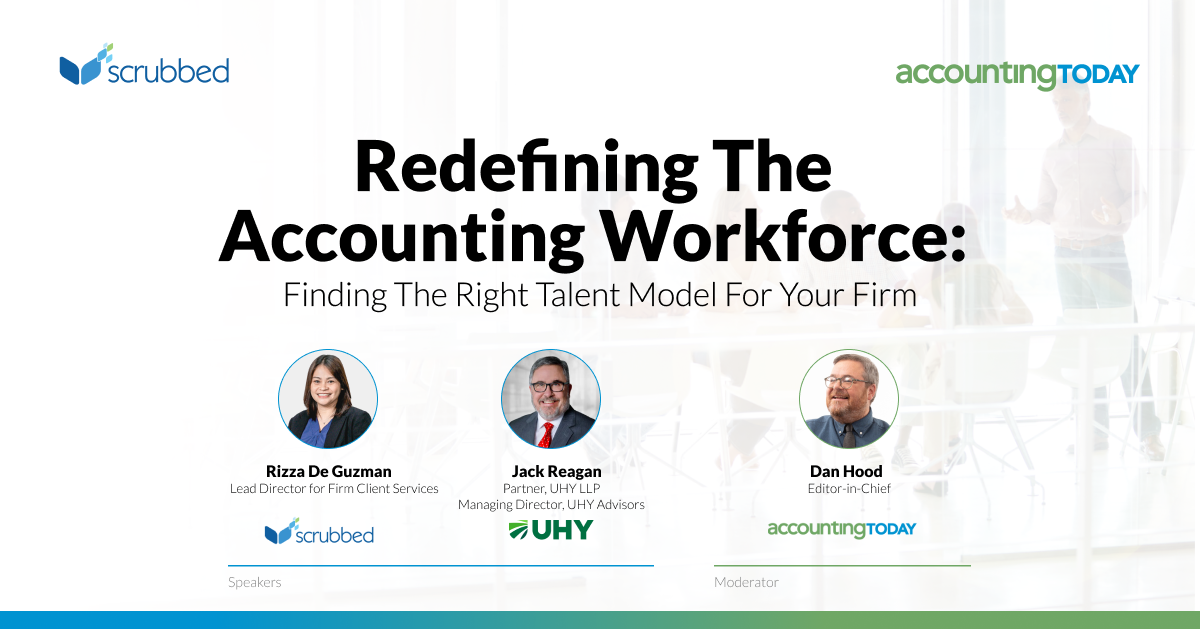
Redefining the Accounting Workforce: Finding the Right Talent Model for Your Firm

Redefining the Accounting Workforce: Finding the Right Talent Model for Your Firm

The accounting profession is currently going through major changes. With talent shortages, shifting client expectations, and growing competition, CPA firms are pressured to rethink how they build and manage their teams.In a recent webinar hosted by Dan Hood, the Editor-in-Chief at Accounting Today, industry experts Rizza De Guzman, the Lead Director for Firm Client Services at Scrubbed, and Jack Reagan, Partner at UHY Advisors, explored the recent shift in the industry and shared their thoughts on how firms can adjust to these challenges. They offered their expertise and strategies to help firms stay competitive and move forward with confidence.Why Firms Are Struggling With the Current Staffing ModelOne of the biggest challenges accounting firms face today is the growing gap between the demand for skilled professionals and the number of people available to do the work.Rizza highlighted several factors that could be causing this shortage, such as the retirement of experienced professionals, the lack of new professionals entering the field, and other industries attracting potential talent with competitive pay and more appealing career paths. As a result, many firms are finding their teams stretched thin. They’ve done all they can with the staff they have, and it’s becoming clear that relying solely on traditional hiring methods isn’t sustainable.Another challenge that Jack mentioned is how client needs have evolved. Work that used to be predictable and ongoing is now more project-based and specialized. So, the skills that you may need now might be different from the skills you need tomorrow. This unpredictability means that firms need to be able to quickly scale their teams up or down, and that kind of agility is hard to achieve with the current staffing model. For Jack, “having that flexibility to match not only the cycle but then the skill set that the project demands is critical.”Building Flexible Teams Through Hybrid and Outsourced StaffingOnce the challenges around talent became clear, the conversation shifted to what firms can do about it. One of the key solutions Rizza discussed was to explore other models, like outsourcing, to create a more agile and scalable workforce. She defines outsourcing as a situation when a company ”fully or partially delegates work to an external partner who becomes an extension of your team.”This kind of model helps firms stay agile and allows them to tap into specialized skills when needed, manage costs more effectively, and adjust quickly as workloads shift. Instead of trying to overload internal teams with work or hire full-time staff for short-term needs, firms can bring in the right expertise at the right time.How to Make Outsourcing Work for Your FirmOne of the most effective ways for firms to stay competitive is by bringing in outside expertise. But making that work takes more than just hiring a third party and hoping for the best. Successful outsourcing starts with clearly defined roles and expectations. Open communication is key, and the relationship needs ongoing attention, not just a one-time setup. Regular check-ins and performance reviews help keep everything on track.Rizza highlights that one of the first steps for companies to start exploring outsourcing or hybrid workforces is by taking a good look at where their team stands today. What skills are missing? What kind of work is piling up? From there, firms can start small. Try a hybrid model, see what works, and adjust as you go.Jack agreed, but noted that for these partnerships to work, firms need to treat outsourced professionals like true team members. According to him, it’s important that firms “…have a say on who is gonna be part of the team,” rather than just being assigned an employee, as this helps set the culture in the workplace.And while working remotely is nothing new, as necessitated by the recent pandemic, trust is another big piece of the puzzle. Beyond scheduled meetings, informal chats and the occasional in-person visit can go a long way in strengthening the connection between the firm and its external team and making the collaboration more effective.One example of this is leveraging fractional CFO services, which allows firms to access high-level financial expertise without the commitment of a full-time hire.Remember, there’s no single formula for success here. Every firm is different. The best approach is one that reflects your client’s needs, internal strengths, and long-term goals.Take Action TodayOne thing became clear throughout the discussion: doing nothing is not an option. For Rizza and Jack, the long-term sustainability, growth, and agility offered by outsourcing talent is the way to go.Competitors are already changing how they staff their teams, and firms that don’t adapt risk falling behind, both in terms of competitiveness and their ability to attract and retain top talent. It’s time for firms to rethink their workforce strategy, focusing on flexibility, building strong partnerships, and using technology along with specialized SaaS accounting expertise to their advantage.How can firms maintain quality control when outsourcing talent?This comes down to choosing the right partner from the start. Be sure to take the time to check their credentials and look into businesses that really understand the industry. Don’t be afraid to ask for references to make sure you find the right fit. Once you’re already working together, regular check-ins and clear communication go a long way in making sure everything stays up to your expectations.Can outsourcing help with seasonal workload spikes?One of the biggest advantages of outsourcing is the flexibility to scale up or scale down depending on your business needs. In fact, a lot of firms may bring in outsourced talent during peak times to help manage the extra workload and avoid overwhelming the internal team.Are outsourcing and hybrid models the same?While outsourcing and hybrid work environments both involve remote work, they are fundamentally different work models. Outsourcing involves bringing in external talent into the team while a hybrid set up has more to do with the location of the internal team. Hybrid can also include external talent, making it a mix of both internal and external resources.How can smaller firms start integrating an outsourced team without overextending the budget?The best thing to do is to start small; you don’t have to hire several people at once. Consider outsourcing time-consuming tasks first, like bookkeeping, to determine whether this staffing model works well for your organization. Over time, you can scale based on performance and necessity.How do I choose the right outsourced accounting provider for my biotech company?Start by identifying your company's accounting needs, such as bookkeeping, financial reporting, ASC 606 compliance, or managing R&D tax credits. Then, evaluate your potential providers based on how much experience they have in the biotech industry and with the unique challenges and regulatory requirements your business faces. Review client testimonials and references from similar biotech companies to get a sense of their track record and expertise. Finally, confirm that their services are scalable to support your business as it grows, and that budgets and service levels are in line with your goals.Connect With ExpertsThe landscape for CPA firms is shifting quickly; with fewer professionals entering the field and client needs becoming more complex, the traditional staffing model is becoming harder to sustain. Firms need more flexibility and access to high-level talent without overloading their internal teams.However, finding the right fit in a sea of talent can be difficult and overwhelming. That’s where Scrubbed comes in. We partner with CPA firms and provide outsourced accounting, finance, and audit services to help clients scale their organization smarter and more efficiently. Ready to explore alternative staffing solutions? Schedule a consultation with our team today and discover how smart outsourced accounting team can benefit you.If you missed the webinar, you can watch it here.

Read More >
Blogs

Demystifying Financial Planning for SaaS Companies

Demystifying Financial Planning for SaaS Companies

At Scrubbed, we have extensive experience helping SaaS businesses achieve financial success. We’ve combined our knowledge and best practices into a clear and actionable 6-part series designed to maximize your profitability.This third installment focuses on financial forecasting and planning strategies tailored to SaaS businesses.Looking for Expert Accounting And Finance Support For Your SaaS Business? Click here!In the dynamic SaaS world, recurring revenue fuels growth, and accurate financial forecasting and planning are vital for steering your venture toward success. Your financial model serves as your compass, guiding you with clear insights into the financial impact of every choice but staring down a blank spreadsheet can feel daunting, so we’ve gathered some best practices to help you craft a model that will support your growth goals.1. Build Your Financial ModelFinancial models are the bedrock of informed decision-making in any business. They provide invaluable insights into the financial impact of your every move, allowing you to move strategically towards growth and profitability. Some of the areas where they provide valuable insight are:Pricing strategies: Models let you test different pricing options and pinpoint the sweet spot between maximizing revenue and attracting customers. You can consider factors like costs, volume, and customer segments to tailor pricing strategies for different user groups.Hiring decisions: By forecasting future needs and analyzing costs versus benefits, models help you build the optimal team size and skillset. This ensures you have the right workforce in place to support your growth plans without overspending.Investment opportunities: Models equip you to assess the financial viability of potential investments, allowing you to prioritize projects, manage risk, and allocate resources strategically. This ensures you invest in opportunities with the highest potential return, maximizing your impact with limited resources.In essence, your financial model is your decision-making compass. It provides direction and clarity, guiding you toward success by revealing the financial implications of your choices. It needs to include:Revenue forecast: The revenue forecast identifies and predicts various income streams, including subscription fees, initial setup charges, usage-based billing, and additional services. It allows you to consider key factors like diverse pricing tiers, anticipated customer acquisition, and potential churn rates. Analyzing historical revenue data is a fundamental approach to revenue forecasting for SaaS businesses. The analysis examines past trends, growth rates, seasonality patterns, and other historical metrics to identify patterns and extrapolate future performance. While historical data is your foundation, you should also integrate market analysis, growth plans, and competitor insights to paint a more complete picture.a. Expense projections: SaaS businesses have unique cost structures, and you need to factor in some specific operating expenses:b. Personnel costs, including development, sales and management teams, and customer support based on hiring plans and salary trends.c. Marketing expenses should be linked to your acquisition strategy and target audience, including paid advertising, content marketing, and affiliate programs.d. Research and development expenses, including salaries and benefits, development tools and software, and prototyping and user research.Technology costs include cloud hosting, data storage, and security tools that are your virtual backbone.Cash flow projections: Cash inflows and outflows should be forecast over a specific period, considering factors such as operating expenses, capital expenditures, and financing activities. Cash flow projections help assess liquidity, financing needs, and overall financial health.Financial goals and metrics: Track and monitor key metrics such as Monthly Recurring Revenue (MRR), Annual Recurring Revenue (ARR), Average Revenue Per User (ARPU), Customer Acquisition Cost (CAC) to Lifetime Value (CLTV) ratio, and Churn Rate. KPIs provide insights into business performance and inform your strategic decision-making.Don’t expect a clear, unchanging path. Regularly revisit and update your financial plan based on your actual performance and market changes. Think of it as a living document, not a rigid script.While many components of a SaaS financial model are similar to models for other types of businesses, there are some key differences. SaaS financial models typically focus on recurring revenue streams, subscription-based pricing models, customer retention, and scalability. Additionally, metrics such as MRR, ARR, CLTV, and churn rate are unique to the SaaS business model and play a significant role in financial planning and analysis.2. Stress-Test your ModelIt’s important to prepare for different scenarios to be ready to weather or take advantage of changes in the market or your customer base.Start by identifying the factors that significantly impact your financial health, such as pricing changes, churn rates, market growth, or competitor actions. Then, simulate various scenarios in your model to see how these key drivers affect your revenue and expenses. This will highlight potential risks and opportunities you might have missed.Use data visualization to clearly and concisely present your sensitivity analysis findings to stakeholders, including charts and graphs to make complex data easily digestible.3. Use Financial Planning to Inform Strategic Decision-MakingYour model should be a trusted advisor, guiding decisions on product development, pricing strategies, expansion plans, and resource allocation. Use it to test different options and find the one that maximizes your return on investment.However, don’t fall into the trap of over-reliance. Be aware of your financial plan’s limitations and biases, and regularly update it with new data and market insights.As the SaaS landscape evolves, so should your model. Regularly review and update your assumptions, projections, and drivers to ensure the model reflects your changing business environment.Tips to Improve Your Financial Planning:While it can sound daunting, strategic financial planning can increase your company’s sustainability, helping you make better decisions and improve your financial health. If you’re just starting out (or you’re looking to get more out of your financial planning), following these steps can help:Start simply and scale gradually. Don’t get bogged down in complexity.Collaborate with your team. Sales, marketing, and operations input create a comprehensive and realistic model.Embrace iteration. Your model is never truly finished. Continuously refine it based on new data and learnings.Stay ahead of the curve. Keep up-to-date with the latest trends in SaaS financial forecasting and planning.Remember, your financial model is a powerful tool, but its effectiveness depends on the data you feed it and the insights you extract from it. By customizing and applying these tips, you can improve the value of your financial planning and forecasting and ultimately create a more sustainable business.

Read More >

Contact Information

SF Bay Area Headquarters
111 Anza Boulevard, Suite 320, Burlingame, CA 94010, United States

Phone: (800)837-5160
Email: [email protected]

"Scrubbed" is the brand name under which Scrubbed Advisory, LLC and Scrubbed Assurance LLP provide professional services. Scrubbed Advisory, LLC and Scrubbed Assurance LLP practice in an alternative practice structure in accordance with the AICPA Code of Professional Conduct and applicable law, regulations, and professional standards. Scrubbed Assurance LLP is a licensed independent CPA firm that provides attest services to its clients, and Scrubbed Advisory, LLC provides tax, finance, and support services to its clients. Scrubbed Advisory, LLC is not a licensed CPA firm.

Copyright © Scrubbed. All rights reserved.