
How BryMar CPAs and Advisors Increased Efficiency and Scalability with Scrubbed
BryMar CPAs and Advisors specialized in financial statement audits for nonprofits and faced a challenge that is common in today's accounting industry: a staffing shortage.

The Challenge
Exploring Outsourcing Options
The Partnership
Leveraging Scrubbed’s Audit Expertise

"Having additional resources has allowed us to meet client deadlines without compromising the quality of our work. Having the right support in place has helped reduce burnout and improve staff retention, giving our people the breathing room they need to do their best work."
Stacey Massa
Partner, UHY LLP / Managing Director, UHY Advisors
The Results
Key Benefits of the Partnership

Increased Efficiency & Scalability
"We can scale our workforce up or down depending on the demands of our workload," Stacey says. "And, because we operate in different time zones, we can continue working around the clock. Clients can upload information in the afternoon, and our Scrubbed team members can access it when they start their day—so by the time our clients start their morning, we already have questions ready. We've been able to provide a significant increase in value to our clients through timely communication."

Strengthened Audit Quality
Scrubbed's team have experience with U.S. and international accounting standards which they put to use in every client engagement. "The professionals we work with are highly qualified and experienced," Stacey says. "They bring a wealth of expertise to our team and strengthens the quality of our audits."

Improved Staff Retention and Work-Life Balance
One of the most significant impacts has been on UHY's internal audit team. "With the help of our Scrubbed partnership, we have improved the retention of our audit staff," Stacey says. "Making sure that we are allocating resources strategically to maintain workload balance throughout the year has helped retain our staff and provide them with a great work-life balance."

Cost-Effective Audit Solutions
The partnership has allowed UHY to manage operational costs more efficiently. "Each year, we're required to implement new accounting and auditing standards, which naturally adds complexity and time to our processes," Stacey explains. "As a result, we're constantly seeking ways to improve efficiency and streamline our audit approach to help offset potential fee increases for our clients. Leveraging outsourced contractors has been an effective way to maintain competitive pricing while still delivering high-quality service—and that's been a significant advantage for us."

Sustainable Business Growth
With support from Scrubbed, UHY has achieved consistent annual growth of 10% in its audit practice. "We've always had ambitious growth strategies, so having the resources in place to both serve our existing clients and onboard new ones has been a tremendous advantage of our partnership with Scrubbed," says Stacey. "Knowing we have dependable support has given us the confidence to take on new opportunities and continue expanding the firm."
Why Scrubbed
Advice for Other CPA Firms Considering Outsourcing

Find a Partner That Aligns with Your Values
"Choose a partner like Scrubbed that aligns with your firm values and has a proven track record."

Start with a Pilot Program
"Start with a pilot program or project and take that opportunity to refine your communication and workflow. Make sure that you are using reliable project management tools."

Overcoming Misconceptions
"To ensure they feel included and informed, Scrubbed team members join internal department meetings so the team stays aligned and engaged."
A Scalable Partnership for Continued Growth
"Scrubbed is a trusted partner that delivers excellence, scalability, and peace of mind in our audit outsourcing. Partnering with Scrubbed and leveraging our expertise has helped UHY to strengthen its audit practice, create better work-life balance and retention for employees and positioned the firm for sustainable growth."
Stacey Massa
Partner, UHY LLP | Managing Director, UHY Advisors
Related Insights
Practical AI: How Scrubbed Professionals Built Solutions for Everyday Bottlenecks
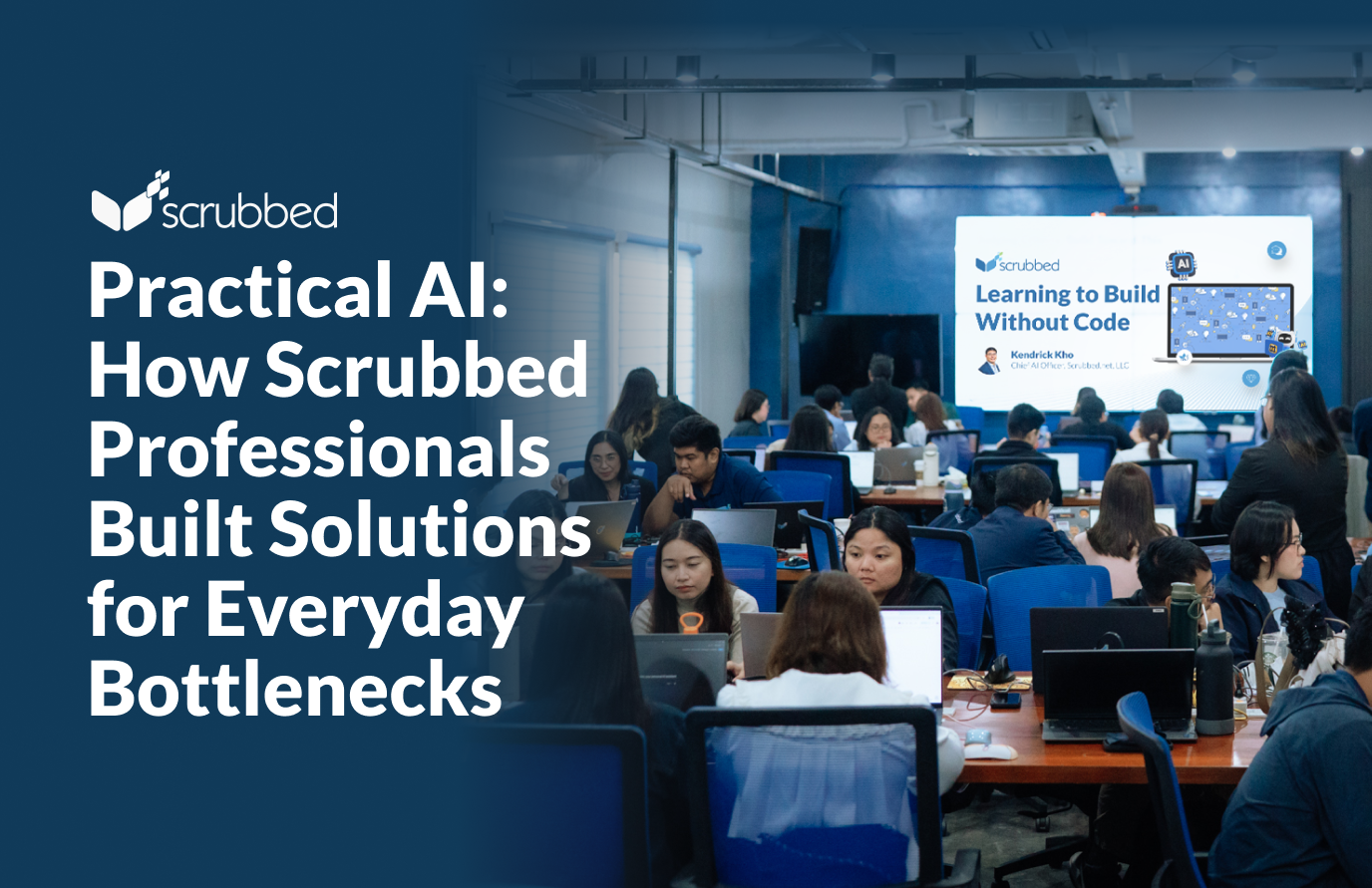
During the inaugural Scrubbed Workflow Hackathon, 66 professionals built practical, secure AI prototypes to resolve the exact operational friction points they face daily. By equipping our teams to systematically address routine bottlenecks, we reduce manual rework and preserve critical bandwidth. On July 15, 2026, 66 Scrubbed professionals gathered on-site at Scrubbed Tech Center for the inaugural Scrubbed Workflow Hackathon. Led by Kendrick Kho , Scrubbed’s Chief AI Officer, the one-day internal learning workshop challenged teams to step away from their standard routines and apply artificial intelligence to the daily friction points they encounter. The objective was highly practical: identify a recurring, time-consuming process or task, and build a working AI solution to fix it. To ensure these proof-of-concept solutions were viable for actual finance operations, teams were evaluated against a rigorous 25-point scoring framework. Judges assessed the prototypes not just on technical capability, but on their ability to solve real workflow pain points and deliver measurable business value. The evaluation placed significant weight on practical implementation, including workflow completeness, scalability, and strict data security guardrails. Ultimately, the strongest innovations were those grounded in real, everyday challenges and designed by people who understand these workflows firsthand. Here is a closer look at the winning prototypes and the teams behind them. 1st Place: FSG Connect Hub Team 3 – Functional Support Group (FSG) Members: Christian Ponce, Carmela Therese Lagman, Ruth Angela Dela Cruz, David Justin Tinio, Catherine Louise Vitug Mentor: Dovie Mayores The Challenge Navigating internal support often involves guesswork. Employees frequently know they need assistance, whether it involves HR, payroll, IT support, or marketing. But they often spend unnecessary time figuring out exactly which department handles the request, leading to multiple redirects and delays. The Solution Team 3 developed the FSG Connect Hub, an AI-powered internal directory and service portal. Instead of requiring employees to memorize organizational structures, the hub was designed to allow users to ask questions naturally. The AI engine guides them directly to the correct team, service, or resource. By consolidating a service catalog and knowledge base into a single, intuitive interface, the tool demonstrated how to eliminate the typical endless loop of internal inquiries. When our professionals spend less time navigating internal administrative hurdles, they preserve their bandwidth for what matters most: accelerating financial execution and maintaining steady, reliable client delivery. Key Takeaway from the Team " Innovation does not always have to come from solving highly complex problems. Sometimes the greatest impact comes from improving everyday experiences and removing friction from common processes. " 2nd Place: Rec 'N' Roll Team 10 – Technical Consultancy and Client Accounting Services (TCCAS) Members: Dexter Ayson, Kimberly Claire Manalili, Christian Dhey Usi, Angel Lou Ruiz Mentor : Kenji Canapi The Challenge Cash reconciliation is a universal pain point in the accounting industry. It requires highly manual, line-by-line checks to match bank transactions with ledger entries, which drains time and increases the likelihood of human error. The Solution Team 10 built Rec 'N' Roll, an AI-powered dual-ledger credit card and bank reconciliation tool. The prototype leverages AI to cross-reference bank feeds with internal records in seconds, effectively handling date mismatches, transposition errors, and fuzzy description matching. To combat task fatigue, the team integrated user-experience features: a "Rec 'N' Roll" mode, a "Cheer Me Up" button, and a mini-game designed to help users maintain focus and accuracy during high-volume reconciliation periods. Key Takeaway from the Team " Workflow automation isn't just about moving data from point A to point B; it's about giving the user the tools, the clear insights, and the mental bandwidth... to make better decisions, faster. " 3rd Place: Financial Package Generator & InvoiceIQ Because the competition was tight, two teams secured 3rd place by tackling different, yet equally critical, data entry bottlenecks. (Note: Because both of these workflows involve parsing sensitive financial information like Trial Balances and invoices, all AI testing and prototyping were conducted within strict, secure data guardrails to protect client confidentiality and ensure safe-use compliance.) Team 6 – Sector Accounting Team 1 (Financial Package Generator) Members: Victorina Leonila Mae Santos, Stephanie Nicolle Vital, Karla Joy Rombaoa, Trisha Nicole Magcalas Mentor : John Christian Donato The Challenge Preparing monthly management reports is notoriously tedious. Exporting massive Trial Balances (TB) from various accounting systems and manually structuring the data in Excel frequently causes system lag, stretching a single client report preparation to 3–4 hours. The Solution The team developed the Financial Package Generator, a two-step AI workflow designed to eliminate manual data formatting entirely. The tool automatically digests raw TB exports and maps them into standardized P&L reporting formats. Furthermore, it utilizes AI to identify Month-over-Month (MoM) variances and to draft preliminary commentary on revenue shifts and expense spikes. This allows preparers to shift their focus from raw data assembly to strategic review and margin evaluation. Key Takeaway from the Team " AI is an accelerator, not a replacement for domain expertise. AI provided the engine to automate data parsing and initial drafting, but our accounting background was vital to guide the prompts, set the logical rules, and validate the output. " Team 13 – Sector Accounting Team 5 (InvoiceIQ) Members: Aimee Marie Lugtu, Thea Louise Mirasol, Hercel Mae Muñoz, Rachelle Ann Romero Mentor : Kris Santiago The Challenge Finance teams spend countless hours manually reading PDF invoices, extracting dates and amounts, and looking up General Ledger (GL) codes. Traditional OCR systems frequently struggle with complex layouts and contextual mapping. The Solution The team mocked up InvoiceIQ, an AI-powered document parsing and bookkeeping tool. Instead of just reading text, the AI was programmed to understand the business purpose behind each line item, extracting verbatim descriptions and intelligently mapping them directly to a company’s Chart of Accounts to generate structured, Google Sheets–ready CSV reports. Key Takeaway from the Team " We learned that clear problem definition and precise instructions are far more critical than complex code. Building effective AI solutions is about acting as an architect—giving the model unambiguous layout constraints, strict field boundaries, and concise context yields far better results than trying to over-engineer a complex system. " Looking Forward The first Scrubbed AI Workflow Hackathon proved a vital operational theory for modern businesses: the most effective technological advancements are those driven by user-centric design. For Kendrick Kho, who led the event, it was a test of what happens when finance teams are asked to cultivate brand-new technical skills with minimal hands-on coaching. The results far exceeded expectations, successfully hitting three major operational outcomes: producing at least one prototype ready for official development by the tech team, proving to Scrubbed leadership that this training yields tangible ROI, and sparking a new culture of building among the staff. So, what comes next? The vision for the Hackathon program is to expand both its reach and complexity. Across the organization, the goal is to cultivate "citizen developers" at every level and within every group. While this inaugural event focused on the fundamentals of building for non-coders, future iterations will shift toward "Building AI for Non-Coders"—incorporating more advanced technologies into exactly what our teams are capable of creating. By equipping professionals with AI tools to solve the exact bottlenecks they face, Scrubbed aims to drastically reduce manual labor, minimize errors, and create more bandwidth for high-level financial analysis. Key Takeaways: When finance starts consuming more time than it should, it is usually a sign the execution layer needs support, which our professionals addressed by proactively building AI prototypes to resolve their exact daily bottlenecks. Because strong execution should reduce pressure rather than add to it, all AI testing was conducted within strict data guardrails to protect client confidentiality and maintain operational rigor. Recognizing that data is only as reliable as the system and team that generates it, these AI accelerators rely entirely on our professionals' domain expertise to guide the rules and validate the outputs. By systematically automating routine reconciliation and internal routing, our teams reduce manual rework and give leaders back time, focus, and confidence.
How to Scale a Fractional CFO Practice: Infrastructure, AI, and Execution
Fractional CFOs scale by separating strategy from daily execution. At the CFO Leadership Conference in Boston, panelists outlined the model: a three-part team structure, AI tools for repetitive analysis, and strict scope boundaries. The common thread is that strategic capacity depends on reliable accounting operations underneath it. Fractional CFOs operate in a fundamentally different model, balancing multiple clients and shifting priorities without the benefit of deep organizational embedding. You are hired to provide altitude, clarity, and rapid impact. But when a client lacks a mature finance operation, that executive focus is quickly consumed by operational cleanup. This exact tension took center stage at the CFO Leadership Conference in Boston. During our morning panel discussion, The Multi-Business Executive: How Fractional CFOs Scale Leadership Across Clients , moderated by Scrubbed’s Accounting Director Arian David, Triangle Coffee founder and fractional CFO Ottavio Siani and Scrubbed’s CFO Aira Pineda detailed how fractional CFOs build capacity to avoid this operational trap. They mapped out the real-world infrastructure and AI practices required to support multiple fast-moving client environments. Here are the operational realities shared in the room. The Infrastructure Blueprint for Scaling a Fractional CFO Practice A primary challenge for scaling organizations is the gap between strategic desires and foundational accuracy. Volume increases faster than structure, and founders frequently bottleneck their own operations by micromanaging the finance function. As Aira shared with the room, stepping into a fractional role often means untangling founder-led accounting and directly telling the CEO, "you're not supposed to do this". Once leaders step back from the daily execution, "suddenly they have time" to actually focus on growing their business. Successful practitioners build a deliberate team architecture to handle the volume. To build a sustainable infrastructure, Ottavio explained that a fractional CFO setup requires three key elements: A fractional CFO to provide strategic direction. A trusted internal employee to manage sensitive operational context. An external accounting firm to run the daily numbers. This structure prevents the CFO from becoming the operational bottleneck. Read: Are Fractional CFOs the Future for Growing Companies? Navigating Risk in Founder-Led Environments The most pointed friction in a fractional role often comes from enforcing structure. During the session, an audience member challenged the panel on how to balance strict risk controls with the commercial reality of working for independent founders who operate as the "gods of their own businesses". Aira addressed this tension directly, clarifying that operational controls and commercial growth do not have to collide. "I don't think it's contradictory, to be honest. I think it's complementary," she explained. "I think you make better decisions as a CFO, having kind of just at the back of your mind that risk mindset." Taking calculated risks is necessary to create shareholder value. However, a fractional CFO can only support that aggressive growth when the foundational accounting operations are secure enough to absorb the complexity. Building Fractional CFO Capacity with AI Tools Technology accelerates this architecture when carefully managed. Ottavio shared how he uses Claude to generate monthly financial statement analyses based on tested templates, reducing a repetitive task to minutes. Arian detailed using Claude to abstract private equity contracts, while Aira highlighted using NotebookLM to summarize 50-page forensic documents. However, systems create results, but human professionals must validate them. Aira illustrated the danger of false confidence by testing a complex revenue recognition issue across Claude, Gemini, and ChatGPT. Although all three models provided the exact same answer, they failed the final human review when "A big CPA firm comes and says, no, that's not the accounting treatment." Designing Aligned Execution and Preventing Scope Creep Growth adds complexity. Strong execution ensures that complexity remains manageable. When fractional leaders possess a reliable accounting layer, closes become predictable and strategic conversations gain traction. Without this layer, scope creep inevitably takes over. "I think a challenge with being a fractional CFO is having to limit your scope, right?" Ottavio noted. "I typically dedicate like a day a week, and I need to keep myself from spending too much time outside of the original scope that we, we agreed upon, so that I can make sure that I'm kind of meeting all my clients". Key Takeaways: A sustainable fractional CFO practice separates strategy from execution: the CFO, a trusted internal employee, and an external accounting team each hold a distinct role. Founders bottleneck their own operations by staying in the daily accounting. Helping them step back frees time for growth. Risk mindset and commercial growth are complementary. Calculated risks require stable accounting operations underneath them. AI tools like Claude and NotebookLM compress repetitive analysis from weeks to minutes, but experienced professionals must verify every output against source documents. Scope discipline holds only when a reliable accounting layer runs the day-to-day work. About the Panelists Arian David | Accounting Director, Scrubbed Arian serves as the Accounting Director for Retail and Distribution at Scrubbed. She brings over 12 years of specialized execution experience managing complex accounting operations across the distribution, e-commerce, and retail sectors. Aira Pineda | CFO, Scrubbed Aira directs financial strategy and operations as the Chief Financial Officer at Scrubbed. She brings over a decade of hands-on experience operating as a fractional CFO for small to medium-sized enterprises. Ottavio Siani | Fractional CFO & Founder, Triangle Coffee Ottavio is the founder of Triangle Coffee, a multi-location café business operating in Boston and Washington, D.C. As an active fractional CFO, he advises a portfolio of clients, including Hon, CN Naturals, and Port of Mocha, on building and restructuring finance teams.
Scaling Your Finance Function: When to Hire a Fractional Finance Team

As noted at the CFO Leadership Conference, volume often outpaces structure, quietly straining finance execution. To scale capacity, growing companies can integrate partner-led finance teams anchored by an internal liaison. By taking responsibility for this daily execution, these professionals restore predictable reporting and give leaders their focus back. For many middle-market companies, there is a distinct moment when the finance function shifts from supporting the business to struggling to keep up. Transaction volume increases. Deadlines tighten. The close starts taking longer, and reviews feel rushed. Internal teams spend more time fixing issues than moving forward. During our afternoon panel at the CFO Leadership Conference in Boston, How CFOs Use Fractional Talent to Scale the Finance Function, Triangle Coffee founder and Fractional CFO Ottavio Siani, Scrubbed’s CFO Aira Pineda, and Accounting Director Arian David unpacked a critical reality for growing organizations. Building a finance organization that can flex with the business requires deliberate structural choices. Here is a closer look at how to architect that structure by integrating partner-led finance teams. When to Hire: The 160-Hour Threshold Prompted by Arian to define the trigger point for bringing on fractional help, Scrubbed CFO Aira Pineda highlighted a practical threshold: evaluating whether a role truly demands a full-time, 160-hour-per-month commitment. This evaluation is a cornerstone strategy for companies navigating new growth stages. Fast-moving projects often require immediate, specialized execution. " Sometimes I need a project very quickly done, and I need someone experienced already ," Aira explained. " I don't want to go through the headache [of hiring full-time]. A fractional team just makes it faster for me. " Partner-led finance teams offer a cost-effective alternative to full-time hiring, providing the exact capacity needed without the overhead of onboarding. They take responsibility for the work behind your numbers, allowing the internal team to focus on strategic growth. Full-Time vs. Fractional Finance Team Comparison Feature Full-Time Finance Hire Fractional Finance Team Capacity Commitment Onboarding & Ramp Time Billing Model Specialization 160+ hours/month (Fixed) 60–90 days Annual Salary + Benefits + Equity Generalist execution Flexible / Scalable capacity Immediate deployment Flat Monthly Retainer Multi-disciplinary experts Best Used For Continuous daily operations Fast growth, specialized projects, scaling The Architecture of Integration: The "Bridge" Person A fractional finance team cannot work effectively in isolation. Fractional CFO Ottavio Siani, who systematically leverages these exact structures across multiple ventures to scale his own executive leadership, identified a critical requirement for successful integration: designating an internal "bridge" person. This full-time employee acts as the primary point of contact between the company and the fractional team. They do not need deep accounting expertise. Their value lies in providing internal context and answering day-to-day questions while the company operates. When communication paths and responsibilities are clearly defined, fractional professionals can operate as an extension of the internal finance function rather than as a disconnected outside vendor. Best Practices for Integrating a Fractional Finance Team A fractional finance function only succeeds when it is treated as an integrated part of the business. The Standard of Accuracy : Accuracy is a non-negotiable requirement. As Aira noted during the panel discussion, "We work with numbers, and accuracy matters. If we end up, as a CFO, presenting a wrong number to our board... that is grounds for termination." Match the Billing Model to the Engagement : While hourly billing is common for initial testing, Ottavio strongly advocated for flat-fee models to maintain strategic alignment. "The problem with hourly billing is the company ends up being pretty precious with your time, and you'll often be held out of important meetings," Ottavio noted. "Retainer-based [billing] leads to a much healthier relationship." Demand Verified Data Controls (SOC 2) : Handing over financial workflows requires absolute trust. Middle market businesses must partner with CPA firms that maintain rigorous, verified controls, such as a SOC 2 audit, to guarantee data security. Scaling with Technology and Distributed Talent A fractional model also allows companies to broaden the talent pool available to the finance function. Distributed teams can provide access to specialized skills, additional coverage, and capacity that adjusts as the business changes. However, location alone does not determine whether the model will work. Quality depends on how the team is managed, how communication is structured, how the work is reviewed, and whether the provider understands the company’s accounting requirements and operating environment. Technology can further expand the team’s capacity. During the panel, Aira described analytics teams using AI-assisted tools to write Python code and process data more efficiently than manual Excel workflows would allow. The value is not simply that the technology moves faster. It reduces repetitive work, so finance professionals can spend more time reviewing outputs, investigating exceptions, and applying judgment. Technology can accelerate the work. Accountability remains human. Building the Right Finance Structure Fractional support works best when it solves a defined structural need. The company must still establish internal ownership. Responsibilities must be clear. Workflows must be documented. Review standards must be understood by both teams. When those elements are in place, a fractional finance team can help the business: Add capacity without immediately adding permanent headcount. Access specialized expertise. Support periods of rapid growth or transition. Make the close and reporting process more predictable. Reduce pressure on internal finance leaders. Create a stronger foundation for future hiring. The objective is not to outsource responsibility. It is to build a finance function with the right capacity, expertise, and structure for the company’s current stage of growth. About the Panelists Arian David | Accounting Director, Scrubbed Arian serves as the Accounting Director for Retail and Distribution at Scrubbed. She brings over 12 years of specialized execution experience managing complex accounting operations across the distribution, e-commerce, and retail sectors. Aira Pineda | CFO, Scrubbed Aira directs financial strategy and operations as the Chief Financial Officer at Scrubbed. She brings over a decade of hands-on experience operating as a fractional CFO for small to medium-sized enterprises. Ottavio Siani | Fractional CFO & Founder, Triangle Coffee Ottavio is the founder of Triangle Coffee, a multi-location café business operating in Boston and Washington, D.C. As an active fractional CFO, he advises a portfolio of clients, including Hon, CN Naturals, and Port of Mocha, on building and restructuring finance teams.