Introducing the Context Nature App: Simplifying Energy & Manufacturing Tax Incentives for Businesses

John Mark Respeto

Sustainability and Quality Director

Introducing the Context Nature App: Simplifying Energy & Manufacturing Tax Incentives for Businesses

How businesses can unlock the full potential of the Inflation Reduction Act with intelligent automation

As businesses and tax professionals navigate the evolving landscape of sustainability and decarbonization, one critical opportunity is often left on the table: energy & manufacturing tax incentives under the Inflation Reduction Act (IRA). Despite the significant savings these incentives represent, many companies struggle to discover, qualify for, and manage them due to the complexity of requirements and documentation.

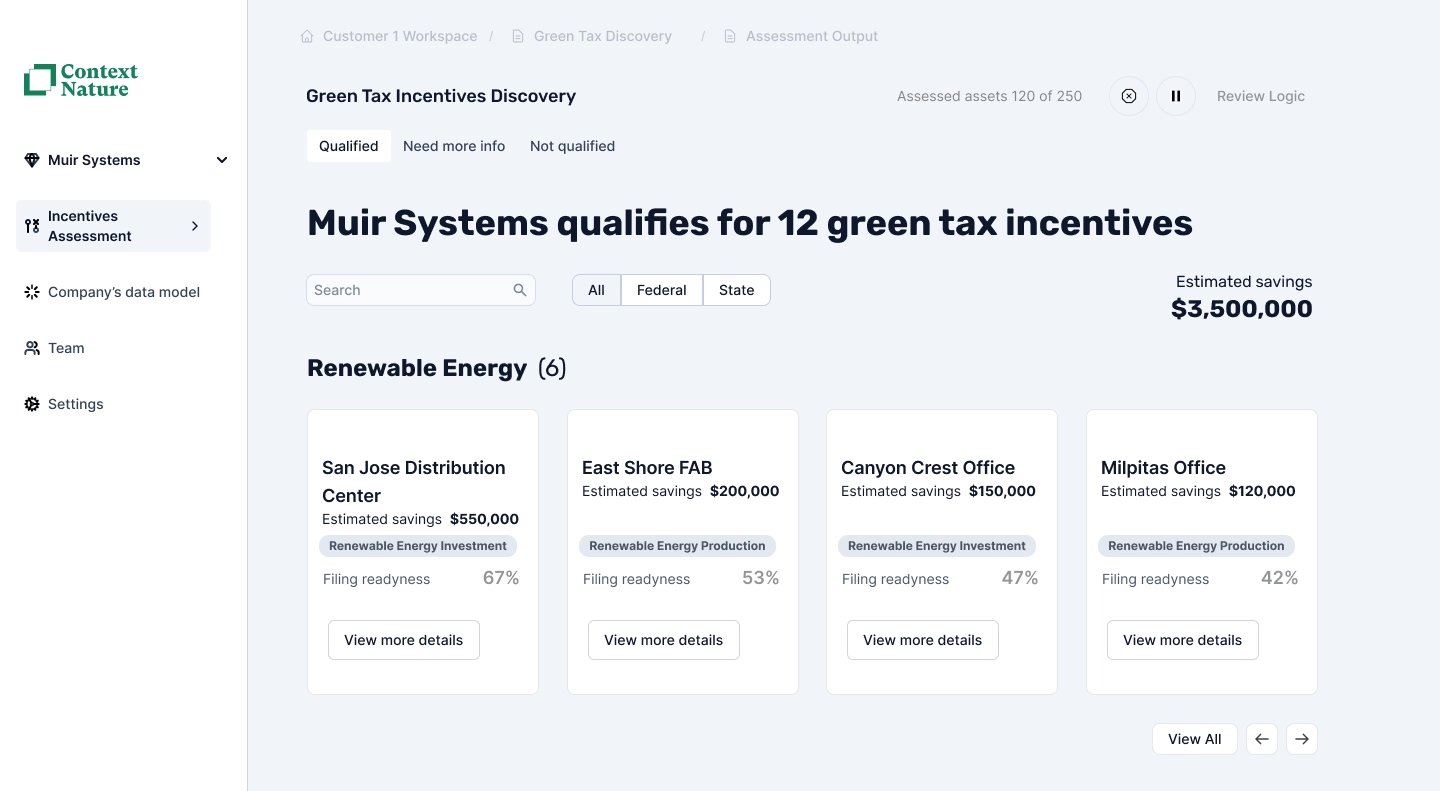
That’s where the Context Nature App comes in—a new AI-driven tool currently in its pilot phase and developed in partnership with Scrubbed. At its core, the app helps accounting teams automate the discovery, qualification, and reporting of these tax credits and incentives, turning a time-consuming challenge into a streamlined opportunity. It also complements broader ESG reporting services by helping businesses align tax strategies with their sustainability goals.


Blog image

Why Context Nature App Matters

Problem: Green tax credits such as those for energy efficiency and advanced manufacturing are valuable, but notoriously difficult to manage. Tax professionals often face:
  • Complex qualification criteria
  • Time-intensive document collection
  • Frequent changes in regulations
  • Limited internal bandwidth to fully explore these opportunities

Solution: The Context Nature App eliminates these barriers with automation and intelligence. Designed for tax accountants and forward-thinking businesses, the app simplifies the end-to-end process of identifying and qualifying for credits, saving time, increasing compliance, and boosting bottom-line results.

Key Features That Set It Apart

Unlike traditional methods or manual spreadsheets, the Context Nature App offers:
  • AI-Powered Discovery: Once tax returns and source documents are uploaded, the app identifies applicable green tax incentives automatically.
  • Customizable Questionnaires: Secure, credit-specific forms make collecting client data fast and accurate.
  • Smart Matching and Modeling: The app evaluates incentive opportunities based on customer data and produces reports with actionable insights.
  • Streamlined Document Collection: A centralized, secure space for sensitive files reduces back-and-forths and delays.
  • Form Drafting Assistance: Saves even more time by helping teams draft necessary tax forms with ease.

“The biggest impact for early users is time saved and the substantial financial value these incentives provide,” said Esfer John Pamintuan, Scrubbed Professional Consultant for the Context Nature App.

The User Journey: From Tax Return to Savings Insight

Here’s how a typical user interacts with the app:
1. Create or Import Client Profiles
2. Collect Information Using Custom Questionnaires
3. Upload Tax Documents Securely
4. AI Analyzes and Matches Data to Incentives
5. Receive Tailored Reports Highlighting Potential Tax Credit Opportunities
This seamless flow ensures tax teams spend less time researching and more time delivering value to clients.

What’s Next for Context Nature?

Backed by a $150,000 seed fund from the Entrepreneurs Roundtable Accelerator, Context Nature has ambitious plans to scale:
  • Expanded Incentive Coverage: Automation for R&D tax credits is on the roadmap.
  • Integrations: The app will soon connect with popular accounting and financial software for a more unified workflow.
  • Continuous Policy Updates: The AI models and incentive databases are designed to evolve with regulatory changes, ensuring up-to-date compliance.

“Our goal is to help businesses decarbonize and save money, without adding complexity to their tax process,” shared Sylvia Vaquer from Context Nature.

Ready to Be Part of the Future of Green Tax Planning?

The Context Nature App is currently in its pilot phase, and businesses or tax professionals interested in early access can join the waitlist here.

Scrubbed is proud to partner with Context Nature in supporting innovation at the intersection of technology, sustainability, and tax strategy.

Get Involved

Join the Waitlist –  Be among the first to experience the app’s capabilities.
Contact Scrubbed – Explore how we can support your sustainability and tax planning goals.

About Scrubbed

Scrubbed is a global professional services firm providing accounting, biotech accounting services, fractional CFO services, and advisory solutions that help businesses grow with confidence. From technology partnerships to innovative tax planning, we’re committed to delivering excellence, backed by a human touch.

How Scrubbed can Help


Ready to simplify green tax planning? Contact Scrubbed today to discover how we can help you identify tax incentives, improve compliance, and accelerate your sustainability goals.

CONTACT US
How Scrubbed can Help

Related Content

Blogs

Tax, Insurance and Cash Flow: Finance Lessons for Multi-Property Real Estate Portfolios
Tax, Insurance and Cash Flow: Finance Lessons for Multi-Property Real Estate Portfolios

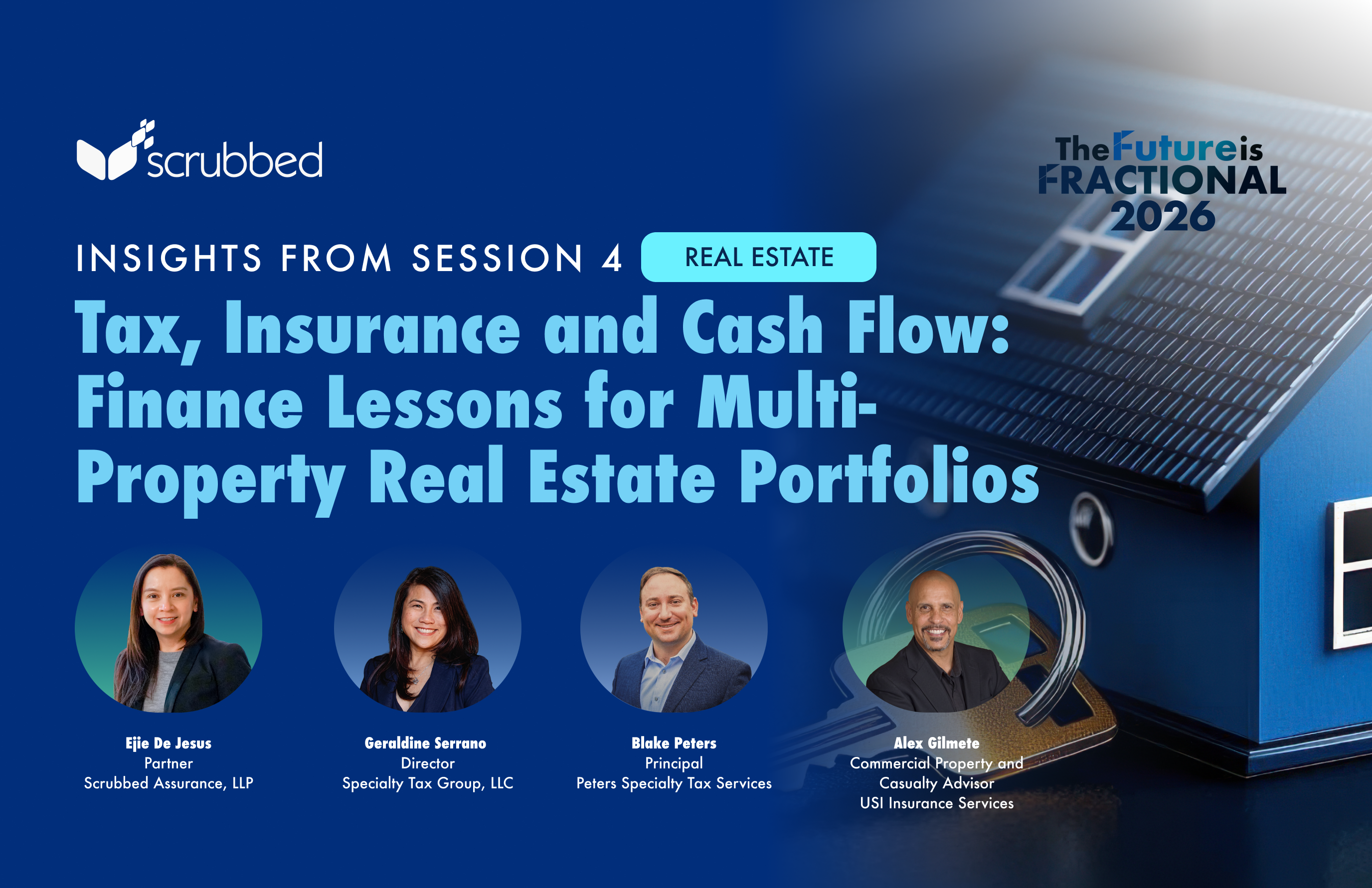
The Real Estate Spotlight was one of three industry spotlights at The Future Is Fractional 2026, hosted by Scrubbed on September 24, 2026. Scrubbed partner Ejie De Jesus moderated a conversation with Geraldine Serrano, Director at Specialty Tax Group; Alex Gilmete, commercial property and casualty advisor at USI Insurance Services; and Blake Peters, founder and principal of Peters Specialty Tax Services. They covered cost segregation and bonus depreciation, R&D tax credits for real estate, insurance availability and replacement costs, and shared and layered coverage for portfolios. The short version: bring tax and insurance specialists in before decisions are made, check that your coverage reflects today’s replacement costs, and look beyond a general CPA for specialized incentives. Real estate finance is rarely one entity with one set of books. It’s multiple properties, multiple entities and often multiple jurisdictions, in a tax and risk landscape that keeps shifting. At The Future Is Fractional 2026, a virtual conference hosted by finance and accounting advisory firm Scrubbed on September 24, 2026, Session 4 split into three industry breakouts running at the same time: real estate, nonprofit and technology. In the real estate track, Scrubbed partner Ejie De Jesus brought together three specialists in cost segregation, tax incentives and commercial insurance to talk about the strategies owners most often miss. Key Takeaways: Timing is the biggest gap. Tax incentives and cost segregation are often considered after key decisions are made, when the options have already narrowed. Cost segregation accelerates depreciation. Splitting a building into shorter-lived components lets owners take larger deductions sooner, and 100% bonus depreciation, restored by 2025 tax law, can pull those deductions into year one. R&D credits reach further than most owners think. Engineering, structural and energy design work on a property may qualify. Insurance has changed fast. Some properties can’t get standard A-rated coverage, and replacement costs may have outrun policy limits. Portfolios can share coverage. A shared primary layer with excess layers on top can cost less than insuring every property to full value. Bring in specialists early, keep the decisions. Specialist advisors fill in the picture; the owner makes the call. Meet the Panel Ejie De Jesus (moderator): Partner, Scrubbed. Geraldine Serrano: Director, Specialty Tax Group, known as the “Cost Seg Queen,” specializing in cost segregation and tax strategy for real estate investors.  Alex Gilmete : Commercial Property and Casualty Advisor, USI Insurance Services, helping businesses manage and transfer risk.  Blake Peters : Founder and Principal, Peters Specialty Tax Services, specializing in R&D tax credits and other incentive programs. Timing and Visibility Gaps in Portfolio Finance Awareness comes too late. Blake Peters said the largest gap he sees is awareness. Incentives such as investment tax credits, R&D credits and energy efficiency deductions are buried in the tax code, and when owners do know about them, they’re often “looked at a little too late in the process.” Evaluating them at the start of a project can improve returns, help finance it and give investors clearer visibility. Risk has shifted fast.  Alex Gilmete said insurance has changed dramatically in just a few years. Supply chain issues, tariffs and, in California, wildfire risk have reshaped how carriers, lenders and investors view a property, and how much liability an owner carries. Property risk and insurance volatility Standard carriers, non-admitted carriers and the FAIR Plan Some properties can no longer be insured by standard A-rated carriers, Gilmete said. Location, fire exposure and crime all affect what carriers will take on. Coverage Route What The Panel Described   Standard A-rated carriers Increasingly selective; may decline older or un-upgraded buildings   Non-admitted carriers An option when standard carriers decline, at higher cost   California FAIR Plan A fallback in California when other options aren’t available That’s why Gilmete talks with investors while they’re still comparing properties. What a carrier thinks of a location affects rates and coinsurance terms (the clause that penalizes owners who insure for less than full value). He said many investors are looking at Nevada as an alternative to California, while Texas carries its own fire and flood challenges. Are you really fully insured? Gilmete warned that long-time investors may not realize how tariffs and supply chain costs have raised replacement values. A building insured for $10 million might now cost $14 million to $15 million to rebuild after a total loss, leaving the owner to cover the gap. Shared and layered coverage for portfolios Rising premiums reduce net operating income, and lower NOI lowers property value. For portfolios, Gilmete described a shared and layered approach. Take 10 properties worth $10 million each. The owner may not need $100 million of primary coverage, since a total loss on every property in one policy period is unlikely unless they share a fire or flood zone. Instead, a shared primary layer, perhaps $30 million, covers all 10, with excess layers stacked on top from different carriers. Each higher layer is less likely to be used, so it costs less per dollar of coverage. Insurance review checklist, drawn from the panel Does the policy limit reflect today’s replacement cost, not the original value? How old are the roof, HVAC, plumbing and electrical systems, and what fire suppression and egress are in place? Is everything disclosed to the carrier accurate? Carriers may inspect, and can cancel if it isn’t. How do the location’s fire, flood and crime exposure affect which carriers will quote? For a portfolio, would a shared and layered structure fit your risk tolerance? Cost Segregation: Accelerating Depreciation for Cash Flow What is cost segregation? Cost segregation is a tax strategy that separates a building’s components into shorter depreciation periods. Instead of depreciating the whole property over 27.5 years (residential rental) or 39 years (commercial), owners can deduct shorter-lived components faster, lowering current tax liability and increasing cash flow. The Lego analogy Serrano’s explanation: picture a house built of Legos. The IRS treats a residential rental as wearing out over 27.5 years. But not every piece lasts that long. Carpet, floor coverings, cabinets and countertops are five-year pieces. Driveways and landscaping are 15-year pieces. A cost segregation study takes the house apart and sorts the shorter-lived pieces into their own buckets. Bonus depreciation under the One Big Beautiful Bill Act The One Big Beautiful Bill Act, signed in July 2025, restored 100% bonus depreciation and made it permanent for qualifying property acquired after January 19, 2025. Combined with cost segregation, that lets owners deduct the full cost of those shorter-lived components in the first year. Serrano told the story of a client she called “Mr. I Hate the IRS,” who was about to mail a $100,000 check to the IRS. Cost segregation studies on his 12 Denver-area rentals eliminated the liability. His CPA hadn’t recommended it because she believed it applied only to commercial property. Results depend on the owner's situation. Rules on passive rental losses and depreciation recapture when a property is sold can change the math. She also pointed to manufacturers. A newer provision allows qualifying manufacturing buildings to be fully expensed rather than depreciated, so those owners may not need a cost segregation study at all. Before or after construction? Before, Serrano said. “The sooner we talk about the project, the better.” She cited an owner who built an Oakland office from shipping containers and welded them together because it was cheaper. Bolting them, so they could be taken apart, might have qualified far more of the building as five-year property. That may not have changed his choice, but he would have made it knowing the tax impact. He also demolished an existing structure without his CPA setting up a general asset account, and missed a tax benefit as a result. For cost segregation, she noted, what matters is when a building was bought and placed in service, not its age. Insurers look at age. Planning has to account for both. R&D Tax Credits for Real Estate and Construction Peters called the R&D credit “one of the worst named credits out there.” For tax purposes, it can cover work involving analysis, alternatives and design, not just scientists and software. In real estate, that can include: Engineers evaluating structural methods depending on contract terms HVAC and energy design to meet efficiency or LEED requirements Custom engineering to improve a building’s performance Manufacturers building capital-intensive facilities Investment in AI, built in-house or subcontracted, across industries His advice: don’t ask “do we do R&D?” Ask where the money and effort are going. What changed recently. From 2022 through 2024, research expenses had to be spread over five years or more instead of deducted right away, research expenses had to be amortized rather than deducted right away, which made the credit less attractive. Peters said the One Big Beautiful Bill Act fixed that going forward and, for some businesses, retroactively. Companies that stopped claiming the credit should reassess. Cost segregation vs. the R&D tax credit. Header Header R&D Tax Credit What it does Accelerates deductions, which lower taxable income A credit that reduces the tax owed dollar for dollar What can qualify, per the panel Shorter-lived components: flooring, cabinets, countertops, driveways, landscaping Structural engineering, HVAC and energy design, custom building systems, capital-intensive facilities When to look Before construction or acquisition decisions At the front end of a project Overlap - Custom HVAC and energy work often touch both, so owners can address them together Capital Improvements: Tax benefit and Insurability Do roof or HVAC upgrades lower insurance costs? Not directly, Gilmete said. But major carriers may refuse to quote older buildings that haven’t been upgraded. He described a Santa Clara property where the roof had to be replaced before A-rated carriers would consider it. On the tax side, Peters said custom engineering for HVAC or energy performance can qualify for the R&D credit. Keep the Decisions, Bring in the Experts The panel’s closing advice was about what to keep in-house. General CPAs may be excellent but lack this level of specialization. Serrano offers clients a second review by another CPA when their current CPA is unfamiliar with cost segregation. Bringing in specialists early to review tax incentives, cost segregation, contracts, insurance policies and risk tolerance lets the owner decide with a full picture. As Gilmete put it, the experts “fill out your dashboard, and then the owner gets to make decisions based on that dashboard.” This session is part of TFIF 2026.  To see how planning connects to talent, AI and team design, read, read Own the Core, Access the Rest: What The Future is Fractional (TFIF) 2026 Revealed About How Finance Teams Are Being Rebuilt   what finance leaders are rethinking about talent, AI and team structure.

Read More >
Blogs

Decoding the Digital Ledger: Navigating FASB’s New Standards for Crypto Assets and Intangibles (ASU 2023-08)

Decoding the Digital Ledger: Navigating FASB’s New Standards for Crypto Assets and Intangibles (ASU 2023-08)

In a groundbreaking move reflecting the swift evolution of the financial landscape, the Financial Accounting Standards Board (FASB) has taken a significant step with the release of the final Accounting Standards Update (ASU) 2023-08 titled “Accounting for and Disclosure of Crypto Assets.” This authoritative guidance specifically addresses Crypto Assets within the Intangibles—Goodwill and Other category, marking a crucial advance in establishing standardized accounting practices for these assets. Bridging the Gap: A Brief Background The rise of digital assets, from cryptocurrencies like Bitcoin and Ethereum to unique non-fungible tokens (NFTs), has challenged traditional accounting norms. Without specific Generally Accepted Accounting Principles (GAAP) guidance, accounting professionals relied on analogies and interpretations, resulting in a diverse patchwork of practices.  Our article “Rise of Digital Assets in Business” explored the evolving landscape, highlighting the AICPA Practice Aid titled “Accounting for and Auditing of Digital Assets” as a crucial guide within the constraints of the existing accounting framework. We are witnessing a groundbreaking shift with the finalized FASB’s ASU on Crypto Assets, effective December 15, 2024, which will change how the world sees crypto assets. Who Will Be Affected? The new ASU applies to a wider range of entities than you might think. Any entity holding crypto assets that meet specific criteria will be impacted. These criteria include: Meet the definition of an intangible asset. Do not grant enforceable rights or claims on underlying goods, services, or assets. Exist on a blockchain-based distributed ledger or similar technology. Are secured using cryptography. Are fungible. Are not created or issued by the reporting entity or its related parties. Crypto assets falling within these criteria must be measured at fair value, with changes in value recognized in their income statement each reporting period. Moreover, transaction costs incurred in acquiring these assets, such as commissions and related fees, will be expensed unless other industry-specific guidance dictates otherwise. A Closer Look at the New ASU  Mandating Relevance: Fair Value Measurement  The update mandates the fair value measurement of crypto assets at each reporting period. This focus on fair value measurement stems from the belief that fair value offers investors more relevant information about the assets’ sale value and changes in that value. The Board rejected historical cost and net realizable value as alternatives due to limitations in reflecting downward and upward price movements. The existing guidance in Topic 820 was deemed sufficient for fair value measurement, given its applicability to other assets and current use by reporting entities. As financial reporting evolves, organizations offering ESG reporting services may also need to consider how such valuation updates intersect with broader transparency and sustainability disclosure requirements. Beyond Annual Assessment: Recognizing Both Gains and Losses Unlike the existing ASC 350 model, which mandates an annual assessment of crypto asset value that only recognizes gains upon sale, the update embraces a more dynamic approach. The new method captures both negative and positive market movements, addressing longstanding concerns about the traditional model’s failure to reflect the true and current economic nature of crypto assets at each reporting period. As well as providing a more comprehensive understanding of the underlying economics and an entity’s financial position, the shift signifies a progressive step toward a more responsive and accurate representation of the financial impact of market fluctuations on digital holdings. Enhancing Transparency: Disclosure Requirements The ASU prioritizes transparency, incorporating detailed disclosure requirements for asset categorization, impairment considerations, and, notably, the separate presentation of crypto assets from other intangible assets in the statement of financial position. Entities must disclose the following for annual and interim reporting periods: 1. Details of significant and less significant crypto asset holdings, including name, cost basis, fair value, and quantity. 2. Information on restricted crypto assets, covering fair value, nature, the remaining duration of restrictions, and circumstances for the potential lapse. For annual reporting periods, additional disclosures are required: 1. A roll forward of crypto asset activity, including additions, dispositions, gains, and losses. Specify the income statement line item for unrecognized gains and losses if not presented separately. 2. Detail dispositions of crypto assets, including sale price, cost basis difference, and relevant activities. 3. The method used to determine the cost basis of crypto assets. These changes enhance transparency and understanding of crypto asset holdings, ensuring comprehensive disclosure for annual and interim reporting periods. Nevertheless, entities immediately converting crypto assets received as noncash consideration or contributions into cash are exempt from the above annual additional disclosures. The Countdown Begins: Timeline and Adoption The final standard takes effect for all entities in reporting periods beginning after December 15, 2024, including interim periods within those fiscal years. Early adoption is permitted, allowing entities to embrace the changes ahead of the mandated timeline. However, early adopters must use a modified retrospective approach, requiring recording a cumulative effect adjustment to equity (or net assets) from the commencement of the adoption year. What Lies Ahead: Implications for the Future The issuance of the finalized ASU 2023-08 represents a proactive response to the growing significance of crypto assets in today’s financial landscape. The finalized ASU is a significant milestone in our journey toward a standardized and transparent future for crypto asset accounting, offering consistency in financial reporting across diverse industries engaged with crypto assets. The FASB’s move acknowledges the need for accounting standards that keep pace with technological advancements and reflect the realities of the modern economy. Stay tuned for further developments. How Scrubbed Can Help You? Navigating the opportunities and challenges of crypto assets demands expertise, whether you’re an individual investor or a business. At Scrubbed, our comprehensive range of services empowers you to stay ahead: • Compliance Experts: Navigate crypto regulations effortlessly with our seasoned professionals. From taxes to reporting, we’ve got your compliance needs covered. • Rock-Solid Controls: Establish secure systems and ensure compliance with the latest financial reporting standards like GAAP and IFRS. • Innovative Strategies: Beyond the numbers, we offer strategic insights about market tren ds and help you make wise decisions. As we collectively pioneer a new era of financial reporting, Scrubbed is committed to bridging the gap between traditional accounting norms and the groundbreaking shifts introduced by the FASB on Crypto Assets. Our Technical Accounting Group is ready to assist your business in decoding the digital ledger, ensuring effective operations, and maintaining compliance with evolving regulations. We also provide specialized biotech accounting services, supporting organizations in highly regulated industries with tailored financial reporting solutions. For a comprehensive consultancy assessment tailored to your specific needs, reach out to [email protected].

Read More >
Blogs

The ESG Translation Gap: Why Good Accounting Data Fails Sustainability Audits

The ESG Translation Gap: Why Good Accounting Data Fails Sustainability Audits

If I had to name the first common mistake I see growing companies make when they tackle ESG reporting, it is foundational: They don’t know if the data they are using is complete and accurate. More than that, they often don’t even know if it is the data they should be using. For years, ESG reporting was largely voluntary, a way to answer the public’s demand for accountability and show investors you were responsible. But as optional guidelines transition into emerging laws and requirements, the landscape shifts. Investors and regulators no longer want marketing campaigns. They want accurate data provided with assurance. This brings us to a harsh reality I share with teams newly subject to these regulations: If you are required to file a report in 2027 based on 2026 data, and you wait until 2026 to start preparing, you are already late. Leaders often assume their existing accounting systems are naturally ready to handle ESG reporting. They almost never are. The Illusion of Alignment I see leadership teams fall into this trap constantly. They look at their organizational chart, see a separate Finance team and a separate ESG team, and assume they are covered. But in practice, these two teams are working in silos, speaking entirely different languages. I see this pattern constantly with companies that have been publishing ESG reports voluntarily for a number of years. As they prepare for mandated regulatory reporting, leadership feels secure because their ESG team is getting the exact reports they requested from Finance. But the moment you dig into the architecture and bridge the two teams, the gaps become obvious. Here is how the breakdown usually happens: The Ask: The ESG team needs data to calculate emissions, so they ask Finance for certain reports. The Hand-off: Finance, wanting to be helpful, pulls the data and hands it over. The Gap: Finance teams are wired to be compliant with accounting standards, but they aren’t trained to understand ESG reporting. ESG teams are great at translating finance data into emissions, but they don’t have the concept of an audit. Because the ESG team didn’t have an audit background, they didn’t know how to establish completeness and accuracy. They didn’t know how to look for certain accounting transactions that would otherwise be considered emission or non-emissive (i.e., advance or duplicate payments, reversed entries in the vendor reports). They were running calculations on raw data. The people didn’t fail: the structure simply wasn’t built to translate between the two departments. The Reality of Retroactive Cleanup The true operational complexity of ESG reporting reveals itself when you try to force accounting data into sustainability buckets. Take something as standard as a growing portfolio of leased facilities. From a purely financial perspective, a company might have these perfectly recorded. But you cannot translate that 1:1 to ESG data. For ESG, you have to review the business structure to see who actually holds ‘operational control’ so you can assign those facilities to the proper emissions categories.. When a company’s data architecture isn’t set up for this level of granularity, teams are forced to go back and manually revisit hundreds of outstanding contracts. What should take a minute to encode upfront easily turns into a multi-month project just to find the proper data sources. When you wait to build the system, you force your teams to look backward instead of forward. What You Need to Check Today The fix is actively bridging the technical gap. You need professionals who can translate complex sustainability metrics into an accounting standard, and vice versa. If you are a CFO or sustainability leader reading this today, before making your next public ESG commitment, take a hard look at your architecture. Ask yourself these three questions: Are my on-book activities scoped properly? Check if all financial transactions have been mapped to the appropriate ESG requirement. Are my off-book activities accounted for? Ensure your people management, technology, and operational data are fully captured. Are all stakeholders involved? If ESG reporting is falling entirely on your Finance team, or solely on your ESG team without Finance’s oversight, you have a translation gap. Operations, HR, and Tech must understand the why and the how of the data they are providing. A calm, predictable reporting cycle is designed, never improvised. Build the data architecture a year or two before the regulations hit, and ensure your financial execution naturally supports confident sustainability reporting.

Read More >

Contact Information

SF Bay Area Headquarters
111 Anza Boulevard, Suite 320, Burlingame, CA 94010, United States

Phone: (800)837-5160
Email: [email protected]

"Scrubbed" is the brand name under which Scrubbed Advisory, LLC and Scrubbed Assurance, LLP provide professional services. Scrubbed Advisory, LLC and Scrubbed Assurance, LLP practice in an alternative practice structure in accordance with the AICPA Code of Professional Conduct and applicable law, regulations, and professional standards. Scrubbed Assurance, LLP is a licensed independent CPA firm that provides attest services to its clients, and Scrubbed Advisory, LLC provides tax, finance, and support services to its clients. Scrubbed Advisory, LLC is not a licensed CPA firm.

Copyright © Scrubbed. All rights reserved.