
Propel Your SaaS Business: Proven Marketing Strategies for Sustainable Growth

Mark Anthony Tacuboy

Tax & Compliance Manager

Propel Your SaaS Business: Proven Marketing Strategies for Sustainable Growth
At Scrubbed, we have extensive experience helping SaaS businesses achieve financial success. We’ve combined our knowledge and best practices into a clear and actionable 6-part series designed to maximize your profitability.
This sixth installment focuses on marketing and growth strategies to boost your SaaS businesses.
In today’s competitive landscape, achieving sustainable growth requires a well-defined marketing and growth strategy. You need a comprehensive approach encompassing various tactics that will help retain existing customers, attract new ones and, ultimately, increase revenue.
Looking for Expert Accounting And Finance Support For Your SaaS Business? Click here!

1. Build a Successful Marketing Strategy

A comprehensive marketing strategy is a strategic investment that fuels customer acquisition, brand awareness, and sustainable business success. Following these steps will help you develop an effective marketing strategy:
  • Understand your target audience: Knowing your audience is essential. Not all users will benefit from your product in the same way. For example, a project management SaaS might target freelancers looking for affordable solutions differently from how they target enterprise clients seeking robust collaboration features. Start by defining your ideal customer’s demographics, needs, pain points, and online behavior. From there, you can develop clear buyer personas and identify distinct segments to allow tailored marketing messages and product offerings that resonate effectively.

  • Set goals and objectives: Determine what you aim to achieve, whether that’s growing brand awareness, boosting leads or improving customer acquisition numbers. Then set Specific, Measurable, Achievable, Relevant, and Time-bound (SMART) objectives that can help you track progress and assess success.

  • Develop content marketing: To generate a steady stream of high-quality leads, position your SaaS company as the go-to expert in your field. Content marketing continues to be a powerful tool for SaaS companies. Create valuable, informative blog posts, whitepapers, case studies, and how-to guides that demonstrate your product’s benefits and solve your target audience’s problems. This strategy establishes trust and makes your brand synonymous with industry leadership.”

  • Leverage diverse channels: Utilize a mix of marketing channels to reach your target audience. Some ways to get started include driving traffic to your website by sharing informative snippets from your content across social media platforms, engaging in industry conversations and discussions, or running targeted email marketing campaigns.

  • Optimize your website: Ensure your website is user-friendly, optimized for conversions, and mobile-responsive. This allows potential customers to easily navigate, understand your value proposition, and take desired actions.

2. Deploy Data-Driven Marketing and Analytics

Analytics tools and relevant metrics, like customer acquisition cost, website traffic, and conversion rates, can help you track the effectiveness of your efforts and refine your marketing strategy.
  • Measure: Monitor how campaigns, channels, and individual tactics perform against your KPIs, ensuring a clear understanding of what’s working and what’s not. Constant measurement helps you gather valuable data-driven insights to refine your marketing processes and strategy, making better-informed decisions about campaign optimization, resource allocation, and future acquisition strategies.

  • Experiment: Don’t settle for what you know. Continuously test different marketing approaches, website layouts, and landing page copy through A/B testing to identify the variations that resonate most with your target audience and optimize your strategy accordingly.

3. Expand Your Reach and Build Credibility

Boosting your reach and solidifying your reputation can be achieved by collaborating with complementary businesses to unlock new avenues for growth.
Reaching wider audiences
  • Joint marketing initiatives: Partnering on marketing campaigns, co-hosting webinars, or participating in industry events together allows you to access each other’s customer bases, extending your reach to new and relevant audiences.

  • Bundled solutions: Combining your offerings with those of a complementary partner creates a more comprehensive value proposition, attracting customers seeking holistic solutions.

  • Cross-promotional opportunities: Leveraging each other’s channels and marketing materials for cross-promotions introduces existing customers to new products or services they might find valuable.


Enhancing Credibility and Trust:
  • Industry influencer collaborations: Partnering with respected figures in your field adds a layer of credibility to your brand, leveraging their reputation and audience trust to your advantage.

  • Joint research and development: Collaborative research projects or product development initiatives demonstrate expertise and innovation, showcasing your commitment to advancing your industry.

  • Case studies and testimonials: Featuring successful collaborations in case studies or customer testimonials provides concrete evidence of the value derived from your partnerships.

Careful selection of partners is key to maximizing the benefits. Align your values, target audiences, and expertise to ensure a relationship that drives mutual growth and strengthens both brands.

4. Prioritize Customer Success as the Engine of Growth

Prioritizing customer success isn’t just a feel-good metric; it’s a strategic investment in your SaaS product’s future. Some steps to strengthen you customer relationships include:
  • Deploy a robust customer support system dedicated to prompt, efficient, and personalized service is the cornerstone of this approach. By consistently exceeding expectations, you cultivate satisfied customers who become vocal advocates and organic catalysts for growth.

  • Prioritize proactive engagement to maximize customer potential. Delivering relevant content and educational resources equips users with the knowledge to fully leverage your product’s features, maximizing its value and fostering a sense of trust.

  • Personalize: Targeted upgrade or upsell opportunities at opportune moments provide seamless paths for customers to expand their engagement and contribute to your company’s growth.

By nurturing strong customer relationships, you build a loyal and invested user base. They drive sustainable growth, provide valuable feedback, drive product improvements, and advocate for your brand. It’s a virtuous cycle: prioritize customer success, reap the rewards of their satisfaction, and reinvest in further strengthening those relationships.
Growing your business is an ongoing process, not a single finish line. By following these practical steps and focusing on making your customers happy, you can confidently steer your SaaS company toward long-term success.

How Scrubbed Can Help

SaaS businesses like yours turn to Scrubbed for accurate, high-quality accounting and finance services that enable them to plan, forecast, reduce risk, and grow. Our team is highly experienced in helping SaaS companies navigate the complexities of SaaS revenue and expense recognition, produce financials that satisfy investors and lenders, and develop budgets and forecasts that help you plan with confidence. The Scrubbed Accounting Group, Technical Accounting Support Group, Tax Group, and Corporate Advisory Group work together to take on your accounting and finance challenges, so you can focus on your core business: developing and delivering robust software that meets your customers’ needs.
In addition to supporting SaaS companies, our expertise also extends to nonprofit financial reporting, ensuring that mission-driven organizations meet compliance standards while maintaining transparency for stakeholders.
Contact us to see how we can help you boost growth for your SaaS business.

CONTACT US
How Scrubbed Can Help

Related Content

Blogs

How SaaS CFOs Can Optimize Spending Without Compromising Growth

How SaaS CFOs Can Optimize Spending Without Compromising Growth

Investors are increasingly rewarding efficient growth over speed, and that means SaaS CFOs need to strike the right balance between fueling expansion and maintaining financial discipline. Cost optimization is the key to increasing operational efficiency, improving cash flow, and ensuring a sustainable path to profitability that satisfies investors and internal growth goals.At Scrubbed, we’ve worked with many SaaS businesses and have seen firsthand how smart financial management can drive profitability and keep growth on track. Here are a few of the successful strategies we’ve observed and supported.Build a Cost-Optimization MindsetProactive financial discipline rather than reactive budget cuts helps CFOs build relationships with department heads and team leads. With their help, you can create a culture of cost awareness and identify inefficiencies before they become major financial drains.Regularly review financials: Routine financial reviews will help you identify areas of excessive spending and potential inefficiencies so you can take corrective action before costs spiral.Leverage variance analysis: Comparing actual spending to budgeted figures helps CFOs pinpoint any unexpected deviations. Your forecasting and cost allocation will also benefit if you have greater visibility into variances.Prioritize value-generating investments: Assess spending to differentiate between necessary growth investments (e.g., product development, customer support) and expenses that don’t directly contribute to revenue or efficiency.Optimize Customer-Related CostsCustomer retention and acquisition are two of the biggest financial levers in a SaaS business. Minimizing your churn and reducing the cost of acquiring high-value customers to aim for a CAC payback period of 12 months or less can significantly improve your profitability.Reduce ChurnImplement Customer Health Scores: Satisfaction and usage data can help you identify at-risk accounts and proactively approach them.Improve Onboarding: Ensuring customers realize value quickly can measurably boost retention rates. For instance, providing new users with a guided walkthrough or interactive tutorial that highlights key features and helps them achieve their first success can reduce time-to-value and improve the likelihood that customers will stick with you.Enhance Engagement: Clear communication and value-driven support will help you build trust and stronger relationships.Lower Customer Acquisition Costs (CAC)Target the Right Customers: Creating an Ideal Customer Profile (ICP) helps focus marketing on the prospects most likely to convert and stay.Invest in Content Marketing: Reducing your reliance on paid ads with other forms of content ( Case studies, SEO, and thought leadership) can be an effective way to reach more potential customers earlier in the buying process.Leverage Referral Programs: Encourage referrals to generate high-quality leads at a lower cost.Improve Cloud and Infrastructure SpendingFor CFOs managing burn rates and investor expectations, cloud hosting is often one of the largest and most variable operational expenses. If you don’t monitor scope creep and spending closely, these costs can start to erode your margins.Review Your Cloud Usage: Regularly audit your cloud instances to identify and eliminate any unused resources, improve utilization, and reduce unnecessary spending.Explore Reserved Instances or Savings Plans: Consider committing to usage agreements with your cloud provider that allow you to access discounts, which will make your long-term cost savings more predictable.Adopt Auto-Scaling Practices: Auto-scaling dynamically adjusts your resource allocation based on demand. It’s a way for your firm to optimize performance while avoiding over or under-provisioning.Review Vendor Agreements: It’s a good idea to assess and renegotiate contracts with third-party vendors from time to time to align costs with current needs and uncover any opportunities for savings.Streamline Internal OperationsOperational inefficiencies can quietly drain your resources. Automating repetitive tasks and standardizing workflows can be the key to reducing overhead without compromising on agility.Automate Finance and Accounting Tasks: Cloud-based tools can help you simplify and streamline invoicing, reporting, and reconciliations.Standardize Workflows: Creating documented processes enhances efficiency and reduces the likelihood of errors in your accounting operations.Eliminate Redundant Tools: Conducting regular audits of your tech stack helps you find opportunities to consolidate overlapping software, reduce redundancies, and cut subscription costs.Additionally, CFOs can evaluate hiring efficiency:Align Headcount with ARR Growth: If you have uncertain sales cycles, it’s easy to hire more employees than you need. Tying hiring plans to revenue milestones or customer metrics can help you keep staffing levels under control. This is where outsourced services come in, helping SaaS teams scale efficiently without overextending internal resources.Use Data for Smarter Decision-MakingData-driven decision-making empowers CFOs to maintain flexibility and optimize costs in real-time.Conduct Financial Modeling and Scenario Planning: Use forecast cost scenarios to evaluate potential cost scenarios and prepare for various growth paths.Track Key SaaS Metrics: Metrics like CAC, LTV, burn rate, and ARR efficiency offer valuable insights to help guide strategic decision-making and align actions with long-term business goals.Deploy Business Intelligence Tools: Real-time dashboards can deliver the actionable insights CFOs need to make informed and timely decisions.Scrubbed supports CFOs with scenario planning, dashboard creation, and metric tracking to guide strategic direction.Scaling Sustainably with Cost OptimizationCost optimization means aligning spending with business priorities to drive sustainable growth. By embedding cost-conscious practices into financial strategy, SaaS CFOs can maximize efficiency, reduce risk, and ensure long-term success.At Scrubbed, we help SaaS businesses navigate financial complexities, from cost forecasting to revenue recognition. Our team specializes in optimizing financial operations so CFOs can focus on strategic growth. For more information, check out our post on Strategies for Cost Optimization in SaaS Businesses.Contact us, and let’s talk about how we can help your SaaS business achieve financial efficiency without compromising innovation.

Read More >
Blogs

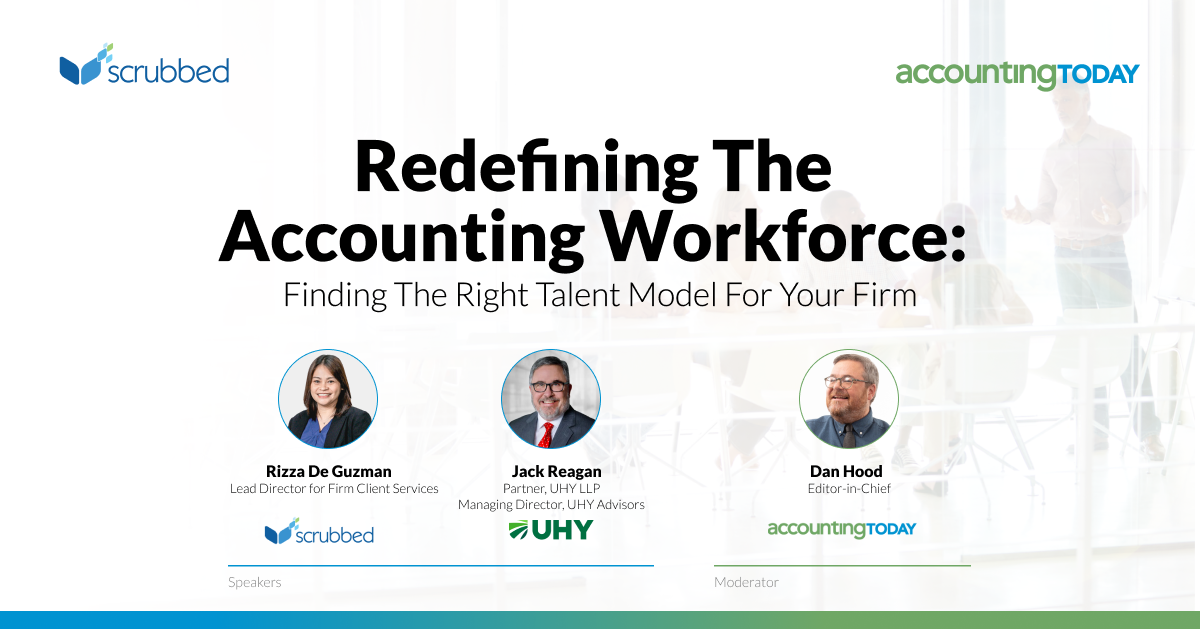
Redefining the Accounting Workforce: Finding the Right Talent Model for Your Firm

Redefining the Accounting Workforce: Finding the Right Talent Model for Your Firm

The accounting profession is currently going through major changes. With talent shortages, shifting client expectations, and growing competition, CPA firms are pressured to rethink how they build and manage their teams.In a recent webinar hosted by Dan Hood, the Editor-in-Chief at Accounting Today, industry experts Rizza De Guzman, the Lead Director for Firm Client Services at Scrubbed, and Jack Reagan, Partner at UHY Advisors, explored the recent shift in the industry and shared their thoughts on how firms can adjust to these challenges. They offered their expertise and strategies to help firms stay competitive and move forward with confidence.Why Firms Are Struggling With the Current Staffing ModelOne of the biggest challenges accounting firms face today is the growing gap between the demand for skilled professionals and the number of people available to do the work.Rizza highlighted several factors that could be causing this shortage, such as the retirement of experienced professionals, the lack of new professionals entering the field, and other industries attracting potential talent with competitive pay and more appealing career paths. As a result, many firms are finding their teams stretched thin. They’ve done all they can with the staff they have, and it’s becoming clear that relying solely on traditional hiring methods isn’t sustainable.Another challenge that Jack mentioned is how client needs have evolved. Work that used to be predictable and ongoing is now more project-based and specialized. So, the skills that you may need now might be different from the skills you need tomorrow. This unpredictability means that firms need to be able to quickly scale their teams up or down, and that kind of agility is hard to achieve with the current staffing model. For Jack, “having that flexibility to match not only the cycle but then the skill set that the project demands is critical.”Building Flexible Teams Through Hybrid and Outsourced StaffingOnce the challenges around talent became clear, the conversation shifted to what firms can do about it. One of the key solutions Rizza discussed was to explore other models, like outsourcing, to create a more agile and scalable workforce. She defines outsourcing as a situation when a company ”fully or partially delegates work to an external partner who becomes an extension of your team.”This kind of model helps firms stay agile and allows them to tap into specialized skills when needed, manage costs more effectively, and adjust quickly as workloads shift. Instead of trying to overload internal teams with work or hire full-time staff for short-term needs, firms can bring in the right expertise at the right time.How to Make Outsourcing Work for Your FirmOne of the most effective ways for firms to stay competitive is by bringing in outside expertise. But making that work takes more than just hiring a third party and hoping for the best. Successful outsourcing starts with clearly defined roles and expectations. Open communication is key, and the relationship needs ongoing attention, not just a one-time setup. Regular check-ins and performance reviews help keep everything on track.Rizza highlights that one of the first steps for companies to start exploring outsourcing or hybrid workforces is by taking a good look at where their team stands today. What skills are missing? What kind of work is piling up? From there, firms can start small. Try a hybrid model, see what works, and adjust as you go.Jack agreed, but noted that for these partnerships to work, firms need to treat outsourced professionals like true team members. According to him, it’s important that firms “…have a say on who is gonna be part of the team,” rather than just being assigned an employee, as this helps set the culture in the workplace.And while working remotely is nothing new, as necessitated by the recent pandemic, trust is another big piece of the puzzle. Beyond scheduled meetings, informal chats and the occasional in-person visit can go a long way in strengthening the connection between the firm and its external team and making the collaboration more effective.One example of this is leveraging fractional CFO services, which allows firms to access high-level financial expertise without the commitment of a full-time hire.Remember, there’s no single formula for success here. Every firm is different. The best approach is one that reflects your client’s needs, internal strengths, and long-term goals.Take Action TodayOne thing became clear throughout the discussion: doing nothing is not an option. For Rizza and Jack, the long-term sustainability, growth, and agility offered by outsourcing talent is the way to go.Competitors are already changing how they staff their teams, and firms that don’t adapt risk falling behind, both in terms of competitiveness and their ability to attract and retain top talent. It’s time for firms to rethink their workforce strategy, focusing on flexibility, building strong partnerships, and using technology along with specialized SaaS accounting expertise to their advantage.How can firms maintain quality control when outsourcing talent?This comes down to choosing the right partner from the start. Be sure to take the time to check their credentials and look into businesses that really understand the industry. Don’t be afraid to ask for references to make sure you find the right fit. Once you’re already working together, regular check-ins and clear communication go a long way in making sure everything stays up to your expectations.Can outsourcing help with seasonal workload spikes?One of the biggest advantages of outsourcing is the flexibility to scale up or scale down depending on your business needs. In fact, a lot of firms may bring in outsourced talent during peak times to help manage the extra workload and avoid overwhelming the internal team.Are outsourcing and hybrid models the same?While outsourcing and hybrid work environments both involve remote work, they are fundamentally different work models. Outsourcing involves bringing in external talent into the team while a hybrid set up has more to do with the location of the internal team. Hybrid can also include external talent, making it a mix of both internal and external resources.How can smaller firms start integrating an outsourced team without overextending the budget?The best thing to do is to start small; you don’t have to hire several people at once. Consider outsourcing time-consuming tasks first, like bookkeeping, to determine whether this staffing model works well for your organization. Over time, you can scale based on performance and necessity.How do I choose the right outsourced accounting provider for my biotech company?Start by identifying your company's accounting needs, such as bookkeeping, financial reporting, ASC 606 compliance, or managing R&D tax credits. Then, evaluate your potential providers based on how much experience they have in the biotech industry and with the unique challenges and regulatory requirements your business faces. Review client testimonials and references from similar biotech companies to get a sense of their track record and expertise. Finally, confirm that their services are scalable to support your business as it grows, and that budgets and service levels are in line with your goals.Connect With ExpertsThe landscape for CPA firms is shifting quickly; with fewer professionals entering the field and client needs becoming more complex, the traditional staffing model is becoming harder to sustain. Firms need more flexibility and access to high-level talent without overloading their internal teams.However, finding the right fit in a sea of talent can be difficult and overwhelming. That’s where Scrubbed comes in. We partner with CPA firms and provide outsourced accounting, finance, and audit services to help clients scale their organization smarter and more efficiently. Ready to explore alternative staffing solutions? Schedule a consultation with our team today and discover how smart outsourced accounting team can benefit you.If you missed the webinar, you can watch it here.

Read More >
Blogs

Demystifying Financial Planning for SaaS Companies

Demystifying Financial Planning for SaaS Companies

At Scrubbed, we have extensive experience helping SaaS businesses achieve financial success. We’ve combined our knowledge and best practices into a clear and actionable 6-part series designed to maximize your profitability.This third installment focuses on financial forecasting and planning strategies tailored to SaaS businesses.Looking for Expert Accounting And Finance Support For Your SaaS Business? Click here!In the dynamic SaaS world, recurring revenue fuels growth, and accurate financial forecasting and planning are vital for steering your venture toward success. Your financial model serves as your compass, guiding you with clear insights into the financial impact of every choice but staring down a blank spreadsheet can feel daunting, so we’ve gathered some best practices to help you craft a model that will support your growth goals.1. Build Your Financial ModelFinancial models are the bedrock of informed decision-making in any business. They provide invaluable insights into the financial impact of your every move, allowing you to move strategically towards growth and profitability. Some of the areas where they provide valuable insight are:Pricing strategies: Models let you test different pricing options and pinpoint the sweet spot between maximizing revenue and attracting customers. You can consider factors like costs, volume, and customer segments to tailor pricing strategies for different user groups.Hiring decisions: By forecasting future needs and analyzing costs versus benefits, models help you build the optimal team size and skillset. This ensures you have the right workforce in place to support your growth plans without overspending.Investment opportunities: Models equip you to assess the financial viability of potential investments, allowing you to prioritize projects, manage risk, and allocate resources strategically. This ensures you invest in opportunities with the highest potential return, maximizing your impact with limited resources.In essence, your financial model is your decision-making compass. It provides direction and clarity, guiding you toward success by revealing the financial implications of your choices. It needs to include:Revenue forecast: The revenue forecast identifies and predicts various income streams, including subscription fees, initial setup charges, usage-based billing, and additional services. It allows you to consider key factors like diverse pricing tiers, anticipated customer acquisition, and potential churn rates. Analyzing historical revenue data is a fundamental approach to revenue forecasting for SaaS businesses. The analysis examines past trends, growth rates, seasonality patterns, and other historical metrics to identify patterns and extrapolate future performance. While historical data is your foundation, you should also integrate market analysis, growth plans, and competitor insights to paint a more complete picture.a. Expense projections: SaaS businesses have unique cost structures, and you need to factor in some specific operating expenses:b. Personnel costs, including development, sales and management teams, and customer support based on hiring plans and salary trends.c. Marketing expenses should be linked to your acquisition strategy and target audience, including paid advertising, content marketing, and affiliate programs.d. Research and development expenses, including salaries and benefits, development tools and software, and prototyping and user research.Technology costs include cloud hosting, data storage, and security tools that are your virtual backbone.Cash flow projections: Cash inflows and outflows should be forecast over a specific period, considering factors such as operating expenses, capital expenditures, and financing activities. Cash flow projections help assess liquidity, financing needs, and overall financial health.Financial goals and metrics: Track and monitor key metrics such as Monthly Recurring Revenue (MRR), Annual Recurring Revenue (ARR), Average Revenue Per User (ARPU), Customer Acquisition Cost (CAC) to Lifetime Value (CLTV) ratio, and Churn Rate. KPIs provide insights into business performance and inform your strategic decision-making.Don’t expect a clear, unchanging path. Regularly revisit and update your financial plan based on your actual performance and market changes. Think of it as a living document, not a rigid script.While many components of a SaaS financial model are similar to models for other types of businesses, there are some key differences. SaaS financial models typically focus on recurring revenue streams, subscription-based pricing models, customer retention, and scalability. Additionally, metrics such as MRR, ARR, CLTV, and churn rate are unique to the SaaS business model and play a significant role in financial planning and analysis.2. Stress-Test your ModelIt’s important to prepare for different scenarios to be ready to weather or take advantage of changes in the market or your customer base.Start by identifying the factors that significantly impact your financial health, such as pricing changes, churn rates, market growth, or competitor actions. Then, simulate various scenarios in your model to see how these key drivers affect your revenue and expenses. This will highlight potential risks and opportunities you might have missed.Use data visualization to clearly and concisely present your sensitivity analysis findings to stakeholders, including charts and graphs to make complex data easily digestible.3. Use Financial Planning to Inform Strategic Decision-MakingYour model should be a trusted advisor, guiding decisions on product development, pricing strategies, expansion plans, and resource allocation. Use it to test different options and find the one that maximizes your return on investment.However, don’t fall into the trap of over-reliance. Be aware of your financial plan’s limitations and biases, and regularly update it with new data and market insights.As the SaaS landscape evolves, so should your model. Regularly review and update your assumptions, projections, and drivers to ensure the model reflects your changing business environment.Tips to Improve Your Financial Planning:While it can sound daunting, strategic financial planning can increase your company’s sustainability, helping you make better decisions and improve your financial health. If you’re just starting out (or you’re looking to get more out of your financial planning), following these steps can help:Start simply and scale gradually. Don’t get bogged down in complexity.Collaborate with your team. Sales, marketing, and operations input create a comprehensive and realistic model.Embrace iteration. Your model is never truly finished. Continuously refine it based on new data and learnings.Stay ahead of the curve. Keep up-to-date with the latest trends in SaaS financial forecasting and planning.Remember, your financial model is a powerful tool, but its effectiveness depends on the data you feed it and the insights you extract from it. By customizing and applying these tips, you can improve the value of your financial planning and forecasting and ultimately create a more sustainable business.

Read More >

Contact Information

SF Bay Area Headquarters
111 Anza Boulevard, Suite 320, Burlingame, CA 94010, United States

Phone: (800)837-5160
Email: [email protected]

"Scrubbed" is the brand name under which Scrubbed Advisory, LLC and Scrubbed Assurance LLP provide professional services. Scrubbed Advisory, LLC and Scrubbed Assurance LLP practice in an alternative practice structure in accordance with the AICPA Code of Professional Conduct and applicable law, regulations, and professional standards. Scrubbed Assurance LLP is a licensed independent CPA firm that provides attest services to its clients, and Scrubbed Advisory, LLC provides tax, finance, and support services to its clients. Scrubbed Advisory, LLC is not a licensed CPA firm.

Copyright © Scrubbed. All rights reserved.